


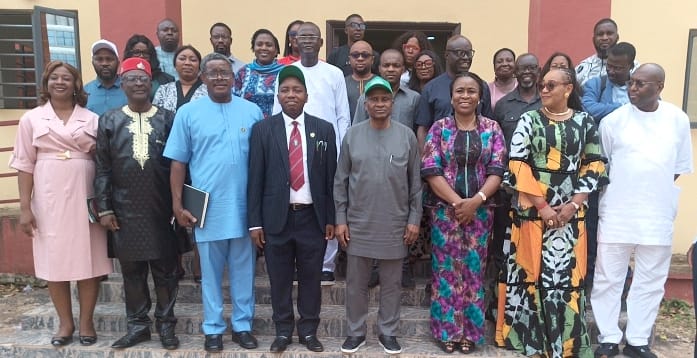
The Federal Government has pledged to support states, especially those in the South-East, to strengthen health security for better health outcomes.
Dr Jide Idris, the Director-General of the Nigeria Centre for Disease Control and Prevention (NCDC), made the pledge during a working visit to Enugu State on Tuesday.
Idris said the visit was meant to assess the uncompleted South-East High-Definition Molecular Laboratory, the level of Ebola prevention and preparedness at the Akanu Ibiam International Airport, Enugu, and other related projects.
He said there was a need for at least one High-Definition Molecular Laboratory for easy detection of tiny pathogens, especially viruses such as Ebola, as well as for fast verification of suspicious cases.
According to him, the NCDC team was there to assess the rate of completion of the High-Definition Molecular Laboratory at the University of Nigeria Teaching Hospital (UNTH).
“We learnt that erosion is threatening the laboratory premises,” he said.
Idris said the inspection was meant to reassess the project and its possible completion. It would stop samples from travelling far to other regions for testing and verification.
He lamented that some states do not have a single High-Definition Molecular Laboratory, but with the NCDC stationing such laboratories in each zone, the health security of Nigerians would be further guaranteed.
The Director-General said that due to the poor maintenance culture of health facilities, the NCDC would be signing a tripartite agreement with the state government and UNTH on the maintenance of the laboratory and other facilities.
“We are here to strengthen Ebola prevention and preparedness as Enugu State is among 10 states designated as having a high importation risk, due to international entry through Akanu Ibiam International Airport, Enugu.
“As there is yet no drug or vaccine for Ebola, our best action is to prepare effectively for prevention and close all known gaps for it to be effective.
“Our strategy is to work in synergy with all relevant stakeholders both at the airports and with health partners, as well as apply all pillars of disease control.
“We are supporting states with capacity building, know-how transfer and some limited level of funding, even as the Federal Government has established the Presidential Task Force for Ebola Prevention and Preparedness,” he said.
Idris said he would be touring medical isolation centres in the state to look at gaps and help the state build and complete at least one standard isolation centre with competent staff, vehicles and equipment.
He also urged states to double their efforts in plugging gaps in their surveillance and preparedness for infectious diseases, as the country was currently battling or trying to prevent 10 disease outbreaks.
The Director-General said states needed to stockpile vaccines, drugs, consumables and personal protective equipment, especially for diseases or outbreaks to which they were vulnerable.
Earlier, the Commissioner for Health, Prof. George Ugwu, said the state needed to strengthen its health security and health outcomes.
“We need NCDC assistance to build a standard medical isolation centre,” Ugwu said.
The professor, who is a member of the Presidential Task Force on Ebola Prevention and Preparedness, called for closer collaboration between the NCDC and the state ministry of health.
According to him, Enugu State needs manpower capacity building, more equipment and funding for surveillance programmes and on-the-spot surveillance operations.
“Our health-loving governor, Dr Peter Mbah, will want to hear your suggestions on steps to ensure the health security of our people, as he is passionate about the security, sound health and well-being of every resident.
“The governor has invested hugely in healthcare, with top-notch 260 primary healthcare centres, 54 secondary hospitals, two tertiary hospitals and, recently, the Enugu International Hospital meant to attract medical tourism to the country,” he said.
