


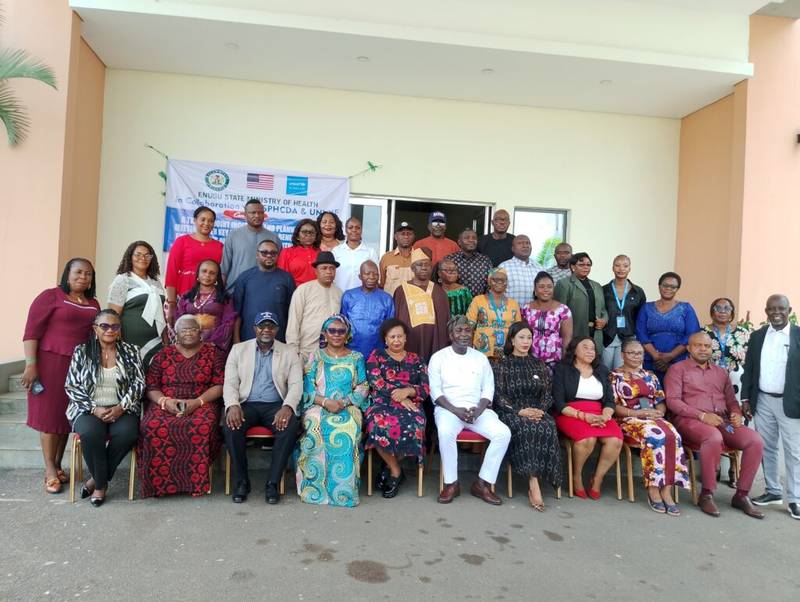
The Enugu State Government invested a total of N439.2 million in nutrition and related health interventions in 2025 to improve child survival and development.
Dr. Ifeyinwa Ani-Osheku, Executive Secretary of the Enugu State Primary Health Care Development Agency, disclosed this at a two-day Joint Inception and Planning Meeting in Awka, Anambra State, on Wednesday.
The meeting, organised for stakeholders from Enugu and Benue States, focused on preventing malnutrition in the first 1,000 days of life. It was facilitated by the United Nations Children’s Fund (UNICEF) in collaboration with the Enugu and Benue State Governments, with funding from the United States Government.
Ani-Osheku said N160 million was allocated to the Child Nutrition Fund for the procurement of essential commodities such as small-quantity lipid-based nutrient supplements, ready-to-use therapeutic food, and multiple micronutrient supplements.
She added that N178 million from the state budget was used to procure two million doses of Albendazole for deworming, while N61.33 million funded two rounds of the 2025 Maternal, Newborn and Child Health Week.
“The sum of N8 million was set aside for World Food Day activities, N4.6 million for the inauguration of Local Government Committees on Food and Nutrition, and N8.9 million for Nutrition Week.
“The quarterly meetings of the State Committee on Food and Nutrition received N1.2 million, while N16 million was committed to initiatives promoting dietary diversity within the first 1,000 days of life,” she said.
The Executive Secretary stated that the investments were part of broader efforts to strengthen nutrition interventions, reduce malnutrition, and improve public health outcomes among vulnerable populations.
She commended UNICEF for donating nutrition commodities worth hundreds of millions of naira, including multiple micronutrient supplements, Vitamin A supplements, therapeutic foods, and lipid-based nutrient supplements.
Ani-Osheku added that UNICEF also provided N75.38 million to support two rounds of the 2025 Maternal, Newborn and Child Health Week.
The State Nutrition Officer, Mrs. Loveth Onwuzulike, noted that Enugu’s child nutrition indicators showed mixed progress, with improvements in exclusive breastfeeding and dietary diversity, but persistent stunting.
She said stunting stood at 15.2 per cent in 2024, wasting at 3.9 per cent, while exclusive breastfeeding slightly declined to 54.1 per cent.
Onwuzulike revealed that only 38 per cent of pregnant women attended at least four antenatal visits, 52 per cent suffered from anaemia, and just 41 per cent received iron or micronutrient supplements. Only 16 per cent of children aged 6–23 months met the minimum acceptable diet.
She identified key challenges as inadequate funding, shortage of nutritionists, weak data management, poor healthcare worker attitude, and insufficient functional treatment centres.
The nutrition officer also decried the absence of policies such as six months’ paid maternity leave and government-owned crèches, which are critical for improving breastfeeding and childcare.
She urged the state government to increase domestic financing, recruit more nutrition officers, approve family-friendly workplace policies, reactivate Integrated Management of Acute Malnutrition centres, and intensify awareness campaigns.
Earlier, the Chief of UNICEF Field Office, Enugu, Mrs. Juliet Chiluwe, commended the Enugu and Benue State Governments for their commitment to improving women and children’s nutrition.
Chiluwe emphasised that the first 1,000 days of a child’s life — from conception to age two — are critical for lifelong health and development.
“This meeting provides an opportunity to align priorities, clarify roles, and drive evidence-based, results-oriented implementation.
“Sustainable nutrition outcomes require coordinated, multi-sectoral efforts across health, agriculture, education, water, sanitation, and social protection. UNICEF remains committed to supporting both states,” she said.
Note: Stunting is a chronic form of malnutrition that causes height deficiency (two standard deviations below WHO Child Growth Standards median), while wasting is an acute condition that makes a child too thin for their height..
