


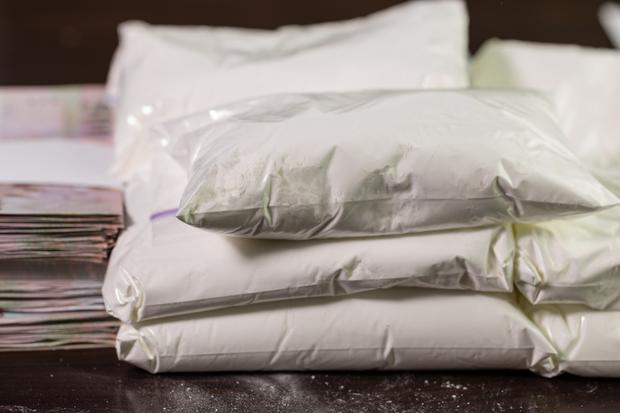
Turkish and foreign law enforcement have seized record quantities of cocaine heading from South America to Turkey, revealing the expanding role of the country’s traffickers in shipping drugs to European and Middle Eastern markets.
In late June, Ecuadorean authorities seized roughly 850 kilograms of cocaine at the port of Guayaquil from a container of bananas bound for Turkey, according to a police statement. The shipment was almost identical to a separate load intercepted in Turkey’s port of Mersin in April, also from Guayaquil and containing over 250 kilograms of cocaine.
The seizures, according to experts consulted by InSight Crime, are just the tip of the criminal iceberg, as Turkish organized crime — long king of the European heroin trade — increasingly turns to cocaine to offset falling opiate prices.
And while still secondary players in Europe compared to the Italian and Albanian mafias, Turkish networks are now taking the lead in supplying the world’s smaller but developing cocaine markets, pushing South American powder into eastern Europe, the Caucasus and the wealthy petro-states of the Persian Gulf.
Below, InSight Crime examines three reasons why Turkey is the latest transcontinental cocaine corridor.
Heroin Connections
It began in the poppy fields. Since the 1960s, Turkish traffickers have dominated the global heroin trade, establishing both deep webs of corruption at home and a criminal tapestry of port contacts, logistics networks and distribution gangs across Europe, said Professor Ryan Gingeras, a historian at the Naval Postgraduate School.
By the 1980s, Turkish traffickers had cemented the so-called “Balkan Route”: a modern, multi-branched Silk Road that transported opiates from Afghanistan and Iran, through the Turkish land mass and into Europe via the Balkans.
Sometimes they favored the eastern Balkans, relaying heroin to Albanian clans. Other times they went through Romania or Moldova, handing the drugs to Soviet mafias. Often, they used maritime channels to send heroin straight to Belgian or Dutch shipping hubs in Antwerp and Rotterdam.
By the time Turkish gangsters imprisoned in Spain met the first generation of Colombian and Galician cocaine barons, also in the 1980s, the Turks had the contacts, infrastructure, experience and political clout to smuggle anything, said Cengiz Erdinc, a Turkish investigative journalist and author of a book on Turkey’s drug trade.
“It was a relationship based on bartering the then more expensive heroin for cocaine,” Erdinc told InSight Crime. “In the 1990s, they swapped 25 kilos of cocaine for one kilo of heroin.”
The Turkish heroin went to South America, the Colombian cocaine came to Europe. It is not clear how those original Turkish gangsters sold the cocaine, said Erdinc, but with ethnic Turkish gangs present in most major European cities, it would not have been hard.
Soon Turkey would see its first big cocaine seizures, including a 750 kilogram load sent from Chile to the port of Mersin in 1998. Then, in the early 2000s, criminal diversification went from opportunity to necessity, with European heroin prices falling just as the continent’s cocaine business was booming.
Turkish traffickers started leveraging their Spanish contacts, while also exploiting Antwerp and Rotterdam’s position as burgeoning cocaine hubs to swap more heroin, said Erdinc.
Back in the homeland, some of the old heroin trafficking clans also began investing in cocaine and, by 2013, the United Nations Office on Drugs and Crime (UNODC) had recorded an uptick in cocaine flows via Turkey and the Balkan Route.
“The provenance of cocaine entering Europe along this route appears to vary. Frequently, cocaine transits Africa…In other cases, traffickers obtain cocaine directly from South America, frequently from Brazil,” noted UNODC in its annual report.
Turkish efforts to secure cocaine supply were boosted thanks to alliances with infamous kingpins such as Sito Miñanco, Galicia’s most renowned drug trafficker. After his latest incarceration in Spain in 2018, police told media he had worked with Turkish mafias for years, first smuggling heroin and later moving cocaine both to and from Turkey.
Closer to home, by the mid-2010s, the modest cocaine market was growing in the Middle East, with seizures noticeably increasing in nearby Syria, Lebanon and Israel, and doubling across the region in 2016.
Demand was rising. So Turkish traffickers packed their bags and crossed the Atlantic.
The Turks in Latin America
In 2016, Paraguayan law enforcement arrested a Lebanese national, allegedly linked to the militant group Hezbollah, for trying to traffic 39 kilograms of cocaine to Turkey. The next year, his two Turkish associates were detained in the same city, the smuggling hub of Ciudad del Este, while processing liquid cocaine and recruiting drug mules to fly to Europe.
They were among the first Turks in a wave of European criminal migration to the region that continues today. Like their counterparts in mainland Europe, these drug traffickers and emissaries connect directly with local producers to source cheap cocaine, according to an InSight Crime investigation published in 2021.
And while the Turks did not appear to have the long-standing local connections enjoyed by Italian mafias, their superb maritime transport infrastructure meant they did not need to outsource smuggling and could ship their own cocaine to Europe, according to a 2019 report by Europol and the European Monitoring Centre for Drugs and Addiction (EMCDDA).
This shipping prowess helps explain why Turkish sailors are frequently found on vessels transporting cocaine across the Atlantic. In 2018, for example, Spanish authorities arrested seven Turkish nationals on a boat crossing the Atlantic with 1.4 tons of cocaine, in what police said was the third quick-fire operation against Turkish cocaine traffickers at that time.
Since then, powerful Turkish traffickers have been arrested across the region. In 2018, Venezuela dismantled a network that used the country’s main airport to smuggle drugs to Turkey, Lebanon and France, arresting a top leader of Turkish-Venezuelan descent.
In October 2021, a convicted Turkish trafficker was arrested with nearly 100 kilograms of cocaine in Peru’s Huánuco valley – a hub for production.
A month later, Colombian police detained a Turkish kingpin hiding out in a luxury villa in the department of Cundinamarca. One of the traffickers most wanted by German authorities, he was conducting business meetings with various Colombians and foreigners, El Tiempo reported.
Some of these traffickers may have had ties to two Latin American groups linked to Turkish organized crime.
The first is the Second Marquetalia faction of Colombia’s FARC dissidents. In May 2021, Colombian police announced they had seized over 400 kilograms of cocaine bound for Turkey just before it was smuggled across the border into Venezuela for onward transit. Police said the cargo was the first in a series of shipments agreed to by a now-deceased FARC dissident commander.
The second group is Mexico’s Sinaloa Cartel, though this connection remains cloudy. No Mexican cocaine shipments have been intercepted en route to Turkey, and there are no reports of Sinaloa Cartel members arrested in the country. Yet Turkish drug experts insist there is a connection, pointing to a series of videos first posted on social media in 2020 that show armed members of Turkey’s far-right Grey Wolves paramilitary saluting the Sinaloa Cartel and its leader Ismael Zambada García, alias “El Mayo.”
At least three additional videos have been posted in response in Mexico, including one showing three individuals with assault rifles sending greetings to their friends in Turkey while a nationalist Turkish song plays in the background. Two drug experts told InSight Crime the Grey Wolves are notorious for smuggling cocaine to Turkey.
Others claim the Turkey-Mexico connection was born decades ago. One US academic told El País the Sinaloa Cartel once hired Turkish drug chemists to fine-tune its heroin production. This story seems farfetched, however, given the Sinaloa Cartel’s pedigree in the opiate trade is as well-known as Turkey’s.
An Alternative Cocaine Route
Cocaine seizures spiked in Turkey after 2017. With North American and European authorities confiscating ever more cocaine, traffickers began looking for alternative routes to get their product into these markets. Turkey was an ideal location, according to the 2021 Turkish government drug report.
Nationwide interdictions hit a record 1.4 tons in 2017, rising to 1.5 in 2018, 1.6 in 2019 and 1.9 in 2020, according to official figures reviewed by InSight Crime.
In June 2020, authorities found 4.9 tons of cocaine at the Colombian port of Buenaventura concealed in two containers of granulated rubber – a staggering discovery highlighting the size of cocaine shipments possibly passing undetected.
Since then, seizures have been large and frequent. June 2021 saw Turkey make its largest ever domestic cocaine seizure of 1.3 tons at the port of Mersin, followed by a further 463 kilograms the following week.
In May that year, 600 kilograms of cocaine were discovered in Panama en route to Mersin, while just months earlier, Spanish authorities seized roughly three tons on a Turkish-crewed vessel.
Then, in August 2021, Brazilian law enforcement found 1.3 tons of cocaine on board a private jet registered in Turkey and staffed by Turks.
In 2022, cocaine shipments heading to Turkey have been seized in Ecuador, West Africa, and Malta, as well as in Turkey itself.
Though the vast majority of this cocaine simply transits through Turkey, a growing minority now stays in the country, according to a 2019 EMCDDA report. The country’s domestic market saw a record expansion between 2007 and 2017, with drug seizures increasing tenfold during this time.
“The cocaine market in Turkey is growing. The number of cocaine addicts and police arrests has increased exponentially,” said Dr. Mahmut Cengiz, a former Turkish counter-narcotics chief and now associate professor at the Terrorism, Transnational Crime and Corruption Center at George Mason University.
According to the 2019 EMCDDA report, crack cocaine use is also spreading in major cities including Istanbul, a sign of drug supply chains stabilizing and local cocaine markets maturing.
“I strongly believe that it is produced locally…Nigerian groups are dominating cocaine [distribution] and are mostly involved in the production of crack cocaine with their Turkish counterparts,” Cengiz told InSight Crime.
