


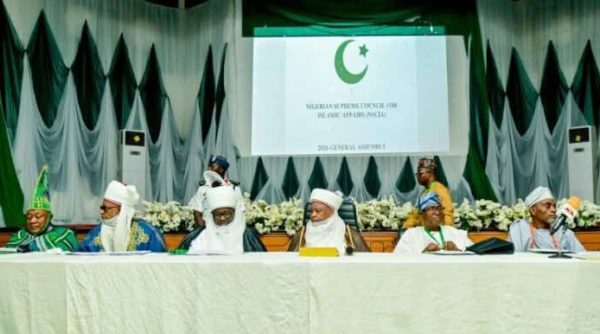
The General Assembly of the Nigerian Supreme Council for Islamic Affairs (NSCIA) has called for a comprehensive overhaul of Nigeria’s security architecture and demanded full respect for the rights of Muslim women and girls to wear hijab in schools, workplaces and other public institutions.
A communiqué issued at the end of the NSCIA General Assembly in Abuja and signed by the Sultan and President-General of the Council, Muhammad Sa’ad Abubakar, and its Secretary-General, Prof. Is-haq Oloyede, also declared that there is no religious genocide in Nigeria.
The Council supported decentralised policing but said any reform must be anchored on professionalism, constitutional safeguards, impartiality, accountability, sustainable funding, respect for fundamental rights and effective coordination between federal and state security institutions.
ALSO READ NSCIA General Assembly: Sultan’s media team charges new officers on service, unity
ALSO READ NSCIA expands leadership structure, appoints 2 journalists as public relations officers
It also urged the Federal Government to accelerate measures to reduce the cost of food and transportation, saying the twin pressures of insecurity and rising living costs were placing a heavy burden on Nigerians.
On religious rights, the NSCIA called on government agencies and institutions to respect the right of Muslim female students, female National Youth Service Corps members, female security personnel and Muslim women in other workplaces to use hijab.
The Council specifically faulted what it described as hostile dispositions to Supreme Court judgments on hijab at the international schools of the University of Ibadan, Obafemi Awolowo University and the University of Lagos.
It urged the institutions to retrace their steps and comply with the law.
The Assembly also called on the Rivers State Government and the management of Rivers State University to implement the Supreme Court judgment concerning the provision of a mosque sought by Muslim students on the university campus.
On the debate over insecurity and religious persecution in Nigeria, the NSCIA said the situation should not be framed as a religious genocide, stressing the need for a more accurate assessment of the country’s security challenges and a comprehensive response to them.
The Council urged Muslims to play a more active role in nation-building, including obtaining their National Identification Numbers and Permanent Voter Cards and participating fully in the electoral process.
It also called for greater attention to quality education that combines Islamic knowledge with Science, Technology, Engineering, Arts and Mathematics, while urging Muslim organisations to strengthen economic independence through lawful investments, Zakat and Waqf.
The Assembly adopted the 2026 report of the National Hajj Commission of Nigeria (NAHCON) and endorsed its recommendations for repositioning the Hajj industry.
It also approved an expanded National Executive Committee of the NSCIA, including Prof. Mahfouz A. Adedimeji as Deputy Secretary-General, National Affairs; Prof. Salisu Shehu as Deputy Secretary-General, International Affairs; Abeni Obomeileh Mohammed, SAN, as Deputy Secretary-General, Corporate Affairs; and Dr Umar Jibrilu Gwandu as Public Relations Officer.
The General Assembly was the Council’s first such gathering in about seven years and brought together Muslim leaders and representatives from across the country.
