


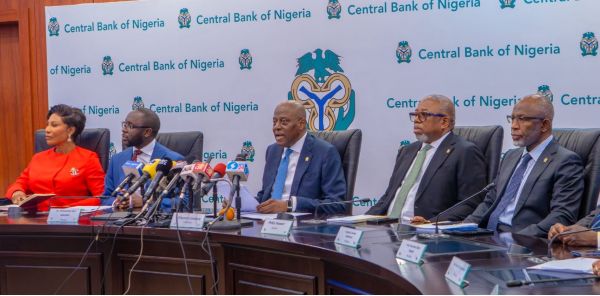
The Central Bank of Nigeria (CBN) retained the Monetary Policy Rate (MPR) at 26.5% at its 305th MPC meeting, keeping policy tight rather than starting another easing move.
The committee also maintained other key policy parameters, signaling that the apex bank remains cautious about inflation, liquidity, and exchange-rate stability.
For investors, the decision has implications across major asset classes.
In the fixed-income market, Treasury Bills, OMO bills, bonds, money market funds and commercial papers are likely to remain attractive as yields stay elevated.
For equity investors, however, high interest rates can create competition for stocks because investors may prefer safer short-term instruments that offer strong returns.
For companies, the implication is more direct: borrowing costs remain high, whether through bank loans, bonds or commercial papers.
What it means for commercial papers
The CBN’s decision to retain the Monetary Policy Rate at 26.5% is expected to affect both new commercial paper issuances and existing listed commercial papers.
For new issuances, the impact can be viewed from two sides: the issuer’s angle and the investor’s angle.
Corporate angle
From the issuer’s perspective, the CBN’s rate hold is likely to sustain the use of commercial papers by corporates seeking short-term funding.
This is because, although CP rates remain elevated, they may still offer a cheaper funding route than conventional bank borrowing.
So far this year, about 24 companies have issued commercial papers, with disclosed rates ranging from about 17% to 24.5%, and an average disclosed rate of around 22.5%.
Issuers such as Sycamore Integrated Solutions Ltd, NGN Gram Ltd, Finceptive Ltd and CIG Motors Company Ltd offered rates as high as 24%, especially on longer-tenor papers.
Despite these elevated rates, commercial papers still appear cheaper than bank borrowing when compared with the upper end of lending rates.
According to the CBN’s weekly bank lending rate report as of May 15, 2026, the average maximum bank lending rate stood at about 34.5%, significantly above the average disclosed commercial paper rate of about 22.5%.
This suggests that CPs may remain attractive to corporates as a short-term funding option, especially for companies trying to avoid more expensive bank loans.
Investor angle
For investors, the CBN rate hold means commercial papers are likely to remain a high-yield short-term investment option.
With policy rates still elevated, CP issuers will have to continue offering attractive rates to compete with Treasury Bills, OMO bills, and FGN bonds.
Based on disclosed issuances so far this year, commercial papers have averaged about 22.5%, which is higher than the average T-bills stop rate of 16.08%, the 364-day T-bill true yield of 19.26%, the average OMO marginal rate of 20.77%, and the average FGN bond marginal rate of 17.02%.
This means CP investors are earning a risk premium of about 3.24 percentage points over the one-year Treasury Bill true yield, 1.73 percentage points over OMO bills, and 5.48 percentage points over FGN bonds.
The premium reflects the additional corporate credit risk investors take when they buy commercial papers instead of sovereign-backed instruments.
Also, the rate hold keeps the CP market in high-yield mode, but liquidity will determine how deep investor demand remains.
If liquidity stays strong, quality issuers may continue to raise funds successfully despite elevated rates. For investors, the attraction is the yield premium over Treasury Bills, OMO bills, and FGN bonds.
The risk, however, is that CPs are corporate obligations, not sovereign-backed instruments. Therefore, the real investment question is whether the extra yield is enough compensation for issuer repayment risk.
Therefore, investors should not only chase the highest rate, but also assess the issuer’s credit rating, financial strength, use of proceeds, maturity profile, and ability to repay at maturity.
Existing listed CPs
For already issued and listed commercial papers, the CBN rate hold means yields are unlikely to fall sharply in the immediate term. Investors holding high-yield CPs may continue to benefit if they hold to maturity, and the issuer repays as expected.
However, existing CPs may be affected in the secondary market. If new CP issuances come at higher rates, older papers with lower yields may become less attractive. But if rates begin to decline later in the year, existing high-yield CPs could become more valuable to investors.
Overall
The CBN’s decision to retain the MPR at 26.5% means commercial papers are likely to remain in a high-yield state.
New CP issuers may need to keep offering attractive discount rates and implied yields to compete with Treasury Bills, OMO bills and FGN bonds, as investors demand compensation for corporate credit risk.
For existing listed CPs, pricing will remain tied to current market yields, making lower-yield papers less attractive if new issuances come at higher rates.
Strong liquidity and active investors may support demand, but the market will remain selective, favouring quality issuers while weaker names pay higher premiums.
Idika is a Chartered Stockbroker with expertise in financial analysis, equity research, perspective analysis, and investment commentary.
