

• Home
  • Agric
  • Sci & Tech
  • Health
  • Environment
  • Hausa News
  • More
    • Business/Banking & Finance
    • Politics/Elections
    • Entertainments & Sports
    • International
    • Investigation
    • Law & Human Rights
    • Africa
    • ACCOUNTABILITY/CORRUPTION
    • Hassan Gimba
    • Column
    • Prof. Jibrin Ibrahim
    • Prof. M.K. Othman
    • Defense/Security
    • Education
    • Energy/Electricity
    • Entertainment/Arts & Sports
    • Society and Lifestyle
    • Food & Agriculture
    • Health & Healthy Living
    • International News
    • Interviews
    • Investigation/Fact-Check
    • Judiciary/Legislature/Law & Human Rights
    • Oil & Gas/Mineral Resources
    • Press Freedom/Media/PR/Journalism
    • General News
    • Presidency
  • About Us
    • Contact Us
    • Board Of Advisory
    • Privacy Policy
    • Ethics Policy
    • Teamwork And Collaboration Policy
    • Fact-Checking Policy
    • Advertising
  • Media OutReach Newswire
    • Wire News
  • The Stories
Facebook Twitter Instagram
Trending
  • Naira outperforms African peers despite persistent FX pressures
  • LASU begins indigeneship verification for 2026/2027 admissions
  • Reps approve $516m loan for Sokoto–Badagry superhighway
  • Court affirms FCCPC’s power to probe medical negligence
  • Indigenous, feminist groups push rights-based energy transition at Colombia conference
  • NGX reports smooth start to extended trading hours
  • Reps panel adopts N105.14bn RMAFC 2025 budget
  • China becomes first major economy with full Africa zero-tariff
Facebook Twitter Instagram YouTube
AsheNewsAsheNews
  • Home
  • Agric

    World agriculture forum inaugurates Nigeria Country council

    April 28, 2026

    U.S. revives GSM-102 credit scheme to deepen agricultural trade with Nigeria

    April 27, 2026

    Poultry farmers seek increased financing to boost production

    April 27, 2026

    Malnutrition: FG rolls out community food bank programme in Northeast

    April 27, 2026

    Yam prices surge across Lagos markets

    April 26, 2026
  • Sci & Tech

    Artemis II: Space exploration, and the question of African future, By Prof. M. K. Othman

    April 28, 2026

    Nigeria needs unified cybersecurity – Expert warns

    April 27, 2026

    MTN Nigeria backs youth platform with over N45m

    April 27, 2026

    PalmPay CEO flags trust issues in digital payments

    April 25, 2026

    Meta to cut 10% of workforce amid AI push

    April 25, 2026
  • Health

    Kano commences 2026 Africa vaccination week

    April 28, 2026

    Nigeria faces acute shortage of public health physicians

    April 28, 2026

    Ghana rejects U.S. bilateral health deal

    April 28, 2026

    Social media fuels health misinformation – Expert

    April 28, 2026

    FCT residents express mixed views on childhood immunisation

    April 28, 2026
  • Environment

    CTV audience grows over 300% to 8m viewers on GOtv

    April 27, 2026

    Yobe council approves N59.8bn for project, infrastructure

    April 27, 2026

    Rainstorm damages homes, school in Kaduna

    April 27, 2026

    LASTMA to launch free short code for traffic reports

    April 27, 2026

    LASEMA averts casualties in truck accident at Daleko bridge, Isolo

    April 27, 2026
  • Hausa News

    Otti plans 250-room 5-star hotel in Umuahia

    April 11, 2026

    Anti-quackery task force seals 4 fake hospitals in Rivers

    August 29, 2025

    [BIDIYO] Yadda na lashe gasa ta duniya a fannin Ingilishi – Rukayya ‘yar shekara 17

    August 6, 2025

    A Saka Baki, A Sasanta Saɓani Tsakanin ‘Yanjarida Da Liman, Daga Muhammad Sajo

    May 21, 2025

    Dan majalisa ya raba kayan miliyoyi a Funtuwa da Dandume

    March 18, 2025
  • More
    1. Business/Banking & Finance
    2. Politics/Elections
    3. Entertainments & Sports
    4. International
    5. Investigation
    6. Law & Human Rights
    7. Africa
    8. ACCOUNTABILITY/CORRUPTION
    9. Hassan Gimba
    10. Column
    11. Prof. Jibrin Ibrahim
    12. Prof. M.K. Othman
    13. Defense/Security
    14. Education
    15. Energy/Electricity
    16. Entertainment/Arts & Sports
    17. Society and Lifestyle
    18. Food & Agriculture
    19. Health & Healthy Living
    20. International News
    21. Interviews
    22. Investigation/Fact-Check
    23. Judiciary/Legislature/Law & Human Rights
    24. Oil & Gas/Mineral Resources
    25. Press Freedom/Media/PR/Journalism
    26. General News
    27. Presidency
    Featured
    Recent

    Naira outperforms African peers despite persistent FX pressures

    April 28, 2026

    LASU begins indigeneship verification for 2026/2027 admissions

    April 28, 2026

    Reps approve $516m loan for Sokoto–Badagry superhighway

    April 28, 2026
  • About Us
    1. Contact Us
    2. Board Of Advisory
    3. Privacy Policy
    4. Ethics Policy
    5. Teamwork And Collaboration Policy
    6. Fact-Checking Policy
    7. Advertising
    Featured
    Recent

    Naira outperforms African peers despite persistent FX pressures

    April 28, 2026

    LASU begins indigeneship verification for 2026/2027 admissions

    April 28, 2026

    Reps approve $516m loan for Sokoto–Badagry superhighway

    April 28, 2026
  • Media OutReach Newswire
    • Wire News
  • The Stories
AsheNewsAsheNews
Home»Food & Agriculture»The trillion-Naira illusion: Why record agricultural budgets aren’t filling Nigerian pots
Food & Agriculture

The trillion-Naira illusion: Why record agricultural budgets aren’t filling Nigerian pots

Tina GeorgeBy Tina GeorgeJanuary 20, 2026Updated:January 21, 2026No Comments4 Mins Read
Share
Facebook Twitter LinkedIn Pinterest Email

​On paper, the Nigerian agricultural sector is swimming in cash. In the corridors of the National Assembly and the sleek PowerPoint presentations of the Federal Ministry of Agriculture and Food Security, the narrative is one of “massive production” and “restoration.”

​Yet, in the dusty markets of Minna, the overflowing grain silos of Kano, and the farm settlements of Benue, the reality is starkly different. Despite the Federal Government increasing the agriculture budget in recent years, the average Nigerian is paying more for food today than at any point in recent history.

​As we settle into 2026, a critical question hangs over the President Tinubu administration: Why is increased funding failing to translate into food security?

​The Maputo Math: A broken promise

​President Bola Tinubu’s “Budget of Restoration” for 2025 was hailed as a turning point. The nominal increase in allocation was historic. However, analysts at ASHENEWS have crunched the numbers, and the “boom” appears to be a mirage when adjusted for inflation and international benchmarks.

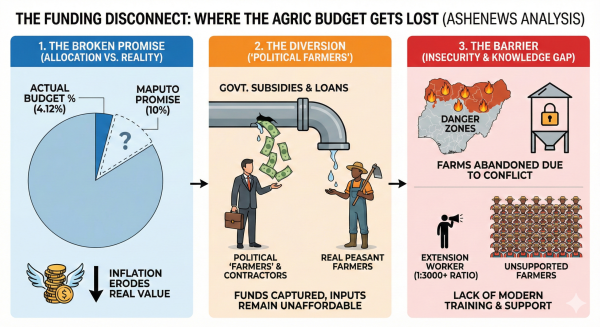
​While the ₦2.27 trillion figure looks impressive, it constitutes only about 4.12 per cent of the total national budget. This is a far cry from the 10 per cent commitment made under the Maputo Declaration, a pact Nigeria signed nearly two decades ago to ensure food sufficiency.

​”We are celebrating motion, not movement,” says Dr. Chike Obi, an agro-economist based in Lagos. “When you factor in the devaluation of the Naira, the real purchasing power of that budget for imported machinery, fertilizers, and chemicals is actually lower than it was five years ago. We are throwing Naira at a Dollar problem.”

​The “political farmer” syndrome

​Perhaps the most damning disconnect lies in who actually gets the money.

​The All Farmers Association of Nigeria (AFAN) has raised the alarm repeatedly last year. In a scathing critique, AFAN leadership noted that government interventions, such as the National Agricultural Growth Scheme (NAGS-AP), often bypass the peasant farmers who produce 80 per cent of Nigeria’s food.

​”Real farmers are in the bush, battling kidnappers and high input costs,” said a state chapter chairman of AFAN who pleaded anonymity.

“The people you see collecting subsidized fertilizers and cheap loans in Abuja are ‘portfolio farmers’, politicians and contractors who own farms on paper but have never held a hoe. They collect the funds, round-trip the money, and the real farmer buys fertilizer at the open market rate of ₦45,000 per bag.”

​This “capture” of funds means that despite trillions released, the input cost for the actual producer remains sky-high.

​Silos of insecurity

​Funding becomes irrelevant if the farm itself is a death trap. Between 2023 and 2025, insecurity in Nigeria’s food baskets, Niger, Borno, Kaduna, and Benue, has forced thousands of farmers to abandon their harvest.

​The 2025 Humanitarian Needs and Response Plan projected that over 30 million Nigerians would face acute food insecurity by mid-2025. The prediction has largely held true.

In Niger State, mining disasters and banditry have shrunk arable land usage. In the North East, insurgents still dictate who plants and who harvests.

​The budget allocates billions to “mechanization” and “clearing of land,” but it allocates little to the specific security architecture needed to protect those lands.

​The extension void

​Another critical failure point is the near-extinction of the Agricultural Extension Worker. Global best practices suggest a ratio of 1 extension worker to 800 farmers.

In Nigeria, the ratio is estimated to be 1 to 3,000 or worse. The 2025 budget heavy-lifting is on capital projects like the procurement of tractors and building of silos which are lucrative for contractors.

​However, “soft” investments like hiring and training extension officers to teach farmers about climate-resilient seeds or modern pest control are woefully underfunded. The result is a farming population practicing 19th-century agriculture in a 21st-century climate crisis.

​The verdict

​As 2026 unfolds, the Tinubu administration stands at a crossroads. The government has successfully cleared the first hurdle: admitting that the sector needs more money. But money alone is not strategy.

​To move from ” Budget of Consolidation, Renewed Resilience and Shared Prosperity” to “Plates of Plenty,” three things must happen immediately:

  1. ​De-politicize Distribution: Use technology (biometrics/NIN) to bypass the “political farmers” and route subsidies directly to rural wallets.
  2. ​Secure the Farms: Agro-Rangers must be more than a ceremonial force; they need to be deployed offensively to clear farming corridors.
  3. ​Monitor Execution: The Ministry of Agriculture must publish quarterly, verifiable reports on outcomes (tonnes produced), not just outputs (money spent).

​Until then, the trillions in the budget remain just ink on paper, while the price of a measure of garri continues to defy gravity.

2026 Agriculture Budget Nigeria
Share. Facebook Twitter Pinterest LinkedIn WhatsApp Reddit Tumblr Email
Tina George

Related Posts

World agriculture forum inaugurates Nigeria Country council

April 28, 2026

U.S. revives GSM-102 credit scheme to deepen agricultural trade with Nigeria

April 27, 2026

Poultry farmers seek increased financing to boost production

April 27, 2026

Leave A Reply Cancel Reply

Naira outperforms African peers despite persistent FX pressures

April 28, 2026

LASU begins indigeneship verification for 2026/2027 admissions

April 28, 2026

Reps approve $516m loan for Sokoto–Badagry superhighway

April 28, 2026

Court affirms FCCPC’s power to probe medical negligence

April 28, 2026
About Us
About Us

ASHENEWS (AsheNewsDaily.com), published by PenPlus Online Media Publishers, is an independent online newspaper. We report development news, especially on Agriculture, Science, Health and Environment as they affect the under-reported rural and urban poor.

We also conduct investigations, especially in the areas of ASHE, as well as other general interests, including corruption, human rights, illicit financial flows, and politics.

Contact Info:
  • 1st floor, Dogon Daji House, No. 5, Maiduguri Road, Sokoto
  • +234(0)7031140009
  • ashenewsdaily@gmail.com
Facebook Twitter Instagram Pinterest
© 2026 All Rights Reserved. ASHENEWS Daily Designed & Managed By DeedsTech

Type above and press Enter to search. Press Esc to cancel.