


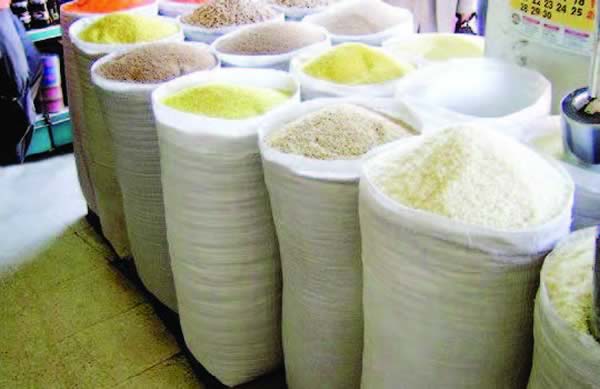
Some consumers in Lagos are enjoying relief from lower rice prices, while others continue to struggle with rising costs of their preferred brands.
Traders and consumers, who spoke to reporters in separate interviews on Sunday in Lagos, reported mixed price movements across markets.
While some rice varieties have become cheaper, others have recorded fresh increases, forcing households to adjust their food budgets.
A 50kg bag of agric rice, including People’s Choice, now sells for N55,000, down from between N60,000 and N65,000 between July and September.
Similarly, a derica of My Choice rice sells for between N1,000 and N1,100, compared with between N1,300 and N1,500 previously.
Mrs Chioma Chigozie, a consumer and fashion designer on Vaughan Street, Costain, said the reduction in My Choice rice prices had brought some relief to her household.
Chigozie said a derica, which sold for between N1,300 and N1,500 from June to September, had risen to N2,000 at its peak.
She, however, said the current price remained high, considering the economic situation and consumers’ purchasing power.
Chigozie said the high cost of rice had forced her family to reduce consumption while managing other household expenses.
She expressed hope that prices would decline further to enable households to afford the staple food more easily.
A rice trader at Okerube Bus Stop, Ikotun, Mr Daniel Nwachukwu, said the reduction in the prices of some agric rice varieties had made them more affordable.
Nwachukwu said a 50kg bag of agric rice, including People’s Choice, now sold for about N55,000, compared with between N60,000 and N65,000 previously.
He said customers had welcomed the reduction and expressed hope that the trend would continue as the festive period approached.
Nwachukwu added that he stocked good-quality rice at affordable prices to attract customers and sustain sales.
At Eko Idumota, a food seller, Ms Precious John, said rice prices had eased slightly in August, encouraging more customers to buy the commodity.
John said the reduction had brought some relief to sellers and consumers, noting that customers were more willing to purchase rice when prices fell.
She expressed hope that sustained price reductions would improve sales and enable her to serve customers better.
The Lagos State Chairman of the Rice Farmers Association of Nigeria, Mr Raphael Hunsa, said the reduction in rice prices might not necessarily affect farmers negatively.
Hunsa described the development as a welcome relief, noting that prices of agricultural produce could rise or fall depending on production costs and prevailing market conditions.
“In Nigeria, nothing goes up and comes down. We thank God that the price suddenly came down,” he said.
He explained that lower input and production costs could lead to reduced rice prices, while higher production expenses could push prices upward.
Hunsa said government support for rice farmers through the provision of tractors and agricultural inputs would help reduce production costs and sustain lower prices.
He added that improved access to farm machinery and inputs would enable farmers to produce more efficiently and contribute to market stability.
However, not all consumers have benefited from the reductions, as traders reported increases in the prices of several other rice brands.
Mr Samuel Igwe, a foodstuff trader on Oroku Street, Costain, said BHOG and Yummy Gold rice, which sold for between N56,000 and N57,000 per 50kg bag between July and September, now sold for between N61,000 and N62,000.
Igwe said a 50kg bag of Cap Rice, previously sold for between N60,000 and N65,000, now cost between N70,000 and N77,000.
He added that the variety had become scarce, making it more difficult for customers to obtain it at lower prices.
Igwe said other varieties, including Nigerian rice, Three Brothers, African Choice and Elephant Gold, which previously sold for about N48,000 per 50kg bag, now sold for between N54,000 and N55,000.
He said the latest increase in rice prices followed a period of relative stability between July and September.
Igwe attributed the earlier price reductions to the arrival of newly harvested rice in the market, which increased supply and helped lower prices.
He also linked the reductions to an inflow of rice through the borders, which increased market supply and helped ease prices.
Another trader at Ebutero Korodom Market, Mr Kehinde, said rice prices had declined previously but had risen again because of scarcity and high demand.
Similarly, an anonymous trader at the market said Big Bull rice, which sold for about N55,000 in August, now cost N58,000.
The trader added that the prices of My Choice and Mr Rice had risen from about N53,000 to N60,000.
The varying prices mean that while some households are benefiting from lower costs, others must spend more or adjust their food budgets to cope with rising prices.
Sustained reductions in production and transportation costs, alongside improved supply, could help ease rice prices further and improve consumers’ access to the staple food.
