


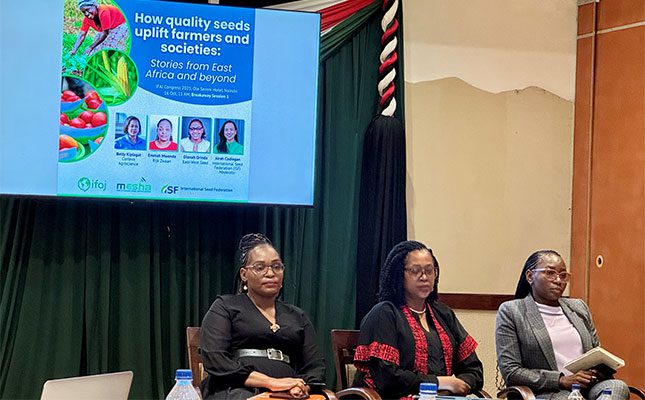
At the International Federation of Agricultural Journalists Congress 2025, held in Nairobi, Kenya, from 15 to 18 October, one of the panel discussions focused on how quality seed can uplift farmers and societies in East Africa.
In her opening remarks, panel moderator Airah Cadiogan, communications manager at the International Seed Federation (ISF), outlined how counterfeit seeds and fertilisers are proliferating, threatening the agriculture sector’s growth and farmers’ long-term sustainability.
She explained that in recent years, there has been an increase in illegal seed practices that include the selling of counterfeit seeds.
According to a study by the Alliance for a Green Revolution in Africa, in some African countries, more than 50% of crop seed sold to farmers was either illegal or counterfeit.
“Counterfeit seeds are low-quality seeds repackaged and disguised as popular or commercial varieties. This is done by mislabelling the seed products or misusing seed company logos, adding illegitimate trademarks to packaging to make the counterfeit seeds appear legal,” Cadiogan explained.
She added that counterfeit seeds have adverse effects on field productivity, regulatory systems, and farmers’ livelihoods, saying: “The ISF is working with all its affiliates to address this problem.”
Quality seed driving transformation
According to Dianah Orinda, country manager for Kenya and Uganda at East-West Seed, quality seed leads to higher yields and productivity and forms the backbone of sustainable agricultural production.
“Quality seed is making transformation possible and enabling farmers to cross the bridge from household to transformative agriculture with improved yields. Quality seed enhances farmers’ productivity and enables them to feed a growing population at affordable prices,” she explained.
Orinda added, however, that for farmers to be able to boost food production, they require access to improved, high-yielding, climate-resilient seed.
“Our mission is to work with the farmers to help them improve their lives by generating a better income. Quality seed offers the opportunity to transform lives; it helps farmers move from merely providing to generating an income and improved nutrition,” she explained.
Orinda noted that the seed industry now offers quality seed with the additional benefit of shorter growth periods and early maturity, which helps farmers mitigate some of the unpredictability of the rainy season.
“The new hybrids have the ability to adapt to climatic and weather fluctuations and offer some resistance to diseases,” she added.
According to her, most seed companies in East Africa also assist farmers with production: “Our agronomists help [farmers] grow different crops and follow good agricultural practices to increase production and the quality of their produce.”
Another factor that helps make quality seed more accessible and affordable is smaller packaging. “Farmers are able to buy small batches; only what they need,” Orinda explained.
Making quality seed more affordable
In her presentation during the panel discussion, Betty Kiplagat, government affairs leader at Corteva Agriscience Kenya, acknowledged that cost is a factor that can hinder access to quality seed. However, she added that, in addition to small packaging options, bundled products play an important role in giving farmers access not only to seed but also to other quality inputs such as fertiliser and crop protection products.
“Through programmes and partnerships with other input providers, we enable farmers to buy bundled products that actually provide a complete crop production programme. This makes production more affordable and accessible,” Kiplagat stated.
She added that the private sector fulfils a critical role in bridging the gap between traditional practices and emerging innovations.
“Investment in research, resilient seed varieties, and efficient distribution networks can drive the much-needed transformation in Africa’s seed systems and ultimately strengthen its food systems from the ground up.”
Kiplagat mentioned the private sector has accepted the responsibility of providing more than seed and often provides agronomic support, too, but stressed that governments must share that responsibility.
“In many African countries, the extension services system [has] died. We have to look at what we do as private-sector partners to introduce these services again. But we cannot do it alone. Governments should go out to areas and contact retired researchers and scientists and empower them to become extension and agronomic services providers, because they have the knowledge,” she explained.
She reiterated that for the agriculture sector to thrive, it needs a clear policy framework. “Clear, streamlined policies that protect the developers of the seed and technology are needed. We need the assurance that intellectual property will be protected. Only then will the private sector invest more in research and development. We need predictable, science-based regulations and policies.”
In addition, Kiplagat acknowledged that barriers between the private sector and governments need to be removed: “We need conversations with government […] because we all want to create a sector that thrives.”
She pointed out that when everyone works together, we will have success. “What is happening in Ethiopia tells an excellent story of success. The value chain came together, and farmers progressed from using open-pollinated varieties to planting hybrids.
“The system and grain supply is more predictable now. This has been enabled by transparent guidelines and cooperation between all parties,” she explained.
Inaccuracies about seed
Kiplagat mentioned four misconceptions about seed that need to be addressed. They are:
- All seeds are equal: she stressed the importance of quality, certified seed and referred to the problems created by counterfeit seed. “Fake seed is one of our biggest problems. We must teach farmers to recognise counterfeit seed and how to look for the attributes of certified hybrid seed.”
- Seed innovation is only relevant to large-scale farmers: “All farmers need access to technology, knowledge, inputs, and quality seed. These resources and inputs benefit all farmers.”
- Seed regulation restricts freedom: “Seed regulation actually enables all involved to operate with freedom. Regulations enable companies and government to safely move seed across borders.”
- Seed companies are only focused on their own interests: in many instances, seed companies and other input suppliers are focused on addressing challenges brought on by climate change. Kiplagat said private-sector companies are developing new products that are more adaptable to the changing climate. She used the example of breeding short-growth cultivars: “[Earlier-] maturing plants yield within shorter periods and enable farmers to plant later and harvest earlier [in response to] changes in weather conditions. Seed products are also tailor-made to adapt to specific climate and environmental conditions, and some are more tolerant to certain diseases in specific areas.”
Emmah Mwenda, client manager at Rijk Zwaan Kenya and board member of the Seed Trade Association of Kenya (STAK), said STAK helps farmers identify possible markets.
“These markets demand quality products, and to produce quality products, farmers need quality seed. We train farmers to command the market. We train them to use digital tools so they cannot be exploited. We also help them look for potential in the market and connect [them] to the market.”
She added that, after farmers have planted, Rijk Zwaan agronomists follow up with them to ensure they grow the crop as it is supposed to be grown: “We not only introduce new products and varieties to the farmers, but we also train them on how to plant and produce the crops.”
Mwenda acknowledged that while quality seed is expensive, the value derived from planting quality, certified seed far outweighs the cost.
“We also collaborate with propagators of seedlings so they can deliver quality seedlings to farmers. In the end, our goal is for everybody in the value chain, from the farmer to the consumer, to benefit from quality seed,” she concluded.
