


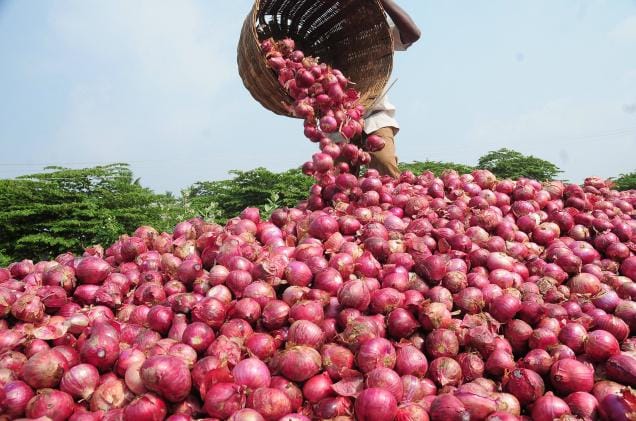
Onions remain one of the most consumed food items in Nigerian households, yet the crop’s economic potential is still largely underappreciated despite supporting millions of livelihoods across the country.
With Nigeria producing about 2.1 million metric tonnes annually and generating an estimated N1.17 trillion in value, onion farming is emerging as a highly profitable agribusiness – offering employment opportunities, boosting rural economies, and positioning the country as a major player in Africa’s agricultural market.
In 2019, global onion production was put at 4.5 million tonnes, with China producing 22 percent of the world’s total production, followed by Japan, Mali, and South Korea as secondary producers.
Onion farming in Nigeria is highly neglected, yet this crop supports millions of lives in Nigeria and the world over. In fact, there are many families, especially in the northern part of Nigeria, that depend on onion farming and are living the life of their choice without other people knowing of it.
Onion farming plays a vital economic role globally, particularly in countries like India and Brazil, by providing employment, supporting exports, and enhancing income generation.
In India, agriculture employs 58 per cent of the population, with onion farming sustaining millions of livelihoods. Innovations like vertical farming in the Philippines further expand employment opportunities.
Onion production in Nigeria, particularly in Sokoto and Kebbi States, is a profitable agricultural activity influenced by resource allocation and weed management. Farmers in Kebbi earn a higher net income (N237,862.76) compared to Sokoto (N126,774.10), with returns on investment of 91.89 per cent and 197.92 per cent respectively, despite inefficiencies in resource use.
India, the second-largest onion producer, contributes 20 per cent of global production, generating $500 million in exports. Studies in Benin Republic confirm onion farming’s profitability and efficiency.
Sustainable practices, such as hydroponics, improve competitiveness and income while research in Brazil emphasizes soil quality and modern techniques for maximizing productivity.
Onions farming method
Before planting onions, preparing the soil is essential to create a fertile foundation. Adding fertilizer to onion farming begins with enriching the soil using organic matter. This is followed by applying well-decomposed organic manure or compost at a rate of 10–15 tons per hectare. This improves soil structure, enhances water retention, and provides a slow-release source of nutrients.
In Nigeria, where soils in regions like Kaduna or Jigawa may be low in organic matter, this step is crucial for building fertility.
To maximize the benefits of adding fertilizer to onion farming, it is best to adopt good field management practices. The farmer will need to conduct a soil test to know the soil’s nutrient profile,which helps the farmer to apply the right type and amount of fertilizer.
There is also the Use of mulch, such as dry grass or straw, to retain soil moisture and suppress weeds, which compete with onions for nutrients. Experts suggest keep the field weed-free to ensure the onions access all the applied nutrients.
Additionally, rotating onions with crops like beans or maize maintains soil fertility over time. Onions are relatively low-maintenance crops, but they respond well to timely care. By consistently adding fertilizer to onion farming at the right stages, a farmer can achieve healthy, profitable yields.
Economic benefits of onions farming
Onions are generally used for salads, pickling, cooking such as in soups, and frying for example, with meat. It also plays an important role in traditional medicine as in the case of a diuretic.
The onion farming business is an attractive venture for individuals and investors looking to explore the agricultural sector in Nigeria. The profitability of this business, coupled with the increasing demand for onion both locally and internationally, makes it a lucrative investment option.
Onion farming is a profitable agribusiness in Nigeria, and in Nigeria, onions are grown mostly in areas where there is hot weather, like Kano, Kaduna, Jigawa, Sokoto, Plateau, Bauchi, and Kebbi states.
According to Mr. Kaita Yisa, who spoke to journalists in 2023, onions farming is a venture that could be practiced along other businesses, given an investor flexibility of time and planning.
Yisa, who is an an expert in onion farming and done much studies on it, said he discovered that eating onions may help reduce risk of heart disease, blood and other ailments
Allaying fear of spoilage, he noted that onions can get spoiled easily which is the reason why a good place with ventilation should be created for them.
Planting and harvesting
The best time of the day to harvest onions is very early in the morning when the onion tops are falling over and brown.
Onions takes around four months for it to grow which means onions require 90-100 days to mature from seed to harvest. In some cases, some species of onions get ready to be harvest after around 80 days, or just under three months.
The best time to grow or plant onions is between August and September, and the late planting is between November and December, although this may change due to climate change.
A Sokoto farmer, Abdulahi Abdulahi noted that a would-be investor in onion farming must have a proper and achievable plan adding that the plan should include sufficient knowledge on how to easily reach markets because onions may not withstand unfriendly conditions before decaying.
His belief is that onions should be harvested when the leaves start to yellow and the bulbs are firm.
“The onions should be left to dry for a few days. Remove the outer layers: The onions should be cleaned by removing the outer layers that are damaged or diseased, and then onions should be stored in a cool, dry, and well-ventilated area to prevent spoilage
As the demand for onions is highest during the dry season, from December to February, when onion supplies are generally lower and prices tend to increase, investors, he said, should target that period in order to meet market demands for profitability.
On February 10, 2026, a report on THE PUNCH titled “Nigeria produces 2.1 million metric tonnes of onions annually – Marketers, the president of the National Onion Producers, Processors, and Marketers Association of Nigeria, Alhaji Aliyu Isah, said Nigeria is among Africa’s largest onion producers, second only to Egypt. Nigerian onions are exported across West and Central Africa, as well as to some European markets.
“Nigeria currently produces about 2.1 million metric tonnes of onions annually, with a value of approximately N1.17 trillion.”
He described onion production as a major contributor to Nigeria’s agricultural economy and rural livelihoods, noting that government interventions have helped stabilize production and market prices.
Isah further said that collaboration with partners from Ghana, the Niger Republic, and Burkina Faso has improved cross-border trade, and there is a need to expand onion processing facilities to increase value addition.
He urged youths to consider onion farming and agribusiness as viable career paths for employment and wealth creation, saying that if the youths considered onion farming, Nigeria would soon lead onion production in Africa.
How Nigeria can improve onion production
For onion production to improve, farmers need to be encouraged to expand their farm sizes for better productivity while larger farms can enable more efficient resource use and higher yields.
The government need to focus on enhancing the overall farming conditions, such as providing access to irrigation, improving soil quality, and offering financial incentives to increase productivity and support food security.
Efforts should be made to encourage more female farmers to actively participate in onion production which would involve providing targeted support, training, and resources to empower women in agriculture.
The government would need to intervene by providing effective pesticides to help manage the pest and disease challenges in onion farming. This would help reduce the impact of harmful pests and diseases, ultimately improving crop yield and quality.
It is essential to educate farmers on the proper use of seeds, fertilizers, and chemicals while field demonstrations and training programs can help prevent the underutilization of key resources, ensuring that inputs are used efficiently to optimize production
