


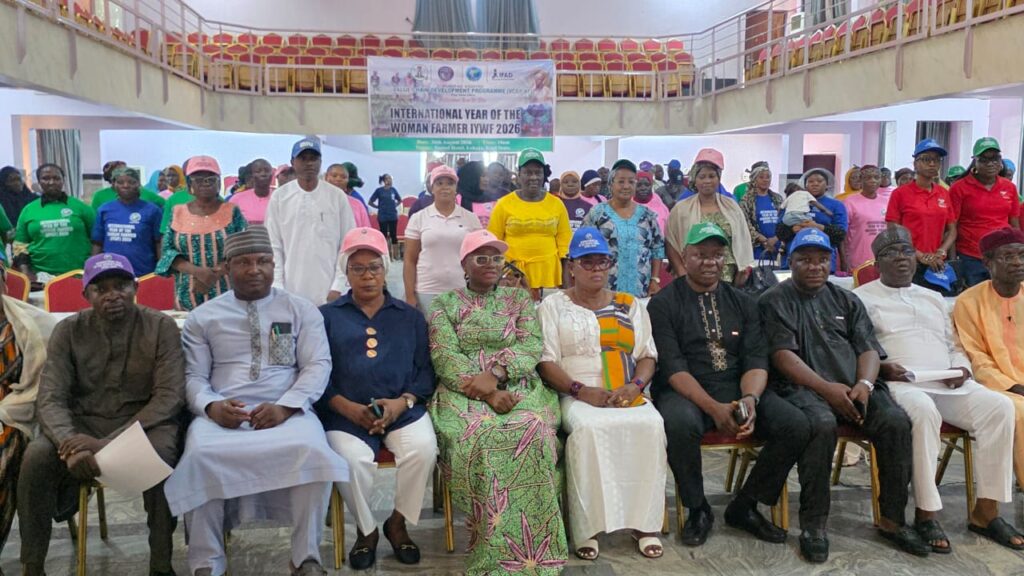
The Federal Government/IFAD Value Chain Development Programme (VCDP) has empowered 3,256 women farmers in Kogi’s rice and cassava sectors through access to inputs, productive assets, and market linkages.
Dr. Stella Adejoh, the State Project Coordinator, announced this in Lokoja during the commemoration of the 2026 International Year of the Woman Farmer.
The event, themed “Celebrating Women Farmers: Driving Food Security, Inclusive Agri-food Systems, and Rural Prosperity,” brought together women producers, processors, and marketers of rice and cassava across five benefiting LGAs.
Other stakeholders included government officials, lawmakers, development partners, traditional and religious leaders, CSOs, and representatives of financial institutions.
Adejoh described the UN’s declaration of 2026 as the International Year of the Woman Farmer as a historic recognition of women’s vital role in agriculture.
“In Kogi State and within VCDP, women are not just beneficiaries—they are producers, processors, aggregators, marketers, innovators, and leaders,” she said.
She noted that women in the five VCDP LGAs—Ajaokuta, Ibaji, Kabba-Bunu, Lokoja, and Olamaboro—have transitioned from subsistence farming to agribusiness.
In rice, women now use improved parboiling, milling, packaging, and branding to enhance quality and income. In cassava, they produce gari, high-quality flour, and odorless fufu for expanding markets.
“Over five years, VCDP has supported 3,256 women in the rice and cassava value chains through access to inputs, productive assets, and market linkages,” she added.
Adejoh also highlighted that the Empowerment Learning Centres are equipping women with skills in agribusiness, financial literacy, nutrition, and entrepreneurship. Women are leveraging digital tools for market information and weather forecasts and adopting climate-smart practices.
“Through VCDP, women have gained access to labor-saving processing equipment and are moving from small-scale production into aggregation and distribution. When a woman farmer is empowered, the benefits extend to her household, community, and the wider economy,” she said.
Despite these gains, she listed ongoing challenges such as limited access to land, affordable finance, extension services, mechanization, storage, and reliable energy. She emphasized that the International Year should catalyze deliberate policies and investments.
The Commissioner for Agriculture and Food Security, Mr. Timothy Ojomah, praised VCDP’s leadership and urged women farmers to see themselves as representatives of the entire state, not just their LGAs. He called for trained women to serve as “trainers of trainers” to expand knowledge to all 21 LGAs.
He reaffirmed the government’s commitment to prioritizing women and youth empowerment.
Dr. George Ogirima, Managing Director of Kogi ADP, described women as the “engine room” of agriculture, contributing about 65% of farm labor nationwide. He urged stronger branding and market linkages to enable women’s products to compete in urban supermarkets and export markets.
Mrs. Comfort Egwaba, Deputy Speaker of Kogi Assembly and House Committee Chairman on Agriculture, emphasized support for agriculture, noting that many communities already have women leading in farming.
“This is about livelihoods and families, not just gender,” she said.
Stakeholders called for scaling up the train-the-trainer model to all 21 LGAs, expanding market access for agribusiness. Financial institutions were urged to develop flexible loans for women, and the private sector to strengthen contracts and partnerships with women-led enterprises.
Mrs. Joy Yusuf, Chairperson of the Women Farmer’s Group Network, praised VCDP for transforming women farmers’ lives through training, value addition, and empowerment programs.
“FGN/IFAD-VCDP has boosted food security, income, and nutrition for women in five Kogi LGAs through training, processing centers, aggregation hubs, and provisions of tricycles,” she said.
Yusuf called on the government to expand the program to more LGAs and communities.
The FGN/IFAD Value Chain Development Programme is active in nine states, aiming to improve incomes and food security for rural households involved in rice and cassava production.
The event featured awards for outstanding farmers, including categories for best woman producer, processor, and marketer for both rice and cassava. Mrs. Rafat Ahmed was named overall best Agripreneur Champion.
Dignitaries also toured an exhibition of rice and cassava value-added products.
