


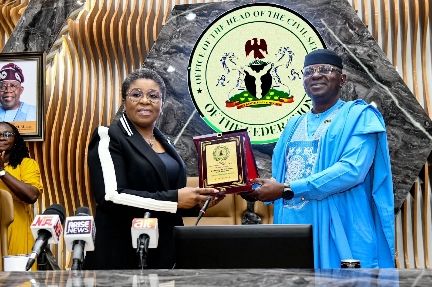
As part of a renewed drive to end open defecation in Nigeria, the Office of the Head of the Civil Service of the Federation (OHCSF) has pledged strong collaboration with the Federal Ministry of Water Resources and Sanitation to advance the Clean Nigeria: Use the Toilet Campaign.
The commitment was reaffirmed during an advocacy visit by the Minister of Water Resources and Sanitation, Engr. Prof. Joseph Terlumun Utsev, to the Head of the Civil Service, Mrs. Didi Esther Walson-Jack, on Tuesday, August 5, 2025, in Abuja.
The Clean Nigeria campaign aims to make the country Open Defecation Free (ODF) by 2030 and contribute to the achievement of Sustainable Development Goal (SDG) 6.2, which focuses on access to adequate and equitable sanitation and hygiene for all.
Commending the Ministry’s progress under the current administration, Mrs. Walson-Jack noted the recent certification of 47 additional Local Government Areas (LGAs) as ODF, bringing the national total to 148. She praised the Ministry’s efforts and stressed the importance of intensified advocacy, institutional synergy, and public sensitization.
“The key to this campaign’s success lies in collaboration, partnership, and sensitization. With these three elements, funding becomes significantly less burdensome,” she said.
Walson-Jack also revealed that the OHCSF has developed a new Protocol on the Use of Federal Secretariat Buildings, which includes mandatory provisions for functional and inclusive toilet facilities. The policy is currently in the approval pipeline and will soon be presented to the Federal Executive Council.
Minister Utsev described the civil service as a critical driver of behavioural change and national policy implementation. He emphasized the importance of leveraging the influence of the service to embed sanitation reforms and shift public attitudes.
He outlined a set of proposals to mainstream sanitation across Ministries, Departments, and Agencies (MDAs). These include:
Issuing administrative guidelines mandating provision and maintenance of sanitation facilities
Integrating sanitation indicators into performance assessments
Promoting clean toilet access in all government buildings
Encouraging a “No Open Defecation” culture among staff and visitors
Instituting a Clean Nigeria Campaign Week across MDAs
“The Civil Service, as the engine room of governance, has the institutional capacity to lead reforms and set standards that will cascade into society,” Utsev stated.
Present at the meeting were top officials from both the OHCSF and the Water Ministry, including the Permanent Secretary, Ministry of Water Resources and Sanitation, Mr. Richard Pheelangwa; Permanent Secretary, Service Welfare Office, Mrs. Patience Oyekunle; Senior Special Assistant to the President on Civil Service Matters, Mr. Alfred Abah; and the National Coordinator of the Clean Nigeria Campaign, Mrs. Chizoba Opara, among others.
The session ended with a united commitment to strengthen inter-agency collaboration, enhance public health outcomes, and institutionalize a culture of hygiene and dignity through access to safe and functional sanitation across Nigeria.
