


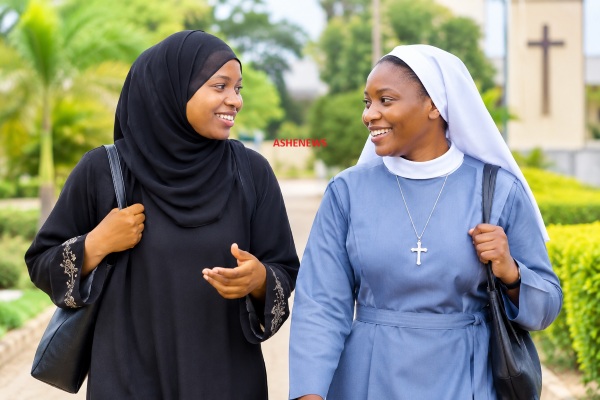
Hijab should be no barrier to education. A girl walks into a school seeking an education. She has her books, her dreams and the determination to build a future for herself. But at the school gate, she encounters an unexpected obstacle: the scarf covering her hair.
She is told that she cannot be admitted unless she removes it.
For the girl and her family, this is more than a disagreement over a school uniform. It is a painful choice between observing a deeply held religious conviction and accessing an education that should be available to every child without discrimination.
This situation raises a fundamental question for Nigeria, a country whose strength lies in its religious diversity: should a Muslim girl be denied an education because she wears the hijab, particularly when the school is owned or operated by Christians?
Our position is clear: a girl’s religiously motivated choice to cover her hair should not be a reason to deny her school admission.
Education should open doors, not close them over differences in religious belief or dress. And a school that seeks to shape the character of young people should be a place where respect, tolerance and mutual understanding are taught through practice, not merely preached in assemblies.
The hijab shouldn’t be an enemy, and it is not
The hijab is an expression of modesty and religious commitment for many Muslim women and girls. While its meaning and practice vary among individuals and communities, wearing it is an important aspect of faith for many Muslims.
In Nigeria, where Christians and Muslims live, work and learn alongside one another, accommodating such differences should not be an insurmountable challenge.
A school may legitimately establish standards for uniforms, discipline, safety and learning. However, such standards should be applied fairly and should not unnecessarily exclude children because of their religious beliefs.
The issue is not whether every school must adopt every religious practice. It is whether a school can maintain its standards while respecting the conscience and dignity of its students.
Surely, this is possible.
What does the Bible say about modesty?
For Christian-owned schools, the discussion presents an opportunity to reflect on the biblical principles of modesty, compassion, fairness and respect for others.
The Bible contains several passages that encourage modest dressing and discourage the excessive emphasis on outward appearance.
In The New American Standard Bible,1 Timothy 2:9, the Apostle Paul writes: “Likewise, I want women to adorn themselves with proper clothing, modestly and discreetly, not with braided hair and gold or pearls or costly garments.”
The passage encourages modesty in appearance and conduct. Although it does not specifically address the Islamic hijab, its emphasis on respectable dressing provides a useful basis for discussing modesty across religious traditions.
Similarly, 1 Peter 3:3–4 teaches that a woman’s beauty should not depend solely on outward adornment but should also be reflected in the inner qualities of a gentle and quiet spirit.
These passages remind Christians that a person’s character cannot be measured simply by appearance. They also invite reflection on whether excluding a girl because of her head covering advances the values of modesty, compassion and moral development that a faith-based school seeks to promote.
The Bible also records that women should cover their heads in particular religious and social settings.
In 1 Corinthians 11:5–6, Paul discusses women praying or prophesying with their heads covered or uncovered. Interpretations of this passage differ among Christian traditions, but it demonstrates that head covering has a place in biblical discussions of religious practice.
In Genesis 24:65, Rebekah took a veil and covered herself when she encountered Isaac. In Genesis 38:14, Tamar also covered herself with a veil, considering that “Shelah had grown up, and she had not been given to him as a wife.”
These passages describe particular circumstances and are not presented here as proof that biblical veiling and the modern Islamic hijab are identical practices. Nevertheless, they provide historical and scriptural context for understanding that head coverings have existed in biblical societies.
Mary, the mother of Jesus, is also traditionally depicted in Christian art wearing a head covering. Although the Bible does not explicitly state that Mary wore the modern Islamic hijab, her familiar image has made the veiled woman a recognisable figure in Christian culture.
The lesson is not that Christians must adopt Muslim dress, or that Muslims must adopt Christian practices. A head covering should not automatically become a source of hostility between people who profess different faiths.
Christianity also teaches love and fairness
Beyond modesty, the Christian scriptures place considerable emphasis on loving one’s neighbour and treating others with fairness.
In Matthew 7:12, Jesus teaches: “So, in everything, do to others what you would have them do to you.”
This principle, commonly known as the Golden Rule, challenges school proprietors and administrators to consider how they would feel if a child were excluded from education because of a sincere religious conviction.
Would they consider such exclusion fair if they imposed the same restriction on their own children?
The question deserves honest reflection.
In Matthew 22:39, Jesus commands his followers to love their neighbours as themselves. And in Luke 6:31, he repeats the principle of treating others as one would wish to be treated.
These teachings offer a strong moral basis for peaceful coexistence. They do not require Christians to agree with every Islamic belief, just as Muslims are not required to accept every Christian doctrine. They require people to treat one another with dignity despite their differences.
A Christian-owned school does not surrender its identity by admitting a Muslim girl who wears a hijab. Neither does it compromise its religious convictions by allowing a student to observe her faith, provided reasonable school rules are respected.
Rather, it demonstrates that religious conviction and respect for other people’s rights can coexist.
Education must not become a religious battleground
Nigeria has struggled for years with religious tension, mistrust and disputes over the expression of faith in public life. Schools should not become another arena in which these divisions are deepened.
A school is expected to prepare children for life in a diverse society. It should teach them how to disagree without hostility, how to respect people whose beliefs differ from theirs, and how to recognise the humanity they share with others.
Denying admission to a Muslim girl solely because she wears a hijab risks teaching a damaging lesson: that acceptance depends on concealing an aspect of one’s religious identity.
That is not the kind of lesson a responsible educational institution should impart.
The consequences can also extend beyond the affected child. Parents may feel humiliated, communities may become aggrieved, and a dispute that could have been resolved through dialogue may develop into a wider religious controversy.
School proprietors should therefore engage parents, consult relevant authorities and develop clear, fair policies on religious dress.
Where concerns relate to uniformity, discipline or security, schools should seek practical solutions rather than impose blanket exclusions. A properly designed school-coloured hijab, for example, can preserve uniform standards while respecting the student’s religious practice.
Dialogue should be the first response, not confrontation.
The law and the responsibility of school owners
Nigeria’s constitutional framework also provides an important basis for considering this issue.
Section 38 of the 1999 Constitution, as amended, protects freedom of thought, conscience and religion, including the freedom to manifest and practise one’s religion, subject to the constitutional provisions governing that right.
Section 42 prohibits discrimination against Nigerian citizens on specified grounds, including religion.
The precise legal obligations of a particular school may depend on its ownership, applicable state laws, the circumstances of the case and other relevant legal provisions. The constitutional position should therefore not be reduced to the assumption that every dispute over school uniforms has an identical legal answer.
Nevertheless, private ownership should not be treated as a licence to disregard applicable law or to discriminate unlawfully.
Christian proprietors have the right to establish schools in accordance with their lawful educational and institutional objectives. Muslim parents likewise have legitimate reasons to expect that their daughters will not be unfairly excluded because they observe their religion.
The challenge is to reconcile legitimate school regulations with the rights and dignity of students.
This requires fairness, careful consideration of the law and a willingness to accommodate religious differences wherever reasonably possible.
A call for understanding
We call on Christian school proprietors and administrators to reconsider policies that prevent Muslim girls from gaining admission solely because they wear the hijab.
We also urge Muslim parents and community leaders to pursue dialogue, lawful remedies and peaceful engagement where disputes arise.
State governments, education authorities and relevant professional associations should provide clear guidance on religious dress in schools, helping institutions develop policies that protect students from discrimination while maintaining appropriate educational standards.
Religious leaders on both sides should use their influence to reduce suspicion and promote understanding.
Most importantly, children must not become casualties of adult religious disagreements.
A Muslim girl wearing a hijab is not necessarily challenging the identity of a Christian-owned school. She may simply be observing what she understands to be an obligation of her faith.
Similarly, a Christian student should be free to express her beliefs within the bounds of applicable school rules and the law.
Respect must work in both directions.
Nigeria’s religious diversity should be a reason to strengthen mutual understanding, not an excuse to deny children opportunities.
A school can teach Christian values without humiliating a Muslim student. It can maintain discipline without forcing a child to choose between her conscience and her classroom. And it can preserve its institutional identity while preparing young people to live peacefully with those who believe differently.
The ultimate test of a school’s values is not merely what it teaches from a textbook or quotes from scripture. It is how those values are reflected in the treatment of the children entrusted to its care.
No girl should have to remove her hijab to prove that she deserves an education. The classroom should be a place where her mind is developed, her character is nurtured, and her future is protected—not where her faith becomes a barrier to opportunity.
For Christian and Muslim Nigerians alike, the message should be simple: we may worship differently, interpret our scriptures differently and dress differently, but our children deserve dignity, fairness and access to education.
For us at ASHENEWS, that is not a concession to another religion. It is a commitment to humanity, justice and peaceful coexistence.
