


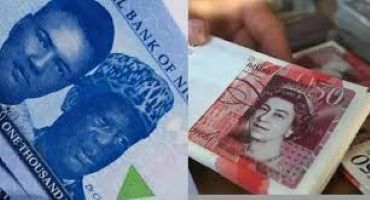
The Naira posted modest gains against the British pound, trading at about N1,836/£ in the official market, as the sterling weakened against the US dollar in global foreign exchange markets.
After a prolonged depreciation phase, the naira has entered a broad sideways trend, with the GBP/NGN pair hovering around N1,836.5/£. Market dynamics indicate a shift from earlier panic-driven demand to a more balanced “willing buyer, willing seller” structure.
Volatility has eased significantly. Metrics such as the Average True Range (ATR) show that the wide daily swings of N50–100/£ seen in 2024–2025 have largely subsided, signalling improved stability in the foreign exchange market.
Analysts expect the pair to remain range-bound in the near term, particularly if the Bank of England sustains its tight monetary stance while the Central Bank of Nigeria (CBN) continues efforts to stabilise the naira. However, any dovish shift by the Bank of England—such as interest rate cuts—could further weaken the pound against the naira.
Short-term projections place the exchange rate within the N1,800/£ to N1,850/£ band. A break above N1,850 would indicate renewed pressure on the naira, while a dip below N1,800 could signal the effectiveness of the CBN’s tightening measures.
The naira is currently in a consolidation phase. While structural risks persist, reforms implemented between 2024 and 2025 are beginning to yield results. Under Governor Olayemi Cardoso, the CBN has maintained a tight monetary stance to curb inflation, targeting single-digit levels by 2026. Improved oil output and steady portfolio inflows have also supported external reserves, which are now estimated at approximately $50 billion.
Nigeria’s GDP growth is projected at 4.3–4.5 percent. In contrast, the UK is expected to maintain a “higher-for-longer” rate environment to contain inflationary pressures, particularly from energy costs.
Sterling weakens against the dollar
The British pound reversed earlier gains, slipping to around 1.3200 against the US dollar as global risk sentiment deteriorated. The greenback strengthened following remarks by US President Donald Trump on tensions in the Middle East.
Although the dollar’s safe-haven appeal has moderated on hopes of de-escalation, its downside remains limited due to persistently high oil prices, which could delay any easing by the US Federal Reserve.
Geopolitical developments continue to influence the currency market. While Iran has signalled openness to peace talks, uncertainty remains over energy infrastructure and supply disruptions. The Strait of Hormuz blockade has reportedly cut daily oil flows by about 11 million barrels, sustaining upward pressure on prices.
In recent remarks, Trump said the conflict with Iran is “very close” to resolution but warned of possible escalation if negotiations fail, including potential strikes on critical infrastructure.
Overall, the foreign exchange market remains highly sensitive to geopolitical risks, monetary policy signals, and fluctuations in energy prices.
