


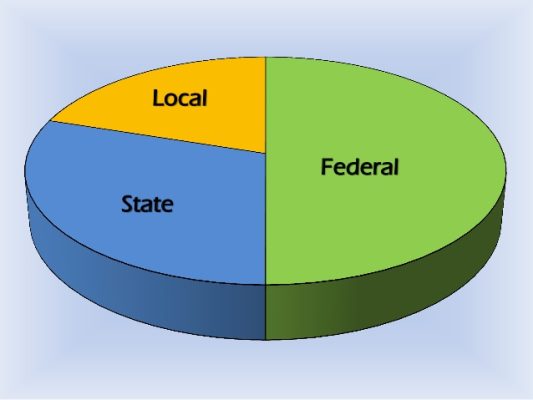
The Federal Government, 36 states and 774 local government councils have shared ₦2.428 trillion in federally collected revenue for September 2026, providing another round of funding for the three tiers of government.
The allocation was disclosed by Bawa Mokwa, Director of Press and Public Relations at the Office of the Accountant-General of the Federation, following the Federation Account Allocation Committee’s (FAAC) October meeting in Abuja.
The distributable revenue comprised ₦1.672 trillion from statutory revenue and ₦756.587 billion from Value Added Tax (VAT).
However, total gross revenue available for distribution during the month was higher at ₦3.913 trillion before deductions for collection costs, transfers, refunds and savings.
A total of ₦131.758 billion was deducted as the cost of collection, while transfers, refunds and savings amounted to ₦1.352 trillion.
How the ₦2.43tn was shared
The Federal Government received ₦832.242 billion, while state governments received ₦799.872 billion. Local government councils were allocated ₦560.660 billion.
In addition, eligible states shared ₦236.049 billion as the 13 per cent derivation revenue from mineral resources.
The statutory revenue component was distributed as follows:
- Federal Government: ₦756.583 billion.
- State governments: ₦383.749 billion.
- Local government councils: ₦295.855 billion.
From the ₦756.587 billion VAT component, the Federal Government received ₦75.659 billion, states received ₦416.123 billion, while local governments received ₦264.805 billion.
The figures reflect the separate revenue-sharing arrangements applicable to statutory revenue, VAT and derivation payments.
Statutory revenue rises as VAT declines
Gross statutory revenue increased to ₦3.096 trillion in September from ₦2.850 trillion in August, representing a rise of ₦246.384 billion.
Gross VAT revenue, however, fell to ₦816.872 billion from ₦834.843 billion in the preceding month, a decline of ₦17.972 billion.
According to the FAAC report, Petroleum Profit Tax, Hydrocarbon Tax, petroleum royalties, import duty, Common External Tariff levies and excise duty recorded significant increases.
In contrast, Companies Income Tax, Capital Gains Tax, Stamp Duties, VAT, mineral royalties, gas-flaring penalties, gas-flaring fees and miscellaneous oil revenue recorded declines.
The mixed performance highlights the differing contributions of revenue sources to the federation account, with statutory revenue improving even as gross VAT collections weakened.
States continue to depend on FAAC allocations
The September distribution comes amid continued reliance by state governments on monthly federal allocations to finance public expenditure, including infrastructure and other government responsibilities.
Nigeria’s 36 states received a combined ₦2.39 trillion from the Federation Account in the second quarter of 2026, up ₦259.41 billion, or 12.2 per cent, from the ₦2.13 trillion allocated in the first quarter.
The latest allocation provides another injection of funds into federal, state and local government budgets. However, the amount available to each tier is determined by the applicable revenue-sharing formula and the composition of distributable revenue.
For state and local governments, the key fiscal challenge remains translating monthly allocations into reliable public services and development spending while managing their other revenue sources and expenditure obligations.
