


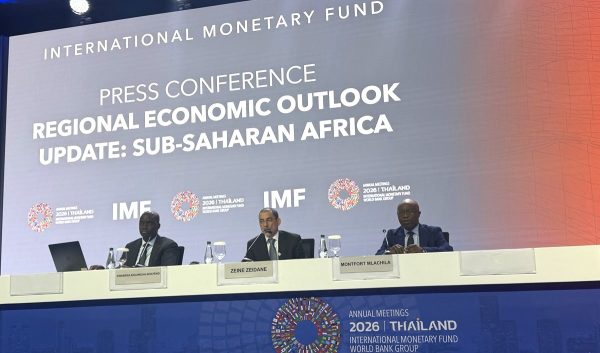
The International Monetary Fund (IMF) has endorsed the Central Bank of Nigeria’s decision to reset its benchmark interest rate to 23 per cent, describing the move as appropriate given the progress made in moderating inflation.
Zeine Ould Zeidane, Director of the IMF’s African Department, gave the assessment during a press briefing at the ongoing IMF–World Bank Annual Meetings in Bangkok, Thailand.
Zeidane said Nigeria had made significant progress in bringing inflation down from elevated levels, creating room to realign monetary policy rates with prevailing economic conditions.
He explained that the adjustment was justified by the reduction in inflationary pressures and the high real interest rates maintained during the earlier phase of monetary tightening.
However, the IMF cautioned against interpreting the decision as a complete shift towards monetary easing, stressing that Nigeria’s overall monetary policy stance remains restrictive.
“The qualification that the central bank did is the right one in our view,” Zeidane said, adding that monetary policy must remain responsive to economic data, with the ultimate objective of bringing inflation towards the CBN’s target.
Why the CBN reset its benchmark rate
The CBN’s Monetary Policy Committee (MPC) lowered the Monetary Policy Rate (MPR) by 350 basis points, from 26.5 per cent to 23 per cent, at its September meeting.
The adjustment was the biggest single-meeting reduction in the benchmark rate since December 2006. The apex bank, however, described the move as an operational reset designed to improve the effectiveness of monetary policy rather than a conventional easing of its stance.
The decision followed a growing disconnect between the official benchmark rate and prevailing money-market rates, which had weakened the MPR’s effectiveness as the main signal guiding financial market transactions.
The MPC also recalibrated the Standing Facilities Corridor to +50 and -300 basis points around the MPR, while retaining the Cash Reserve Requirement at 45 per cent for deposit money banks, 16 per cent for merchant banks and 75 per cent for non-Treasury Single Account public-sector deposits.
Inflation remains the key test
Nigeria’s headline inflation rate eased marginally to 15.39 per cent in August 2026 from 15.43 per cent in July, extending the disinflation trend to three consecutive months.
The economy also recorded stronger growth, with real gross domestic product expanding by 4.43 per cent in the second quarter, compared with 3.89 per cent in the first quarter.
These developments provided the backdrop for the CBN’s recalibration, although the IMF’s position underscores the need to sustain the progress rather than assume that inflation has been brought under control.
The Fund’s endorsement therefore supports the timing of the reset but does not signal that further interest-rate reductions are guaranteed. Future decisions will depend on inflation trends and the effectiveness of monetary policy in steering prices towards the central bank’s target.
Nairametrics
