


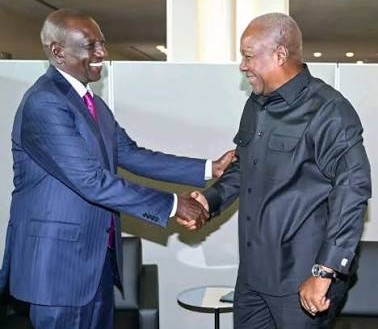
It is October now, and the voices I listened to in September have not left me. I began with Mia Mottley of Barbados, moved to John Dramani Mahama of Ghana, and then returned to the arguments of William Ruto of Kenya and Cyril Ramaphosa of South Africa. I had not set out to write about the institutions through which the world distributes money, authority and protection. I set out only to listen. What held me was the convergence of their demands and the distance between the recognition those demands now receive and the power their countries are still permitted to exercise. I call that distance the Recognition Trap, the condition in which an institution learns to say everything a grievance requires long before it does anything the grievance demands.
A system can change its language for a generation before it changes its arithmetic. That tension runs beneath the struggle over who writes the lending rules, whose vulnerability counts when financing is allocated, and which countries can convert their interests into binding decisions. The applause that follows a speech may acknowledge the justice of an argument while leaving untouched the arrangements against which it was made.
These voices earned their hearing long before September. Mottley, a barrister called to the bar in England, Wales and Barbados, became her country’s first female Attorney General and, in 2018, its first female Prime Minister, a distinction renewed this February through a third consecutive landslide. Her COP26 address brought urgency to the debate on climate finance, while the Bridgetown Initiative translated that urgency into proposals officials could negotiate. By COP27, sustained pressure had secured agreement in principle on a loss and damage fund long treated as impossible, and COP28 gave it operational form. Her authority to say “the math ain’t mathing” comes from having remained in the room long enough to understand both the resistance to reform and the work required to turn a principle into an instrument.
Mahama, a historian who first led Ghana in 2012, lost his bid for reelection in 2016 and returned to office in January 2025, delivered his seventh General Assembly address this September. His intervention carried forward a position already articulated at the previous session. He connected it to Ghana’s resolution on the trafficking and enslavement of Africans, adopted in March 2026 with 123 votes in favour. That support must be described accurately, for votes in favour and formal sponsorship are different measures of commitment. An argument about institutional accountability must itself remain accountable to the record.
Ruto, president since 2022 after nearly a decade as deputy president, has carried the financing argument from the Mo Ibrahim Forum to the financing for development summit in Seville. His description of “an engineered doom loop” directs attention to the design of the system and the way its mechanisms can reproduce the difficulties they claim to address. His insistence that Africa seeks fairness rather than favour supplies a useful standard against which both international institutions and African governments may be judged. The demand is for rules that can withstand comparison, scrutiny and consistent application.
Ramaphosa’s biography appears suited to this negotiation. As founder of the National Union of Mineworkers, the ANC’s chief negotiator during the transition from apartheid and chair of the constitutional assembly, he learned how organised demands can become institutional settlements. As president, he was among the leaders who advanced the African Union’s admission to the G20 in 2023. Yet biography alone cannot sustain political authority. Leaders earn attention through proposals, coalitions and results, and their domestic conduct must face the same scrutiny they demand of the institutions of Bretton Woods.
That standard compels me to speak plainly about Ramaphosa’s handling of recurring xenophobic violence in South Africa. I confess real displeasure at the distance between the dignity he invokes abroad and the protection fellow Africans too often struggle to secure within his own borders. The president who insists that African dignity requires a seat at the international table has also presided over repeated attacks on African migrants, including the violence of 2019 and renewed tensions reported in May 2026, when Nigeria began repatriating its citizens. His August 2026 rejection of “xenophobia, Afrophobia, vigilantism and discrimination” was correct in substance, as his condemnations were in 2019. The adequacy of the response, however, must be measured by protection, enforcement and accountability rather than by the correctness of its language.
Pretoria should understand the injury this contradiction inflicts on its continental leadership. A government asking the world to dismantle a hierarchy of nations must confront the hierarchy of Africans tolerated within its own society. Solidarity proclaimed abroad loses authority when African lives remain exposed at home. The structural achievement and the domestic failure belong in the same assessment, because the principle of equal dignity must travel with the leader from the international podium to the streets over which his government exercises responsibility.
My own listening is shaped by an intellectual formation I did not choose casually. Ali Mazrui’s insistence that Africa is an author of history, with the capacity to interpret and shape its own experience, remains central to how I understand these questions. So does the intellectual courage I associate with His Highness, Sanusi Lamido Sanusi, whose willingness to question power reinforces my conviction that authority must answer to one standard regardless of who holds it. That formation makes me impatient with reform whose momentum ends at the microphone.
It also explains the grief with which I considered Nigeria’s place in this conversation. Missing from this chorus was the sustained voice of a country whose first prime minister, Abubakar Tafawa Balewa, declared within weeks of independence that Nigeria would not rest while the continent remained under foreign domination. Nigeria’s support for the ANC, its role in the struggle against apartheid and its assistance to liberation movements gave substance to that commitment. Its influence was built through resources, diplomatic persistence and a conception of national interest broad enough to include the freedom of others.
I make the comparison carefully. Nigeria did not originate every argument now carried by Accra, Nairobi and Bridgetown, and its historical contributions do not confer a permanent entitlement to leadership. They do, however, establish an inheritance against which present choices may reasonably be assessed. It is a bitter thing to watch other capitals sustain, with greater continuity, a conversation in which Nigeria once exercised considerable influence. The disappointment concerns the leadership it could provide now and the purpose to which its considerable weight might be directed.
The historical record deserves the same precision. Forty-four Allied nations met at Bretton Woods in July 1944, while the permanent membership of the United Nations Security Council was established a year later around the distribution of power at that moment. These arrangements answered the circumstances and priorities of their founding period. Their survival across a profoundly changed world raises a question about the capacity of institutions to revise the privileges embedded in their own design. Power rarely volunteers to examine the arrangements from which it benefits. That examination usually begins with those who bear their costs.
The intellectual foundations of this criticism were laid by thinkers such as Raúl Prebisch and Samir Amin. Their approaches differed, but both directed attention to the structures through which unequal development is reproduced. They asked how economies enter international exchange, what they produce, how value is distributed and which countries retain the capacity to determine the terms of accumulation. Their work helps explain why a succession of apparently reasonable transactions can leave the underlying hierarchy intact. Contemporary leaders are carrying versions of that structural argument into the institutions and forums where the rules are defended and, occasionally, revised.
Bridgetown matters because it gives that argument a practical programme. Earlier liquidity support, the rechannelling of Special Drawing Rights and the widening discussion of pandemic preparedness and artificial intelligence governance move the debate towards instruments, responsibilities and implementation. A proposal gives negotiators something more demanding than a grievance to acknowledge. It requires them to explain which measures they accept, which they resist and why. Mottley’s contribution lies partly in narrowing the room for sympathetic language to stand in place of a substantive answer.
Africa’s claim to permanent representation on the Security Council encounters a more formidable barrier. The African Union’s Ezulwini Consensus of 2005 demanded two permanent seats with full veto rights, refusing an arrangement that would admit Africa permanently while withholding the privileges enjoyed by existing permanent members. Two decades later, the continent still holds no permanent seat. Article 108 of the UN Charter requires amendments to be ratified by every permanent member, placing reform partly in the hands of the states whose exclusive privileges are being challenged. The difficulty is therefore written into the machinery through which change must be achieved.
The African Union’s admission to the G20 in 2023 demonstrates that representation can nevertheless change. It was a collective achievement secured under India’s presidency, with support from several leaders and governments, and should be remembered in that spirit. Yet entry into one forum does not resolve the distribution of authority across the wider system. The IMF’s 2023 quota review illustrates the distinction. Its 50 per cent increase was allocated in proportion to existing holdings, expanding the institution’s resources while preserving the relative distribution of quota shares. An institution can acquire greater financial capacity without granting its members a different balance of influence.
Nigeria’s position remains a diagnostic question for me. Its history of liberation support and serious diplomacy should provide a foundation for renewed action. The relevant distance is between its potential weight and the leadership it currently exercises. Historical memory can inspire that renewal, but it cannot perform the work. A generation invoking Balewa must also consider the commitments, discipline and continental purpose that gave his words their authority. An inheritance retained only in commemorative language gradually becomes a record of what its custodians have allowed to diminish.
The guardians of the existing order should also consider what prolonged delay does to institutional legitimacy. Members must be able to secure meaningful change through the institutions to which they belong. Repeated recognition without delivery spends the patience on which cooperation depends. When reform appears indefinitely deferred, governments have stronger incentives to invest in alternative arrangements, deepen financial cooperation among countries of the South and seek greater room for decision outside established structures. Those alternatives carry difficulties of their own, but their appeal grows whenever existing institutions make internal reform appear unattainable.
The authority gathering in Bridgetown, Accra, Nairobi and the Pacific will be judged by what it can build from this moment. The coalition has made familiar evasions harder to sustain and brought greater clarity to the relationship between vulnerability, representation and finance. Its next task is to convert proposals into binding decisions, and those decisions into more dependable conditions of life for ordinary people. Nigeria has unfinished work within that effort. It must renew its voice through sustained engagement, credible proposals and the willingness to commit resources to a common purpose. Only then can the right to be heard mature into what independence promised: a meaningful share in the power to decide.
Dr. Mohammed Mohammed Haruna, a Political Economist and Public Relations Practitioner, writes from Minna, Niger State. He can be reached through msquare1306@gmail.com
