


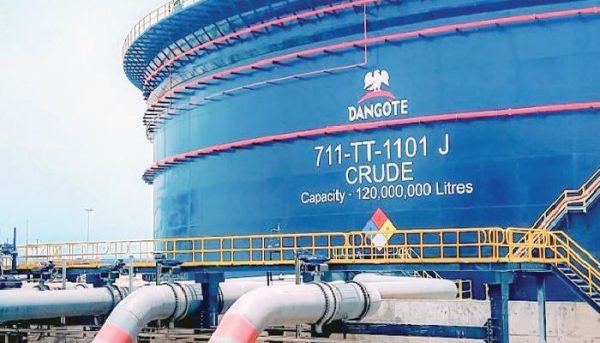
Dangote Petroleum Refinery could become one of the most influential companies on the Nigerian Exchange (NGX) if it proceeds with an initial public offering (IPO) at a valuation close to the $40 billion implied by a recent private placement.
According to EBC Financial Group, in a statement emailed to ASHENEWS on Thursday, such a valuation would put the refinery’s value at about N54.63 trillion, based on the Central Bank of Nigeria’s Nigerian Foreign Exchange Market rate of N1,365.6856 per dollar as of August 7, 2026.
The figure represents a significant share of Nigeria’s equity market. Companies listed on the NGX had a combined market capitalisation of N158.513 trillion on the same date.
If the refinery were added to the market at a valuation of N54.63 trillion, total NGX market capitalisation would rise to about N213.14 trillion, with Dangote Refinery accounting for approximately 25.6 per cent of the enlarged market.
The estimate assumes that the full $40 billion equity valuation is reflected in NGX market capitalisation and that the values of other listed companies remain unchanged.
David Precious, Senior Market Analyst at EBC Financial Group, said the refinery’s listing could have significant implications for the Nigerian equity market.
“If Dangote Refinery entered the Nigerian Exchange at close to a $40 billion valuation, it could account for roughly one-quarter of the resulting NGX market value,” Precious said.
He added that the impact could extend beyond the refinery if the valuation proved difficult to sustain, the number of shares available for public trading was limited, or investors had to sell existing Nigerian holdings to participate in the offering.
Private placement does not determine IPO valuation
According to EBC, the $40 billion valuation is based on a private transaction and should not be regarded as the definitive valuation for the proposed IPO.
Details published on August 4 indicated that a $2.5 billion private placement for a 6 per cent stake implied a valuation of approximately $40 billion.
The proposed IPO is reportedly targeting about $5 billion, although the eventual valuation and the percentage of shares to be offered to the public have not been disclosed.
EBC noted that valuations established through private transactions can differ from those that public investors are willing to accept during an IPO.
For comparison, the market value of Türkiye’s Tupras was cited at about $12 billion, while US-listed HF Sinclair was valued at approximately $16 billion.
At $40 billion, Dangote Refinery would therefore be valued at about 3.3 times Tupras and 2.5 times HF Sinclair.
However, EBC cautioned that the companies are not directly comparable because of differences in profitability, debt levels, operations and growth prospects.
The valuation gap, it said, makes audited financial statements, cash-flow data, debt obligations and investment plans particularly important in assessing whether the proposed valuation is sustainable.
$5bn IPO could reshape capital allocation
The reported $5 billion fundraising target would be worth approximately N6.83 trillion at the August 7 exchange rate, equivalent to about 4.3 per cent of the existing NGX market capitalisation of N158.513 trillion.
EBC said the impact on the wider equity market would depend partly on the source of the funds.
If new domestic or foreign capital is brought into the Nigerian equity market to subscribe to the offer, the IPO could expand the pool of capital invested in Nigerian equities.
However, if investors finance their subscriptions by selling existing holdings, the transaction could trigger a reallocation of capital away from other NGX-listed companies.
The amount of Dangote Refinery shares available for public trading would also be crucial.
NGX listing rules provide that Main Board companies can qualify through either 20 per cent public ownership held by at least 300 shareholders or publicly tradable shares valued at a minimum of N20 billion. The corresponding value threshold for the Premium Board is N40 billion.
Shares held by promoters, directors and their close relatives, governments, and strategic investors holding at least 5 per cent are excluded from qualifying public shares.
Consequently, a company with a market value running into tens of trillions of naira could still have a relatively small free float if ownership remains concentrated.
Regional investors, pension funds may influence demand
Potential participation by investors from other African markets could also shape the outcome of the IPO.
Details published on August 4 indicated that discussions had involved South Africa, Kenya, Egypt, Ghana and Rwanda, including possible participation of up to $500 million from Kenya, although no allocations had been confirmed.
The Johannesburg Stock Exchange has separately said Dangote Group had expressed strong interest in pursuing a South African listing after Nigeria.
EBC said participation by regional investors in the Nigerian offer could bring additional capital into the country’s equity market, while a subsequent South African listing could broaden access to the company without directly increasing the funds raised through the Nigerian IPO.
Pension funds could also play a role in the offering.
The National Pension Commission (PenCom) has waived the usual existence, profitability and dividend requirements to allow Pension Fund Administrators to consider investing in the proposed IPO.
The commission, however, retained requirements relating to internal investment policies, risk management and fiduciary responsibilities to pension contributors and retirees.
PenCom described the dispensation as exceptional, one-off and specific to the proposed IPO.
Nigeria’s pension funds held N5.907 trillion in domestic ordinary shares at the end of June, compared with the approximately N6.83 trillion equivalent of the reported IPO target.
EBC stressed that the figures do not mean pension funds would finance the offering, but highlight the scale of the capital-allocation decision facing fund managers.
Precious said the listing could mark a significant development for Nigeria’s capital market if it results in broader ownership and attracts additional African investment.
“Dangote being listed could become a turning point for Nigeria’s equity market if it brings wider public ownership and additional African capital,” he said.
He added that investors would need evidence supporting the valuation, clarity on the amount of the company that would be available for trading and details of how funds raised from the IPO would be deployed.
SEC approval and prospectus remain key
The Securities and Exchange Commission (SEC) said on June 23 that no IPO application from Dangote Refinery had been filed or approved at that time and directed unauthorised pre-marketing activities to stop.
However, details published on August 4 indicated that an IPO application had subsequently been submitted, with regulatory approval expected in the following weeks.
EBC said the eventual prospectus would be expected to provide clarity on the company’s valuation, the number of shares being offered, public ownership, use of proceeds and other material terms.
Until the final terms are released, the potential impact of the listing on the Nigerian equity market will depend on whether Dangote Refinery can combine a sustainable valuation with broad public ownership and genuinely additional investment.
