


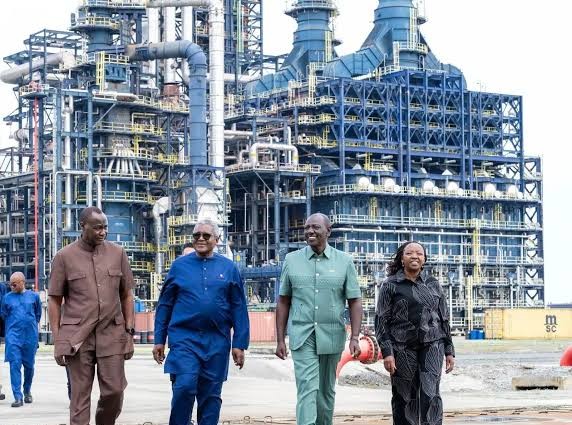
Lamu, Kenya — Kenya has launched construction of a $16–17 billion oil refinery in Lamu, with Nigerian-born industrialist Aliko Dangote expected to run the project once completed.
The mega refinery, estimated at KSh2.2 trillion, will process up to 700,000 barrels of crude oil per day into petroleum products. It held its groundbreaking ceremony in Lamu on September 30, 2026, in the presence of regional heads of state and government.
Kenyan President William Samoei Ruto described the project as a government-enabled, private-sector-led investment and said the government would use the national infrastructure fund to invest in the refinery.
“This is the largest single investment in the history of our country,” Ruto said at the ceremony, adding that the project would transform Lamu and create wider economic opportunities across Kenya.
He assured residents that the project would create jobs while protecting the environment, particularly the sensitive coastal ecosystems in Lamu.
According to Ruto, the refinery is expected to generate up to 60,000 direct and indirect jobs for Kenyans, while businesses in transport, food, accommodation and logistics could generate more than KSh2 billion monthly.
The Kenyan president also said the project would have broader economic implications, including increasing Kenya’s gross domestic product by almost 12 per cent and raising annual foreign direct investment by nearly $4 billion, from about $3.2 billion to as much as $7 billion.
Among the regional leaders who attended the launch were Uganda’s President Yoweri Museveni, Ethiopia’s Prime Minister Abiy Ahmed, Togo’s President Jean-Lucien Savi de Tové and former Nigerian President Olusegun Obasanjo.
Nigeria’s Minister of State for Petroleum Resources also represented President Bola Tinubu at the ceremony.
Ruto said his confidence in Dangote’s ability to deliver the project was reinforced by his visit to the Dangote Refinery in Lekki, Lagos, describing the facility as one of the world’s largest oil refineries and a demonstration of advanced science, technology and engineering.
He also praised Dangote for expanding his business operations across Africa, including in Ethiopia, Mozambique, Burundi, Uganda, Tanzania and Nigeria.
Speaking at the launch, Dangote described the Lamu project as a major step towards strengthening African industrialisation and reducing the continent’s dependence on imported refined petroleum products.
He said the idea for the refinery emerged in April following engagements with Presidents Ruto and Museveni.
Dangote put the estimated cost of the project at KSh2.2 trillion, or about $16–17 billion, with a planned capacity of 700,000 barrels per day. He said the project team expects to return to the site in 40 months to inaugurate the completed refinery.
He added that, after stabilisation and commencement of operations, the refinery would be listed on the Kenyan Stock Exchange, allowing Kenyan and other investors to participate in its ownership.
Dangote said a training school would be established to train more than 2,000 experts, while tens of thousands of people were expected to benefit through employment, construction, logistics and related businesses.
He said indigenous communities and young Kenyans would be included in the project, while companies across East Africa would have opportunities to supply construction materials, labour, services and other products, including bioproducts required by the refinery.
Dangote also called for a stronger regional market, arguing that projects of this scale should be viewed beyond Kenya alone. He said 30 per cent of the refinery’s proceeds had been earmarked for the East African market.
He stressed the importance of environmental protection, saying development for future generations must go hand in hand with safeguarding the environment.
According to Dangote, Africa’s greatest deficit is not resources but confidence. He urged African entrepreneurs and governments to think bigger and invest in major projects across the continent.
He thanked the Kenyan government and people of Lamu, as well as Nigeria’s leadership, for creating an environment of confidence for African businesses to expand across the continent.
Dangote also acknowledged former President Olusegun Obasanjo, whom he credited with encouraging him to expand beyond Nigeria.
Addressing possible legal challenges to the project, Dangote said those opposed to it were free to seek legal redress and that his team was prepared to defend the project through due process.
He said Africa must move beyond exporting raw materials to producing finished goods for the global market.
“African entrepreneurs must be bold. Together as one, we stand to gain more,” he said.
