


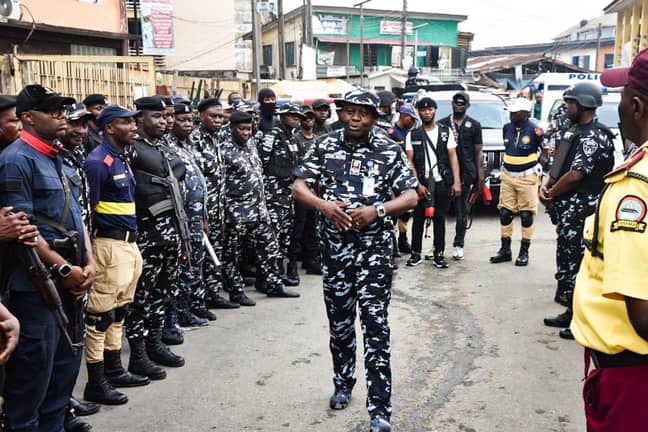
The State Police Constitution Alteration Bill passed by the House of Representatives has introduced measures aimed at insulating the proposed State Police Services from political interference while guaranteeing direct funding and strengthening independent oversight.
The bill, which seeks to amend the 1999 Constitution to establish a dual policing structure comprising the Federal Police Service and State Police Services, also outlines the financial, operational and institutional framework for the proposed system.
One of the key provisions is the direct funding of State Police Services. The proposed amendment to Section 121 of the Constitution stipulates that any amount standing to the credit of a State Police Service shall be paid directly to the service.
The provision is designed to prevent governors or other political actors from weakening state police institutions by withholding funds.
The House noted that without guaranteed funding, state police services could become ineffective or vulnerable to political manipulation.
The bill also seeks to strengthen the independence of police oversight bodies by removing executive control over their operations.
ALSO READ State police debate: A point of reflection for Nigeria’s policymakers, by DIG Mohammed Usaini Gumel
ALSO READ State police: Ex-DIG Gumel urges Nigeria to embrace reform with strong safeguards
Under the proposed amendments to Sections 158 and 202, the Federal Police Service Commission, National Police Council and State Police Service Commissions would not be subject to the direction or control of any other authority, including the President at the federal level and governors at the state level.
The lawmakers argued that granting independence only to the Federal Police Service Commission, without extending similar protection to the National Police Council, could leave oversight of state police services vulnerable to executive interference.
The proposed legislation further allows the relevant commissions to regulate their internal procedures without requiring presidential or gubernatorial approval, while State Police Service Commissions would be required to submit annual reports to their respective state Houses of Assembly.
Under the proposed policing structure, the Federal Police Service would retain responsibility for terrorism, organised crime, cybercrime, border security, policing of the Federal Capital Territory and offences with interstate or international dimensions.
State Police Services, on the other hand, would be responsible for enforcing state laws, maintaining public order, protecting lives and property and handling other local policing responsibilities within their jurisdictions.
The bill also restricts state police operations to their respective states, except where authorised by the National Assembly or permitted under provisions covering fresh pursuit and reciprocal policing arrangements.
It further establishes strict conditions for federal intervention in state policing matters. The Federal Police would only intervene after necessary operational and technical support to the State Police Service had been exhausted, with intervention described as a measure of last resort.
Such intervention could be triggered by an actual or imminent breakdown of public order beyond the capacity of a State Police Service, a request by a governor, serious administrative or operational incapacity, evidence of egregious human rights violations or partisan intimidation, or a serious threat to national security or the country’s territorial integrity.
Any intervention must be temporary, necessary, proportionate and limited to the specific territory, functions and period required to address the situation.
The President would be required to authorise the intervention in writing and state the reasons, duration and territorial scope, while notifying the governor, Speaker of the State House of Assembly, National Police Council and National Assembly within 48 hours.
The bill also subjects federal intervention to judicial review and requires approval from both chambers of the National Assembly if it is to continue beyond the period prescribed by law.
The proposed framework further prohibits the use of federal intervention to dissolve a State Police Service or suspend elected state institutions outside the provisions of the Constitution.
In another significant change, the bill removes the President and state governors as members of the National Police Council. The reconstituted council would include the Attorney-General of the Federation, a senior serving police officer representing the Federal Police Service, Attorneys-General of the 36 states, retired police officers representing the six geopolitical zones and representatives of relevant institutions and professional bodies.
The council would also be responsible for coordinating national policing policy between federal and state police services, supervising both institutions and recommending the appointment and removal of the Inspector-General of Police and state police chiefs.
At the state level, each State Police Service would be headed by a Chief of Police appointed by the governor on the recommendation of the National Police Council and subject to confirmation by the State House of Assembly.
The chief could only be removed following a fair hearing, a recommendation by the National Police Council and approval by at least two-thirds of the members of the State House of Assembly.
The bill also provides mechanisms for police officers to challenge unlawful directives by referring such orders to the appropriate Police Service Commission for review.
As part of its community policing framework, the legislation mandates the establishment of Community Policing Committees in each of Nigeria’s 774 local government areas.
The committees would comprise representatives of traditional institutions, local governments, women, youth organisations, persons with disabilities, civil society organisations and recognised professional bodies. However, they would have advisory functions only and would not exercise police powers.
The National Assembly would also be empowered to establish national minimum standards for recruitment, training, certification, promotion, discipline, use of force, firearms, public reporting, accountability and cooperation between federal and state police services.
States would be allowed to adopt standards higher than the national minimum but would not be permitted to fall below the prescribed standards.
The bill provides for continuity in the existing police structure by allowing the Nigeria Police Force to continue as the Federal Police Service until it is restructured in line with the amended Constitution and an Act of the National Assembly.
It also guarantees the continuity of serving police personnel, including the Inspector-General of Police, under the new Federal Police Service.
Existing state and community security outfits, meanwhile, would not be automatically converted into State Police Services under the proposed constitutional framework.
