



Healthcare is undergoing a profound digital transformation globally, and Nigeria is emerging as one of Africa’s most promising frontiers for telemedicine investment. While many investors continue to focus on fintech and e-commerce, a quieter but equally transformative revolution is reshaping healthcare delivery through digital technologies.
Nigeria’s healthcare system faces a significant supply-demand imbalance. With a population exceeding 230 million people and an estimated doctor-to-population ratio of approximately 1:10,000, well below the World Health Organization’s recommended benchmark of 1:1,000, access to quality healthcare remains a major challenge, particularly in rural and underserved communities (WHO, 2024; Federal Ministry of Health and Social Welfare, 2025).
According to the WHO, Telemedicine offers a scalable solution by connecting patients with licensed healthcare professionals through digital platforms, reducing geographical barriers and improving service delivery.
ALSO READ Muhaza Consult launches innovative healthcare services to transform medical access in Sokoto
ALSO READ FG reaffirms commitment to strengthening telemedicine, digital health innovation
Digital infrastructure is also creating a favourable investment climate. Smartphone penetration continues to rise, internet connectivity is expanding, fintech payment systems have matured, and digital literacy is improving among urban and semi-urban populations. These developments are accelerating consumer acceptance of virtual healthcare services (Egwudo et al., 2025).
Industry analysts estimate Nigeria’s digital health and telemedicine market at approximately US$1.5 billion, with strong medium-term growth driven by increasing demand for affordable healthcare, government digital health initiatives and private sector innovation. Market expansion is expected across teleconsultation, remote patient monitoring, electronic health records, digital diagnostics and AI-enabled healthcare solutions.
Unlike many emerging sectors that depend primarily on consumer spending, telemedicine addresses a structural need. Millions of Nigerians travel long distances for routine consultations, wait several hours before seeing a physician or postpone treatment altogether because healthcare facilities are inaccessible. Digital healthcare significantly reduces these barriers while lowering operating costs for providers.
Another powerful investment signal is the growing interest from development finance institutions, venture capital firms and international health organizations. Nigerian digital health startups have attracted increasing levels of seed funding since 2019, although recent research suggests that long-term success depends less on raising capital and more on building sustainable business models, regulatory compliance and strategic partnerships (Elechi et al., 2025).
Government policy is also becoming more supportive. The National Digital Health Policy, implementation of the Nigeria Data Protection Act (2023), expansion of the National Health Insurance Authority (NHIA) and ongoing discussions around a Digital Health Services Bill demonstrate increasing institutional recognition of digital healthcare as an important component of Universal Health Coverage.
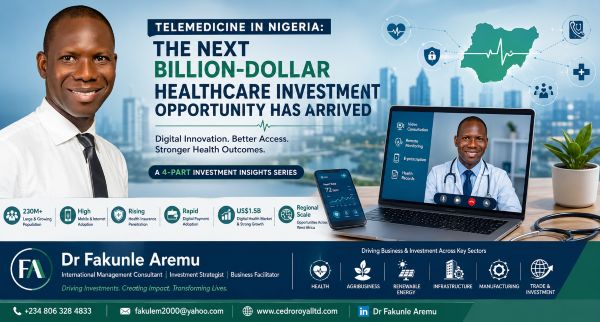
For investors, Nigeria offers several compelling advantages:
A large and underserved healthcare market.
High mobile phone adoption.
Increasing health insurance penetration.
Rapid digital payment adoption.
Growing private healthcare expenditure.
Strong demand from employers for corporate digital health services.
Opportunities to scale solutions beyond Nigeria into West Africa.
However, investors should view telemedicine not merely as a technology business but as a regulated healthcare enterprise. Success depends on integrating clinical governance, data protection, insurance partnerships and physician networks into a sustainable commercial model.
The next decade is likely to witness the convergence of telemedicine, artificial intelligence, wearable health technologies and electronic medical records. Companies that establish trusted healthcare ecosystems today are likely to become tomorrow’s dominant healthcare infrastructure providers.
For long-term investors seeking sectors capable of generating both financial returns and measurable social impact, telemedicine represents one of Nigeria’s most compelling investment opportunities.
Dr. Fakunle Aremu is an international management consultant and investment strategist who facilitates business growth across healthcare, agribusiness, renewable energy, trade, infrastructure and manufacturing. He advises governments, investors and development partners on investment, market entry, public-private partnerships and private sector development, driving sustainable economic growth and enterprise competitiveness.
