


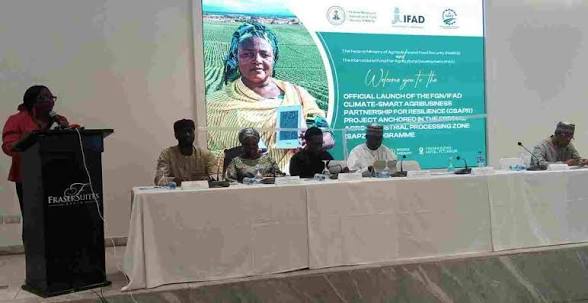
The Federal Government and the International Fund for Agricultural Development (IFAD) have unveiled the Climate-Smart Agribusiness Partnership for Resilience (CSAPR) project to improve the resilience and profitability of Nigeria’s agricultural value chains.
Dr Marcus Ogunbiyi, Permanent Secretary, Federal Ministry of Agriculture and Food Security, speaking at the project launch on Friday in Abuja, said CSAPR would integrate Climate Information Services (CIS) into private sector-led agribusiness solutions.
He said the project would also strengthen collaboration between public institutions and private-sector actors.
The project would connect climate science with agricultural decision-making through partnerships involving the Nigerian Meteorological Agency (NiMet), financial institutions, insurers, agri-tech companies and farmer organisations.
According to him, the partnerships would support the development and expansion of climate-informed products to benefit farmers, especially smallholders, women and youths.
Ogunbiyi said the project aligns with IFAD’s Country Strategic Opportunities Programme (COSOP) 2024–2029 and the Comprehensive Africa Agriculture Development Programme (CAADP) Kampala Declaration on resilient and climate-smart food systems.
He described the initiative as a milestone in efforts to build a productive, inclusive and climate-resilient agricultural sector.
The permanent secretary noted that climate-change impacts — including floods, droughts, irregular rainfall, desertification and rising temperatures — continue to threaten agricultural production and livelihoods.
“Strengthening resilience within the sector is no longer an option but an urgent necessity,” he said.
Ogunbiyi added that CSAPR emerged from policy dialogue and best practices from corporate climate partnerships held in 2025, and that it would serve as a pilot initiative.
IFAD Country Director Dede Ekoue said CSAPR was designed to strengthen the business case for Climate Information Services by promoting practical and financially sustainable partnerships between public institutions and private-sector actors.
She said a viable CIS Public-Private Partnership (PPP) model would provide a resilience solution and support resource mobilisation for a more competitive agricultural sector.
The model would complement public climate information and agricultural advisory services by encouraging investments from lenders, insurers, processors, aggregators and logistics operators.
Ekoue said CSAPR would be anchored by the IFAD-funded Special Agro-Industrial Processing Zones (SAPZ) Programme.
The project would link climate resilience with agro-industrial development, value-chain competitiveness, job creation and rural transformation.
She noted that climate-smart agriculture is not only an environmental priority but also an economic opportunity.
“When climate information is integrated through financially viable public-private partnerships in extension, finance, insurance, input supply, aggregation, processing and market systems, it can unlock innovation, investment and better services for farmers and agribusinesses,” she said.
She added that climate information services must be accessible, affordable and delivered through trusted channels, including producer organisations, extension networks, digital platforms, radio, voice services, agro-dealers and community institutions.
Ekoue assured that IFAD remains committed to working with the Federal Government and other partners to ensure CSAPR delivers results for smallholder farmers, particularly women, youths and vulnerable rural communities.
CSAPR is financed by the Gates Foundation, executed by IFAD and implemented by the Federal Ministry of Agriculture and Food Security through SAPZ from 2026 to 2028.
