


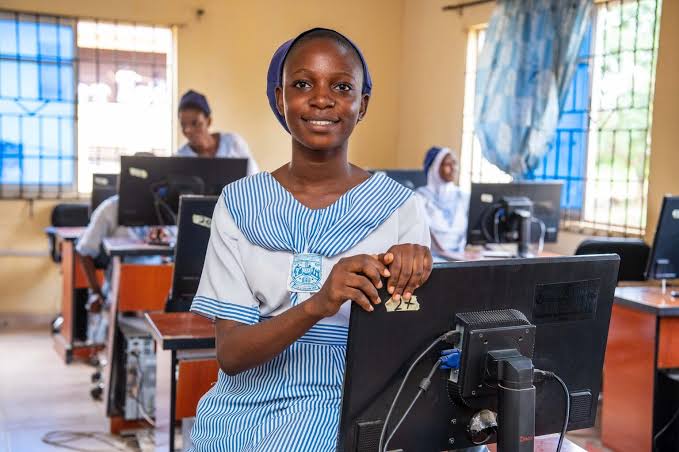
The Kaduna State Team Lead of the Nigerian Learning Passport (NLP), Philip Mamman, has disclosed that over 2.2 million users have enrolled on the online learning platform across Nigeria.
This forms part of efforts to bridge the country’s learning poverty gap.
Mamman stated this on the sidelines of this year’s National Children’s Day celebration at the Air Force Institute of Technology, Kaduna.
Speaking on the impact of the initiative, which is supported by UNICEF in partnership with the Global Partnership for Education and hosted by the Federal Ministry of Education, Mamman said the NLP is an online learning platform designed to provide Nigerian children with access to quality education regardless of location.
“The Nigerian Learning Passport is an online learning platform that aims to close the learning poverty gap, especially in literacy and numeracy,” he said.
“It allows every Nigerian child, whether in rural or urban areas, to access quality education.”
Mamman explained that users can access the platform via Android phones, iOS devices, laptops, and desktops by downloading the NLP app from the Play Store and registering with an email address.
He noted that the platform was launched in Abuja on March 24, 2022, by former President Muhammadu Buhari.
So far, 24 states have launched the initiative, with Gombe being the latest to join in April.
Describing the NLP as the largest online learning platform in Africa, Mamman said enrolment continues to grow nationwide.
“At the moment, we have over two million users across Nigeria, and enrolment is still ongoing,” he said.
On challenges, he revealed that efforts are being made to improve access for learners in hard-to-reach communities through the introduction of offline hubs that do not require internet connectivity.
“We know there are communities without internet access. The offline hub allows learners in such areas to use the platform without the internet,” he explained.
He added that Kaduna State is expected to benefit from the offline hub initiative soon.
Mamman commended UNICEF for providing technical support to states, particularly in teacher training and digital learning innovation. According to him, about 70,000 teachers have been trained on the use of the platform since its launch.
He further disclosed that UNICEF is promoting blended learning by combining conventional classroom teaching with technology-enabled tools, including artificial intelligence and generative AI as teaching assistants.
Looking ahead, Mamman said the programme aims to expand to more states to improve access to education, especially for out-of-school children.
“We are looking at scaling the programme to reach every Nigerian child. In the near future, we hope to expand to over 30 states plus the FCT so that every child can access quality education with just a click,” he said.
