


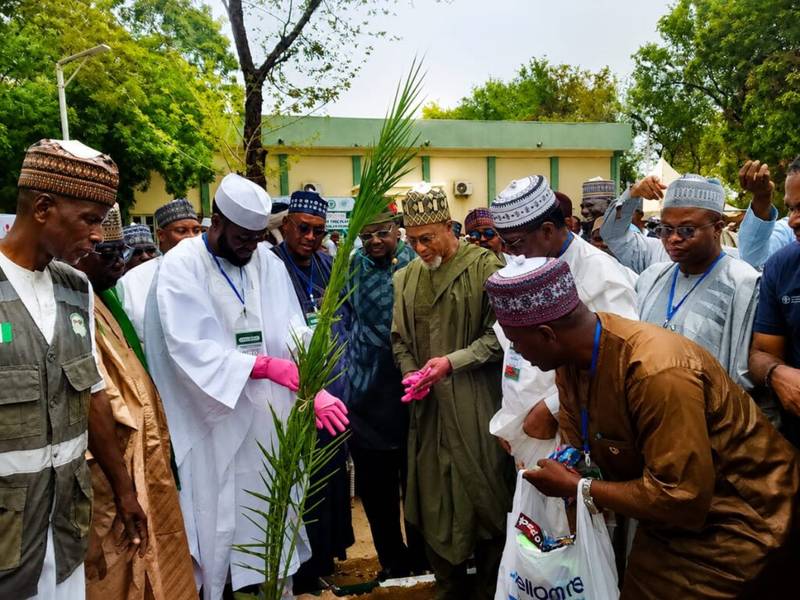
The Federal Government has launched the 2026 tree planting campaign and inaugurated the National Steering Committee for the Sustainable Agricultural Restoration and Growth for Green Wall Areas (SURAGGWA) in Kano.
The Minister of Environment, Malam Balarabe Lawal, performed the inauguration on Thursday during the commemoration of the 2026 Great Green Wall Day at the headquarters of the National Agency for the Great Green Wall (NAGGW) in Kano.
Lawal emphasized that the initiative demonstrates the Federal Government’s commitment to restoring degraded landscapes, combating desertification, and building climate-resilient communities nationwide.
He stated that environmental sustainability is central to President Bola Tinubu’s Renewed Hope Agenda, stressing that healthy ecosystems are vital for food security, economic growth, and Nigerians’ well-being.
The minister praised Kano State for hosting the event and supporting environmental protection and sustainable development efforts.
The theme for this year, “The Green Shield: Restoring Landscapes to Silence the Sand and Dust Storms,” highlights the urgent need to address the increasing impact of sand and dust storms in Northern Nigeria and the Sahel region.
“The solution is restoring our degraded landscapes. The Great Green Wall Initiative is Africa’s flagship response to desertification and climate change,” he said.
Nigeria’s implementation extends beyond tree planting to include land restoration, biodiversity conservation, livelihood improvement, and food security across 11 frontline states: Adamawa, Bauchi, Borno, Gombe, Jigawa, Kano, Katsina, Kebbi, Sokoto, Yobe, and Zamfara.
He noted that relocating the NAGGW headquarters to Kano recognizes the state’s strategic role in the initiative.
Since its establishment, the agency has raised over 48 million indigenous and exotic tree seedlings to support shelterbelts, community woodlots, orchards, plantations, and land restoration.
More than 10.8 million drought-resistant seedlings and 869,089 date palm seedlings have been distributed to farmers to promote agroforestry, boost food production, and increase rural incomes.
The agency has also expanded access to clean energy through solar home systems, street lights, fuel-efficient cookstoves, and solar-powered irrigation pumps.
Over 210,000 Nigerians, especially women and youth, have participated in restoration activities, and more than 1,300 forest guards have been trained to support environmental protection.
Earlier, NAGGW Director-General Saleh Abubakar reaffirmed the agency’s commitment to restoring degraded landscapes and combating desertification across Nigeria.
He highlighted achievements including the production of over 48 million tree seedlings, land restoration, agroforestry promotion, and renewable energy support for rural communities.
He thanked the Federal and Kano State Governments, development partners, and stakeholders, pledging continued efforts toward a greener, climate-resilient Nigeria.
Kano State Commissioner for Water Resources, Environment, and Climate Change, Dr. Dahiru Hashim, reiterated the state’s commitment to environmental restoration and climate action.
He noted that relocating NAGGW to Kano would strengthen efforts against desertification, land restoration, and community resilience. The state has planted millions of trees and restored over 50,000 hectares of degraded land through various programs.
Hashim assured support from Kano for the successful implementation of SURAGGWA.
FAO Nigeria and ECOWAS Representative Mr. Hussein Gadain pledged continued support for Nigeria’s land restoration and climate resilience efforts through SURAGGWA.
He emphasized that desertification and climate change threaten agriculture and livelihoods, especially in Northern Nigeria, and that the Great Green Wall remains vital.
Gadain explained that the SURAGGWA Project, funded by the Green Climate Fund and implemented by FAO with partners, will promote landscape restoration, biodiversity, climate adaptation, and improved livelihoods.
He added that the steering committee will provide strategic guidance, strengthen coordination, and ensure effective project implementation.
The event featured the symbolic launch of the 2026 tree planting campaign and the inauguration of the SURAGGWA National Steering Committee members from the 11 frontline states.
