


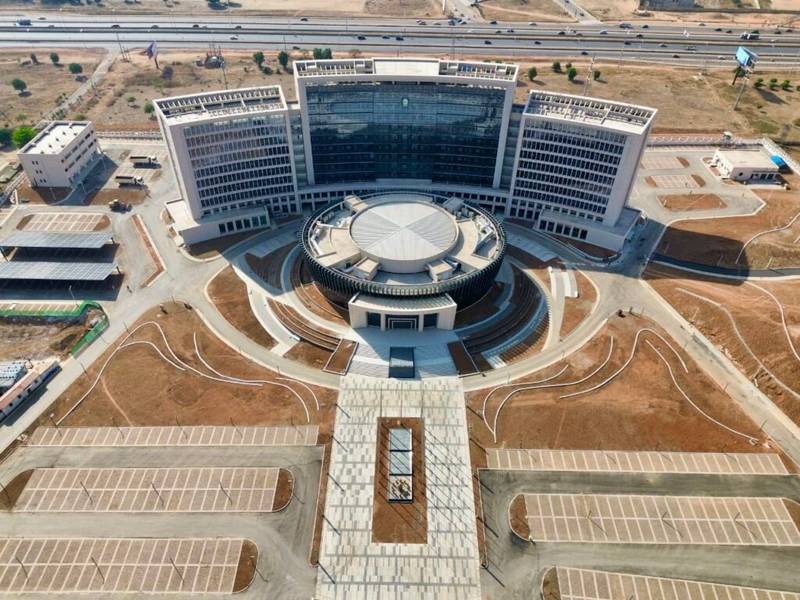
On Tuesday, April 28, China officially handed over the China-Aid Project of the ECOWAS Headquarters to the ECOWAS Commission in Abuja, Nigeria.
Located on Airport Road, about 15 kilometres from the city centre, the complex spans 70,186 square metres, with a total floor area of 36,606 square metres. It comprises an office building, a conference centre, and supporting facilities including internal roads, utility networks, public plazas, parking areas, and a helipad—forming a modern complex that integrates administrative, conference, and service functions.
The China-Aid Project, a flagship initiative under China–ECOWAS cooperation, was funded and implemented by the Chinese government. ECOWAS first proposed the idea during the inaugural China–ECOWAS Joint Committee on Economic and Trade Cooperation in November 2015. In March 2018, both sides signed letters confirming China’s support. Construction began in November 2021 and was completed in December 2025.
Designed to international standards, the project draws on China’s experience in large-scale public architecture, prioritising quality, safety, and efficiency. The master plan centres on the office building and conference hall, arranged in sweeping curved forms, symbolically evoking the “Eye of West Africa” to represent ECOWAS’s role in regional unity and integration.
The main office building covers approximately 29,800 square metres, rising 11 stories at its centre and nine on the sides. It houses offices, meeting rooms, a data centre, training rooms, a medical unit, childcare facilities, a gym, a library, and dining areas. Informal social areas and lounges are thoughtfully integrated for usability and comfort.
The two-story conference centre spans 4,450 square metres, featuring a 720-seat main hall and multiple meeting rooms. Its circular, drum-like design draws inspiration from traditional communal dwellings, symbolising unity and shared identity across West Africa.
The complex’s flowing façade reflects the Niger River, while glass curtain walls and shading elements evoke local mangrove ecosystems, blending environmental awareness with vitality. Chinese contractors promoted local hiring and technical training, enhancing skills development. A solar photovoltaic system and smart management systems improve energy efficiency, safety, and operational performance.
The new headquarters is expected to strengthen ECOWAS’s administrative and coordination capabilities, providing a robust platform for regional integration. Beyond functionality, the “Eye of West Africa” stands as a modern landmark symbolising deepening China–Africa cooperation and a shared future for West African prosperity.
