


• Home
  • Agric
  • Sci & Tech
  • Health
  • Environment
  • Hausa News
  • More
    • Business/Banking & Finance
    • Politics/Elections
    • Entertainments & Sports
    • International
    • Investigation
    • Law & Human Rights
    • Africa
    • ACCOUNTABILITY/CORRUPTION
    • Hassan Gimba
    • Column
    • Prof. Jibrin Ibrahim
    • Prof. M.K. Othman
    • Defense/Security
    • Education
    • Energy/Electricity
    • Entertainment/Arts & Sports
    • Society and Lifestyle
    • Food & Agriculture
    • Health & Healthy Living
    • International News
    • Interviews
    • Investigation/Fact-Check
    • Judiciary/Legislature/Law & Human Rights
    • Oil & Gas/Mineral Resources
    • Press Freedom/Media/PR/Journalism
    • General News
    • Presidency
  • About Us
    • Contact Us
    • Board Of Advisory
    • Privacy Policy
    • Ethics Policy
    • Teamwork And Collaboration Policy
    • Fact-Checking Policy
    • Advertising
  • Media OutReach Newswire
    • Wire News
  • The Stories
Facebook Twitter Instagram
Trending
  • Federal College of Horticulture matriculates 1,266 students
  • UI Imam urges Muslims on kindness, charity
  • COREN intensifies enforcement of engineering standards
  • Troops neutralise 4 terrorists in Katsina
  • PDP Sokoto appoints new State women leader, zonal secretary
  • Association postpones youth drug abuse forum in Sokoto
  • Association inaugurates motorised borehole in Edo community to combat water scarcity
  • Experts call for better hygiene, water, nutrition to reduce child diarrhoea
Facebook Twitter Instagram YouTube
AsheNewsAsheNews
  • Home
  • Agric

    Abandon hoes, cutlasses for modern farming – Tinubu’s Wife urges Nigerians

    May 2, 2026

    Over 200 farmers, herders benefit from SPAR project in Katsina

    May 2, 2026

    Community leaders discuss resource conflicts in Sokoto North, South

    May 1, 2026

    Fortified rice: Nourishing Nigeria, one meal at a time, By Peter Dama

    May 1, 2026

    Niger hosts talks on Eco green industrial city

    April 30, 2026
  • Sci & Tech

    Samsung revenue jumps 43% in Q1

    May 1, 2026

    AfricaX summit to support commercialisation of innovations

    April 30, 2026

    FUTA don advocates people-centred engineering for sustainable industrial growth

    April 30, 2026

    Oyedele calls for tech upgrades to boost Nigeria’s growth

    April 29, 2026

    Australian scientists turn plastic waste into clean fuel using sunlight

    April 29, 2026
  • Health

    Association postpones youth drug abuse forum in Sokoto

    May 2, 2026

    Association inaugurates motorised borehole in Edo community to combat water scarcity

    May 2, 2026

    Experts call for better hygiene, water, nutrition to reduce child diarrhoea

    May 2, 2026

    WHO member states advance pandemic agreement on pathogen sharing

    May 2, 2026

    Kwara to distribute 2m mosquito nets

    May 1, 2026
  • Environment

    COREN intensifies enforcement of engineering standards

    May 2, 2026

    Kwamba residents lament worsening water scarcity in Suleja

    May 2, 2026

    Society pushes wider risk management adoption

    May 1, 2026

    Babangida honors late journalist Yakubu Mohammed

    May 1, 2026

    Nigeria launches geospatial database for census

    April 30, 2026
  • Hausa News

    Otti plans 250-room 5-star hotel in Umuahia

    April 11, 2026

    Anti-quackery task force seals 4 fake hospitals in Rivers

    August 29, 2025

    [BIDIYO] Yadda na lashe gasa ta duniya a fannin Ingilishi – Rukayya ‘yar shekara 17

    August 6, 2025

    A Saka Baki, A Sasanta Saɓani Tsakanin ‘Yanjarida Da Liman, Daga Muhammad Sajo

    May 21, 2025

    Dan majalisa ya raba kayan miliyoyi a Funtuwa da Dandume

    March 18, 2025
  • More
    1. Business/Banking & Finance
    2. Politics/Elections
    3. Entertainments & Sports
    4. International
    5. Investigation
    6. Law & Human Rights
    7. Africa
    8. ACCOUNTABILITY/CORRUPTION
    9. Hassan Gimba
    10. Column
    11. Prof. Jibrin Ibrahim
    12. Prof. M.K. Othman
    13. Defense/Security
    14. Education
    15. Energy/Electricity
    16. Entertainment/Arts & Sports
    17. Society and Lifestyle
    18. Food & Agriculture
    19. Health & Healthy Living
    20. International News
    21. Interviews
    22. Investigation/Fact-Check
    23. Judiciary/Legislature/Law & Human Rights
    24. Oil & Gas/Mineral Resources
    25. Press Freedom/Media/PR/Journalism
    26. General News
    27. Presidency
    Featured
    Recent

    Federal College of Horticulture matriculates 1,266 students

    May 2, 2026

    UI Imam urges Muslims on kindness, charity

    May 2, 2026

    COREN intensifies enforcement of engineering standards

    May 2, 2026
  • About Us
    1. Contact Us
    2. Board Of Advisory
    3. Privacy Policy
    4. Ethics Policy
    5. Teamwork And Collaboration Policy
    6. Fact-Checking Policy
    7. Advertising
    Featured
    Recent

    Federal College of Horticulture matriculates 1,266 students

    May 2, 2026

    UI Imam urges Muslims on kindness, charity

    May 2, 2026

    COREN intensifies enforcement of engineering standards

    May 2, 2026
  • Media OutReach Newswire
    • Wire News
  • The Stories
AsheNewsAsheNews
Home»Health & Healthy Living»[RESEARCH] How Lassa vaccines will save lives, spare economies
Health & Healthy Living

[RESEARCH] How Lassa vaccines will save lives, spare economies

Abdallah el-KurebeBy Abdallah el-KurebeOctober 25, 2024Updated:October 25, 2024No Comments5 Mins Read
Share
Facebook Twitter LinkedIn Pinterest Email

Lassa fever is a cryptic viral disease that is spread predominantly from rodents to humans in West Africa. We estimated the health-economic burden associated with Lassa fever, highlighting the gains to population health and economies that could be afforded by Lassa vaccines, several of which are currently in development.

The problem

Lassa fever is a poorly understood zoonotic disease that causes viral hemorrhagic fever and thousands of deaths annually throughout West Africa. It has also been identified as a leading pandemic threat by the World Health Organization (WHO) and other global health institutions. This has motivated considerable investment in the development of Lassa vaccines, several of which are currently undergoing assessment in clinical trials1,2. However, to date, no estimates of the health and economic burden of Lassa fever are available, impeding analysis of how Lassa vaccines could affect population health and economies. These impacts include pandemic preparedness because Lassa vaccines developed now could form a crucial part of future public health response efforts if, as is feared, a pandemic variant of Lassa virus were ever to emerge.

The discovery

Lassa fever is underdiagnosed and poorly reported through much of its endemic range. Modelling approaches are therefore particularly useful to estimate the largely hidden burden of this disease and evaluate the potential effects of public health interventions.

We leveraged the best available ecological, epidemiological and economic data from West Africa to develop a model that predicts at a high geospatial resolution the daily number of Lassa virus infections occurring in humans, and the health outcomes and economic costs associated with infection (Fig. 1). We then simulated a range of vaccination campaigns that reflect realistic assumptions about vaccine availability and efficacy, and projected the benefits that these campaigns could have on population health and economies. We also evaluated the health-economic effects of large-scale reactive vaccination under a pandemic scenario in which a hypothetical variant of Lassa virus, which we call ‘Lassa-X’, emerges and rapidly spreads throughout the region.
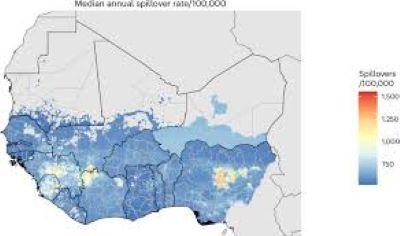
Predicted geospatial distribution of Lassa fever
The heat map shows the median annual incidence of zoonotic Lassa virus infection per 100,000 population across the 15 countries of continental West Africa included in our analysis (Benin, Burkina Faso, Côte d’Ivoire, The Gambia, Ghana, Guinea, Guinea Bissau, Liberia, Mali, Mauritania, Niger, Nigeria, Senegal, Sierra Leone and Togo). Known transmission hotspots are highlighted in the Mano River Region and Nigeria. © 2024, Smith, D. R. M. et al., CC BY 4.0

We estimated that Lassa fever results in 24,000 hospitalizations, 3,900 deaths and 200,000 disability-adjusted life years (DALYs) annually, a burden comparable to those of other infectious diseases in West Africa such as rabies and lymphatic filariasis (although, unlike Lassa fever, these diseases are not thought to have pandemic potential). Vaccination averted roughly tenfold more DALYs when administered preventively in known Lassa fever hotspots, as opposed to reactively in response to local outbreaks. Preventive campaigns that target regions thought to be at greatest risk for Lassa fever were most effective, averting 20,000–29,000 hospitalizations, 3,300–4,800 deaths and 164,00–240,000 DALYs over 10 years, in turn averting US$42–61 million in healthcare costs, $86–126 million in productivity losses and $20–30 million in monetized DALY value.

In the hypothetical event of Lassa-X emerging and spreading throughout West Africa within 2 years, achieving the vaccination targets of the 100 Days Mission — a globally endorsed pandemic response roadmap — averted just 22% of DALYs given a vaccine 70% effective against the disease, but up to 74% of DALYs given a vaccine 70% effective against both infection and disease.

The implications

This work describes the large health and economic toll that Lassa fever bears on West African societies and suggests how forthcoming Lassa vaccines could be rolled out to optimize their impact. Our results also provide insights into the value of pandemic preparedness, by highlighting the health-economic effects that Lassa vaccines could have, assuming a rapid vaccine response is achieved in the hypothetical event that Lassa-X were to emerge.

Although regions known to be at high risk of Lassa fever are an obvious starting point for Lassa vaccination campaigns, our model also predicts a substantial burden of disease in regions not widely classified as endemic. However, these predictions are difficult to validate owing to data limitations, highlighting a need for further epidemiological study throughout the region.

It is hoped that the ongoing ‘Enable’ cohort study will provide important data on characteristics of Lassa fever that remain poorly understood, such as its spectrum of illness, extent of seroreversion and risk factors for infection and disease. Ongoing Lassa vaccine trials will also help to describe the public health potential of specific vaccine products currently in development. Integrating these data into future analyses will be key to estimating the cost-effectiveness of real-world Lassa vaccination programmes. Such analyses will provide stakeholders and decision-makers with critical estimates of the return on Lassa vaccine investment in the context of competing public health priorities.

By David R. M. Smith (University of Oxford, Oxford, UK) & Emily J. Nixon (University of Liverpool, Liverpool, UK.)

Nature Medicine

Lassa vaccines WHO
Share. Facebook Twitter Pinterest LinkedIn WhatsApp Reddit Tumblr Email
Abdallah el-Kurebe
  • Website
  • Facebook
  • Twitter
  • LinkedIn

Related Posts

Association postpones youth drug abuse forum in Sokoto

May 2, 2026

Association inaugurates motorised borehole in Edo community to combat water scarcity

May 2, 2026

Experts call for better hygiene, water, nutrition to reduce child diarrhoea

May 2, 2026

Leave A Reply Cancel Reply

Federal College of Horticulture matriculates 1,266 students

May 2, 2026

UI Imam urges Muslims on kindness, charity

May 2, 2026

COREN intensifies enforcement of engineering standards

May 2, 2026

Troops neutralise 4 terrorists in Katsina

May 2, 2026
About Us
About Us

ASHENEWS (AsheNewsDaily.com), published by PenPlus Online Media Publishers, is an independent online newspaper. We report development news, especially on Agriculture, Science, Health and Environment as they affect the under-reported rural and urban poor.

We also conduct investigations, especially in the areas of ASHE, as well as other general interests, including corruption, human rights, illicit financial flows, and politics.

Contact Info:
  • 1st floor, Dogon Daji House, No. 5, Maiduguri Road, Sokoto
  • +234(0)7031140009
  • ashenewsdaily@gmail.com
Facebook Twitter Instagram Pinterest
© 2026 All Rights Reserved. ASHENEWS Daily Designed & Managed By DeedsTech

Type above and press Enter to search. Press Esc to cancel.