

• Home
  • Agric
  • Sci & Tech
  • Health
  • Environment
  • Hausa News
  • More
    • Business/Banking & Finance
    • POLITICS
    • Entertainments & Sports
    • International
    • Investigation
    • Law & Human Rights
    • Africa
    • ACCOUNTABILITY/CORRUPTION
    • Hassan Gimba
    • Column
    • Prof. Jibrin Ibrahim
    • Prof. M.K. Othman
    • Defense/Security
    • Education
    • Energy/Electricity
    • Entertainment/Arts & Sports
    • Society and Lifestyle
    • Food & Agriculture
    • Health & Healthy Living
    • International News
    • Interviews
    • Investigation/Fact-Check
    • LAW & HUMAN RIGHTS
    • Oil & Gas/Mineral Resources
    • PRESS FREEDOM/JOURNALISM/PR
    • General News
    • Presidency
  • About Us
    • Contact Us
    • Board Of Advisory
    • Privacy Policy
    • Ethics Policy
    • Teamwork And Collaboration Policy
    • Fact-Checking Policy
    • Advertising
  • Media OutReach Newswire
    • Wire News
  • The Stories
Facebook Twitter Instagram
Trending
  • CONUA: Our advocacy has brought stability to university system
  • MRTBN registrar calls for better funding, more physiotherapists
  • Cancer survivors demand better psychological support, affordable treatment
  • Shettima: MSMEs hold key to Nigeria’s economic growth
  • Matna foods executive calls for value addition in Nigeria’s cassava sector
  • Tech expert urges community approach to boost Nigeria’s 5G adoption
  • BUA cement reaffirms support for displaced farmers in Sokoto
  • Niger inaugurates 28 member state health advisory committee
Facebook Twitter Instagram YouTube
AsheNewsAsheNews
  • Home
  • Agric

    Matna foods executive calls for value addition in Nigeria’s cassava sector

    June 27, 2026

    BUA cement reaffirms support for displaced farmers in Sokoto

    June 27, 2026

    Jigawa launches agricultural support for 90,000 farmers

    June 27, 2026

    BOA introduces strict data-driven credit profiling for farmers

    June 26, 2026

    ADP urges farmers to utilise extension services for higher yields

    June 26, 2026
  • Sci & Tech

    MRTBN registrar calls for better funding, more physiotherapists

    June 27, 2026

    Tech expert urges community approach to boost Nigeria’s 5G adoption

    June 27, 2026

    Expert warns against charging phones while sleeping

    June 27, 2026

    Former APWEN Chair, Eterigho, addresses global engineering conference

    June 26, 2026

    ISAAA AfriCenter launches Africa-wide biotech, biosafety information portal

    June 25, 2026
  • Health

    Cancer survivors demand better psychological support, affordable treatment

    June 27, 2026

    Niger inaugurates 28 member state health advisory committee

    June 27, 2026

    Association urges FG to strengthen PHCs for early disease detection

    June 27, 2026

    NHIA introduces 1 hour authorisation approval limit

    June 26, 2026

    EFCC doctor warns pregnant women against eclampsia

    June 26, 2026
  • Environment

    Shettima: MSMEs hold key to Nigeria’s economic growth

    June 27, 2026

    FCT NUJ pledges support for community policing in Abuja

    June 27, 2026

    ESWAMA warns violators of monthly sanitation exercise

    June 26, 2026

    Enugu gov invites global investors for climate projects

    June 26, 2026

    Recycling boom creates jobs for thousands in Lagos

    June 24, 2026
  • Hausa News

    UNA signs MoU to launch air Bissau in Guinea-Bissau

    June 15, 2026

    Otti plans 250-room 5-star hotel in Umuahia

    April 11, 2026

    Anti-quackery task force seals 4 fake hospitals in Rivers

    August 29, 2025

    [BIDIYO] Yadda na lashe gasa ta duniya a fannin Ingilishi – Rukayya ‘yar shekara 17

    August 6, 2025

    A Saka Baki, A Sasanta Saɓani Tsakanin ‘Yanjarida Da Liman, Daga Muhammad Sajo

    May 21, 2025
  • More
    1. Business/Banking & Finance
    2. POLITICS
    3. Entertainments & Sports
    4. International
    5. Investigation
    6. Law & Human Rights
    7. Africa
    8. ACCOUNTABILITY/CORRUPTION
    9. Hassan Gimba
    10. Column
    11. Prof. Jibrin Ibrahim
    12. Prof. M.K. Othman
    13. Defense/Security
    14. Education
    15. Energy/Electricity
    16. Entertainment/Arts & Sports
    17. Society and Lifestyle
    18. Food & Agriculture
    19. Health & Healthy Living
    20. International News
    21. Interviews
    22. Investigation/Fact-Check
    23. LAW & HUMAN RIGHTS
    24. Oil & Gas/Mineral Resources
    25. PRESS FREEDOM/JOURNALISM/PR
    26. General News
    27. Presidency
    Featured
    Recent

    CONUA: Our advocacy has brought stability to university system

    June 28, 2026

    MRTBN registrar calls for better funding, more physiotherapists

    June 27, 2026

    Cancer survivors demand better psychological support, affordable treatment

    June 27, 2026
  • About Us
    1. Contact Us
    2. Board Of Advisory
    3. Privacy Policy
    4. Ethics Policy
    5. Teamwork And Collaboration Policy
    6. Fact-Checking Policy
    7. Advertising
    Featured
    Recent

    CONUA: Our advocacy has brought stability to university system

    June 28, 2026

    MRTBN registrar calls for better funding, more physiotherapists

    June 27, 2026

    Cancer survivors demand better psychological support, affordable treatment

    June 27, 2026
  • Media OutReach Newswire
    • Wire News
  • The Stories
AsheNewsAsheNews
Home»Oil & Gas/Mineral Resources»Nigeria’s petrol prices jump 39.5%, second highest globally
Oil & Gas/Mineral Resources

Nigeria’s petrol prices jump 39.5%, second highest globally

EditorBy EditorMarch 21, 2026Updated:March 21, 2026No Comments4 Mins Read
Nigeria’s petrol prices jump 39.5%, second highest globally
Share
Facebook Twitter LinkedIn Pinterest Email

Nigeria has recorded one of the sharpest increases in petrol prices worldwide, underscoring the country’s continued vulnerability to external oil market shocks despite its status as a major crude producer.

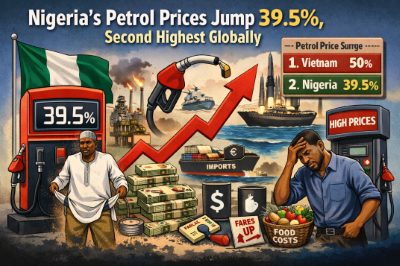
Data from InvestorSight, citing Global Petrol Prices, shows that petrol prices in Nigeria have surged by 39.5 percent since February 23, 2026—ranking second globally behind Vietnam, where prices rose by 50 percent over the same period.

The spike highlights a persistent paradox in Nigeria’s energy landscape: Africa’s largest oil producer remains heavily exposed to fluctuations in international refined product markets due to structural gaps in domestic refining and pricing systems.

Global shock, local strain

The ongoing Iran-related geopolitical tensions have triggered volatility in global energy markets, tightening supply expectations and pushing up crude benchmarks. While oil-producing countries typically benefit from higher crude prices, Nigeria’s downstream sector tells a different story.

With limited refining capacity, the country still depends significantly on imported petroleum products. As a result, domestic pump prices remain highly sensitive to global price movements, exchange rate pressures, and logistics costs.

The nearly 40 percent increase in petrol prices reflects this exposure, worsening inflationary pressures in an already fragile economy where energy costs directly affect transportation, food prices, and the broader cost of living.

Global comparison

Nigeria is the only African country to record such a steep increase since the Middle East conflict began, with its petrol price surge far exceeding those in several advanced economies.

Price increases in countries such as the United States (16.6 percent), Germany (14.9 percent), and Canada (10.6 percent) remain significantly lower. Even major Asian importers like Japan (2.5 percent) and South Korea (3.5 percent) have recorded relatively modest adjustments.

Among oil-exporting nations, the contrast is even more pronounced. Countries such as Qatar (2.7 percent) and the United Arab Emirates (6.4 percent) have seen far smaller increases, reflecting stronger domestic refining capacity and state-backed price stabilisation frameworks.

In contrast, Nigeria’s sharp rise signals limited insulation from global shocks.

Structural weaknesses

Energy analysts attribute Nigeria’s vulnerability to three key factors: inadequate refining infrastructure, foreign exchange constraints, and the absence of a strategic petroleum reserve (SPR).

Timothy Okon, Managing Partner at Teno Energy, said Nigeria must urgently establish strategic reserves to cushion the impact of global supply disruptions and stabilise fuel availability.

“The crisis we now face is not domestically driven. The consequences are what economists describe as negative externalities,” he said, noting that disruptions in key global supply routes such as the Strait of Hormuz have affected market stability.

Despite ongoing efforts to boost local refining—particularly through private sector investments—gaps remain. Marketers continue to push for import licences, further exposing the market to global price volatility.

The depreciation of the naira has compounded the situation, making fuel imports more expensive. Meanwhile, the removal of fuel subsidies has transferred the full burden of price fluctuations to consumers.

Kelvin Emmanuel, Managing Partner at an energy consulting firm, also noted that Nigeria lacks both strategic petroleum reserves and adequate shipping capacity to benefit from global energy disruptions.

“Nigeria does not have crude stockpiles set aside for emergencies beyond what is held at terminals,” he said.

Economic impact

The surge in petrol prices is already rippling across the economy. Transport fares have risen sharply in major cities, while businesses reliant on fuel-powered logistics and generators face escalating operating costs.

For households, the increase translates into reduced disposable income and heightened financial pressure, particularly among low- and middle-income earners.

Inflation is expected to intensify in the coming months as higher energy costs feed into broader price levels.

“If refined products are not readily available, the impact will be significant. Higher prices will drive inflation and potentially lead to higher interest rates,” said James Gooder, Vice-President (Crude Oil) at Argus Media.

Policy outlook

The latest developments reinforce the urgency of accelerating reforms in Nigeria’s downstream petroleum sector.

Analysts say expanding domestic refining capacity, stabilising the foreign exchange market, and improving supply chain efficiency are critical steps to reducing exposure to future global shocks.

BusinessDay

Petrol prices Poi and Gas
Share. Facebook Twitter Pinterest LinkedIn WhatsApp Reddit Tumblr Email
Editor
  • Website

Related Posts

LPG retailers link price hikes to global supply disruptions

June 20, 2026

PICNG-EV boosts awareness on CNG as safer, cheaper Fuel

June 20, 2026

Oil prices steady ahead of Iran deal signing

June 16, 2026

Leave A Reply Cancel Reply

CONUA: Our advocacy has brought stability to university system

June 28, 2026

MRTBN registrar calls for better funding, more physiotherapists

June 27, 2026

Cancer survivors demand better psychological support, affordable treatment

June 27, 2026

Shettima: MSMEs hold key to Nigeria’s economic growth

June 27, 2026
About Us
About Us

ASHENEWS (AsheNewsDaily.com), published by PenPlus Online Media Publishers, is an independent online newspaper. We report development news, especially on Agriculture, Science, Health and Environment as they affect the under-reported rural and urban poor.

We also conduct investigations, especially in the areas of ASHE, as well as other general interests, including corruption, human rights, illicit financial flows, and politics.

Contact Info:
  • 1st floor, Dogon Daji House, No. 5, Maiduguri Road, Sokoto
  • +234(0)7031140009
  • ashenewsdaily@gmail.com
Facebook Twitter Instagram Pinterest
© 2026 All Rights Reserved. ASHENEWS Daily Designed & Managed By DeedsTech

Type above and press Enter to search. Press Esc to cancel.