


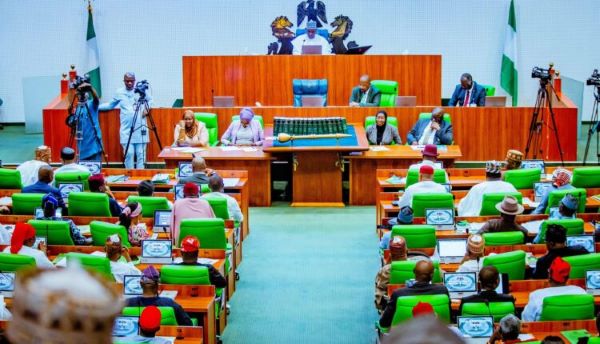
The House of Representatives has commenced clause-by-clause consideration of President Bola Ahmed Tinubu’s executive bill seeking to establish state police, signalling a move towards aligning the proposed legislation with the version already passed by the Senate.
The Deputy Speaker of the House and Chairman of the House Committee on Constitution Review, Benjamin Kalu, disclosed this on Monday during a meeting of the committee.
Kalu said the committee would use the Senate-passed version as its working document, noting that the executive bill was substantially similar to previous versions considered by the National Assembly and was unlikely to require major changes.
“The purpose of today’s meeting is to consider the Executive Bill clause-by-clause and make appropriate recommendations to the House,” he said.
ALSO READ State police: Ex-DIG Gumel urges Nigeria to embrace reform with strong safeguards
He explained that the Senate had already considered and amended the bill, adding that copies of the amended version had been circulated to members of the committee for consideration.
According to him, the Senate introduced about eight minor clauses, alongside provisions covering interpretation, transitional arrangements and the implementation of the proposed state police framework.
“You will see the introduction of Section 318 dealing with interpretation, as well as transitional and saving provisions to facilitate the implementation and operationalisation of the State Police framework, together with other consequential amendments,” Kalu said.
The Deputy Speaker said the House would take into account the work already undertaken by the Senate and adopt relevant provisions where appropriate.
The development follows the House’s decision on July 14 to rescind its earlier passage of its own Constitution Alteration Bill on state police, following the transmission of President Tinubu’s executive bill to the National Assembly.
The House had initially passed its version of the bill on June 11 before proceeding on recess.
Kalu said the decision to reconsider the matter was taken to allow lawmakers to consider the President’s proposal, describing the President, as Commander-in-Chief of the Armed Forces, as being well positioned to initiate comprehensive reforms to address the country’s security challenges.
He added that the executive bill had already passed first and second readings in the House, while stakeholder engagements held during the National Assembly Open Week had effectively fulfilled the public hearing requirement.
Kalu described the proposed state police framework as one of President Tinubu’s major constitutional reform initiatives, noting that the President had advocated a multi-layered policing system since his tenure as governor of Lagos State.
He said the Executive and Legislature were united by the national objective of improving security and addressing the country’s complex security challenges.
“Today, there is a national consensus that security must remain at the forefront of governance, and both the Executive and the Legislature are committed to achieving that objective,” he said.
The Deputy Speaker said the committee’s decision to meet on Monday, outside the House’s usual Tuesday legislative schedule, reflected the urgency attached to the proposed constitutional amendment.
He also expressed confidence that the House and Senate would work in tandem to conclude the amendment process without unnecessary delay before the legislation is transmitted to the President for assent.
The proposed constitutional amendment seeks to establish a multi-tier policing system that would allow states to establish and operate their own police services alongside the Nigeria Police Force.
Supporters of state police have argued that decentralised policing would strengthen intelligence gathering, improve response times and enable security agencies to respond more effectively to local security threats.
However, concerns have also been raised about the potential for state police to be abused by state governments for political purposes.
If approved by the National Assembly, ratified by at least two-thirds of the 36 state Houses of Assembly and assented to by the President, the proposed amendment would mark a significant change in Nigeria’s policing architecture.
