


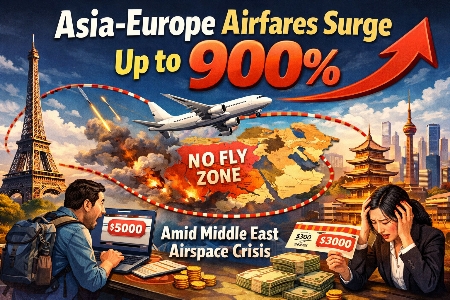
Airfares on key routes between Asia and Europe have skyrocketed by as much as 900%, with one-way tickets now fetching thousands of dollars, as travelers scramble for direct flights to dodge widespread closures of Middle Eastern transit hubs.
The crisis, now in its fourth day, stems from US-Israeli strikes on Iran on February 28 that triggered retaliatory attacks, shutting civilian airspace over Iran, Iraq, Israel, Kuwait, Qatar, Syria, and Bahrain.
Demand has flooded nonstop services from airlines like Singapore Airlines, Cathay Pacific, Thai Airways, and Air China, leaving economy seats sold out for days or weeks ahead.
Thailand’s Civil Aviation Authority (CAAT) reports international airfares to Europe have more than doubled on average, with some jumping over 100% overnight.
Trigger: Escalating conflict shuts major hubs
The surge began after US-Israeli military actions prompted Tehran to launch munitions at Gulf states, forcing immediate airspace shutdowns. Dubai International Airport (DXB), the world’s busiest hub handling over 1,000 daily flights, has slashed operations, while carriers like Emirates, Qatar Airways, and Etihad canceled thousands of services.
Travelers are avoiding connections altogether amid stranding fears, boosting direct Asia-Europe legs. Australia’s Flight Centre noted a 75% spike in emergency rebooking calls, with customers rerouting via Singapore, China, or even North American hubs like Houston.
Skyrocketing prices: Real-world examples
Ticket prices reflect the chaos, with dynamic pricing pushing fares to unprecedented levels:
Singapore Airlines: London-Singapore – ~HK$5,000 (~$640)
Cathay Pacific: Hong Kong-London – ~HK$5,000 (~$640)
Thai Airways: Bangkok-London – ~30,000 baht (~$900)
Qantas: Sydney-London – NA
Air China: Beijing-London (Business) – <50,000 baht return (~$1,500)
CAAT notes no authority to cap international fares, which follow market dynamics, and warns of further hikes if oil prices climb
Airlines adapt amid surge and costs
Asian carriers are capitalizing: Thai Airways reports fully booked Europe flights, minor 5-10 minute extensions via Turkmenistan/Afghanistan routes, and rising charter demand under dynamic pricing. Its CEO Chai Eamsiri said operations remain unaffected.
Cathay Pacific and Singapore Airlines benefit from robust nonstop networks, per Alton Aviation analysts. However, detours—north via Caucasus/Afghanistan or south through Egypt/Saudi Arabia/Oman—add 15-60 minutes, hiking fuel costs 3-8% per flight.
Association of Asia Pacific Airlines head Subhas Menon highlighted the toll: “The whole Middle East is out of bounds… airline profitability will be undermined.”
Outlook: Prolonged pain for travelers and industry
With hubs offline and seats scarce through mid-March, passengers face premium airfares or delays. Airports in Singapore, Bangkok, Kuala Lumpur, and Hong Kong risk network ripples if tensions drag on.
Jet fuel volatility tied to crude could amplify costs, potentially raising surcharges. CAAT has fielded no requests yet but urges monitoring.
As the conflict evolves, the global aviation web feels the strain, underscoring aviation’s vulnerability to regional flashpoints.
