



The tongue is a muscular organ that plays a vital role in speaking, swallowing, and tasting. It’s supported by the hyoid bone and connected to several key muscles, like the palatoglossus, palatopharyngeus, and hyoglossus, which help it move in complex ways.
The tongue is a muscular organ in the mouth essential for speaking, swallowing, and tasting. It is composed of intrinsic muscles that change its shape and extrinsic muscles that move the tongue in complex directions.
Parts of the tongue
- Tip: The most anterior, highly mobile part of the tongue.
- Body: The middle section of the tongue, with a rough dorsal (upper) surface and a smooth ventral (lower) surface.
- Base (Root): The posterior part of the tongue, anchored to the floor of the mouth and extending into the oropharynx.
The tongue is supported by the hyoid bone, a unique “floating” bone in the neck that is not connected to other bones but held in place by muscles and ligaments. Key muscles connected to the tongue include the palatoglossus, palatopharyngeus, and hyoglossus, which together facilitate various movements critical for functions such as speech and swallowing.
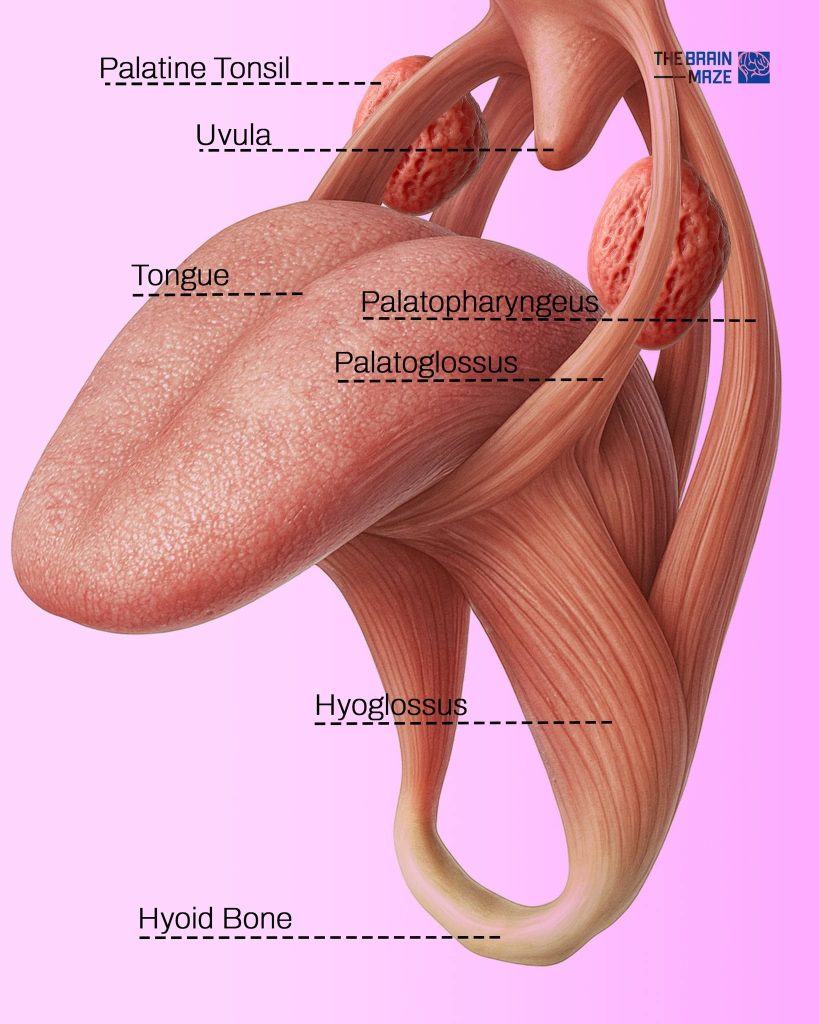
The tongue’s surface is covered by a mucous membrane with papillae containing taste buds that detect basic tastes like sweet, sour, salty, bitter, and umami. It plays a vital role during eating by manipulating food, mixing it with saliva, and forming a bolus for swallowing. Additionally, it is richly supplied with nerves that allow for taste sensation and coordination of movement.
Overall, the tongue is a highly versatile and flexible organ due to its complex muscular structure and neurological connections, supporting its multiple functions in communication and digestion.
Source: study.com
