


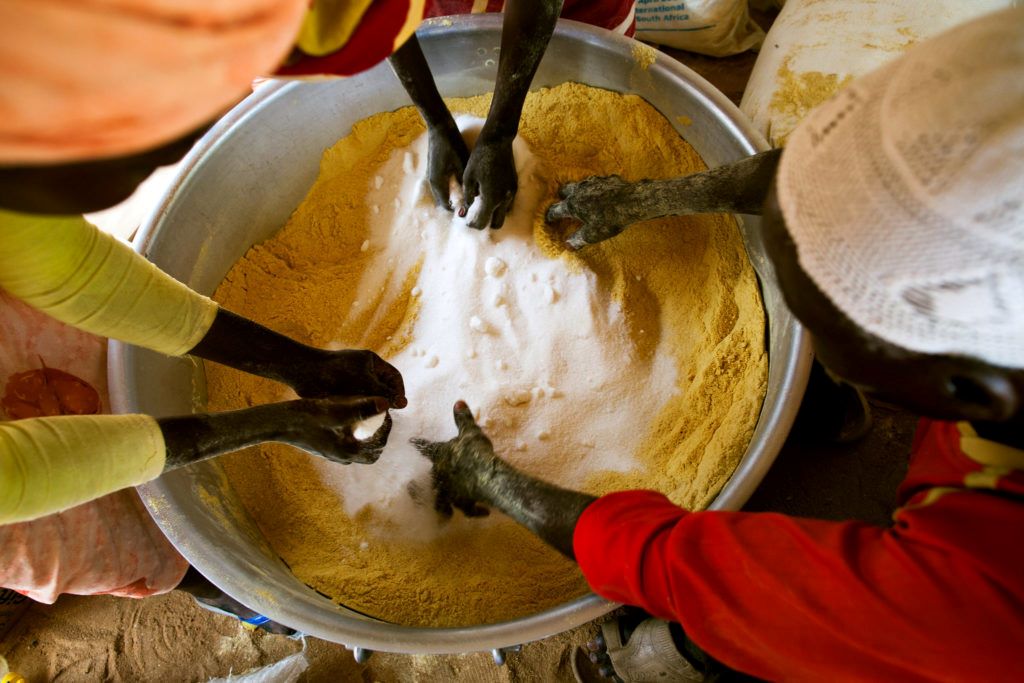
Better nutrition is crucial to breaking the cycle of poverty affecting millions of people across the world. As international development funding faces unprecedented strain, private sector partnerships are a key piece of the jigsaw to close the nutrition funding gap. With the right approach, we can leverage private sector resources and innovation for mutually beneficial partnerships that drive impact at scale.
By Shelley Pigott & Lucy Kanya
Access to good nutrition is essential for communities to thrive. It is deeply linked to global challenges such as poverty, climate change, gender inequality, education inequity, and food insecurity. When we address malnutrition, we save lives, strengthen economies, and break cycles of poverty.
Yet, nutrition remains the “orphan” sector of global health. It receives less than 1% of overseas development assistance, and progress in reducing stunting has plateaued due to a combination of factors including armed conflicts, climate shocks, the lasting impact of COVID-19, and rising living costs.
Recent cuts to development aid have also raised serious concerns about further backsliding, pushing more people into hunger and poverty. The numbers are stark: 733 million people face hunger globally, and nearly half of deaths among children under five are linked to malnutrition.
With official development assistance shrinking and governments facing growing fiscal pressure, it’s clear that traditional funding sources alone cannot close the $128 billion global nutrition financing gap. This is where the private sector must play a greater role.
Finding shared purpose
At this year’s Nutrition for Growth summit, we saw real commitment from private sector actors, some relatively new to the space, as part of the nearly $28 billion raised towards the Sustainable Development Goals.
While the private sector is not expected to replace traditional funding, its capital, innovation, and influence offer much-needed hope. We must seize this momentum.
But aligning efforts between the nutrition and private sectors isn’t always straightforward. Projects that appeal to businesses often differ from those prioritised by development actors. The private sector tends to be drawn to initiatives that align with profit margins, brand identity, or short-term impact goals.
In contrast, nutrition’s biggest challenges, such as reducing stunting, require long-term, systemic change and solutions that don’t deliver quick returns and directly attributable impact metrics.
Further complicating matters, the private sector is far from monolithic. Stakeholders range from food and beverage companies to agribusinesses, the healthcare sector, foundations, philanthropic organisations and high-net-worth individuals, each with their own motivations and priorities. Partnering effectively means understanding these differences and finding shared purpose.
Match-funding
The Power of Nutrition has spent a decade mobilising financing to address malnutrition in Africa and Asia. Through a catalytic match-funding model, we’ve leveraged $647 million in investments for 26 programmes, with 68% of funding coming from private sources. Partnerships with organisations like Unilever, Cargill, the PVH Foundation, and the Aliko Dangote Foundation have helped elevate the role of private capital in tackling global malnutrition.
While creativity and innovative thinking are key to developing tailored partnerships, we also recognise the importance of being targeted about who to engage with.
Not all private sector funding aligns with our mission, and we have a robust assessment process to ensure that any partner supports, rather than undermines, the long-term credibility and impact of our work. For example, we don’t work with companies that market breast milk substitutes, and we advocate for all partners to adhere to the International Code of Marketing of Breastmilk Substitutes.
One of our programmes in India, with partners including Cargill and Unilever, focuses on improving maternal and child nutrition. It promotes diet diversity during pregnancy, early initiation and continuation of breastfeeding, and timely complementary feeding with locally available foods. These partnerships go beyond funding as they support long-term behaviour change through community-based solutions.
Smart investing – not charity
To better understand what drives successful private sector engagement, we recently partnered with academics at the London School of Economics and Political Science (LSE) to evaluate how to make private sector engagement in nutrition financing more effective.
The evaluation identified key challenges – including difficulties in measuring impact and concerns about greenwashing – but also revealed valuable lessons. One thing was clear: economic arguments resonate best with the private sector.
Fortunately, we can prove that better nutrition boosts workforce productivity and human capital. In 95 low- and middle-income countries, childhood stunting costs the private sector at least $135.4 billion in sales annually. The same study found that every dollar spent in reducing stunting can yield up to $81 in economic returns.
In Bangladesh, The Power of Nutrition’s partnership with the government, apparel company PVH Corp, and civil society is delivering results for maternal and child nutrition, showing that investment can offer both immediate benefits and long-term gains.
The programme, running in 20 PVH Corp suppliers’ garment factories, includes the setup of new safe breastfeeding spaces and breaks, childcare provision, the distribution of multiple micronutrient supplements and paid maternity leave.
Based on the programme’s results, in line with their corporate and social responsibility targets, PVH Corp has now established a new partnership with The Power of Nutrition to work on a programme in India.
But a strong business case alone isn’t enough. The evaluation by leading academics from LSE highlighted that, to build lasting partnerships, we need to:
- Foster collaboration through a convening body, which helps to align incentives, pool resources, and facilitate joint action through tailored partnerships.
- Expand nutrition investment through innovative financing mechanisms, including private equity, venture capital, and non-traditional philanthropic sources.
- Ensure transparency and impact by aligning investments with corporate goals, backed by strong accountability frameworks and clear metrics.
We know this approach works. In Ethiopia, a multi-sectoral nutrition programme brought together government, private sector and community actors across climate, health, and education to strengthen nutrition outcomes. The result: holistic interventions that combine maternal care, growth monitoring, deworming, cooking demonstrations, and behaviour change communications.
This integrated model avoids the inefficiencies of isolated efforts. Now, instead of having to go back and forth to health facilities to access different services, a parent or caregiver can access information, services and support in an integrated way, either at the community level or in fewer visits to a health centre. To date, the programme has reached over 7.4 million women and provided vitamin A and deworming treatments to 1.2 million children.
The private sector brings capital, reach, and innovation. The development sector offers expertise, networks, and accountability. By aligning these strengths through co-investment and shared outcomes, we can shift the trajectory of global nutrition. This isn’t charity, it’s smart, long-term investing. Without a mindset shift, malnutrition will continue to steal futures and undermine prosperity for generations.
Shelley Pigott, Director of Strategic Engagement at The Power of Nutrition. Shelley has over 20 years’ experience developing multi-million-dollar partnerships with organisations such as UNICEF UK and Save the Children. She is a board member of Medair UK and advises on sustainable income growth.
Dr Lucy Kanya, Assistant Professorial Research Fellow at LSE Health (London School of Economics and Political Science), specialises in health economics and policy. She has led evaluations of health financing programs in sub-Saharan Africa and recently authored a study on The Power of Nutrition’s private sector engagement (2015–2025).
