


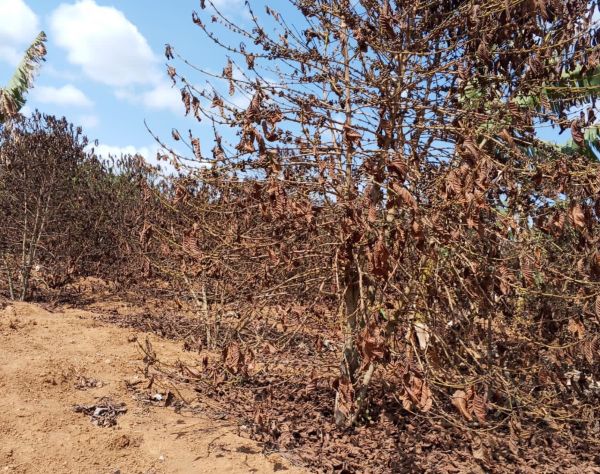
Uganda has assured farmers and traders, especially those dealing in coffee and cocoa, not to lose heart over crop-yield losses caused by the current widespread drought and subsequent downward fluctuations in global prices, describing the situation as temporary and likely to improve soon.
The Ministry of Agriculture, Animal Industry and Fisheries (MAAIF), while expressing sympathy for farmers and traders over the losses, assured them that the current price fluctuations should not be interpreted as a disappearance of demand for coffee or cocoa.
“It is largely a response to changing expectations in global supply and inventories. Coffee and cocoa are internationally traded commodities. Their prices in Uganda are, therefore, influenced not only by what happens on our farms, but also by production, inventories, weather, shipping, currencies, consumption and buying decisions in major producing and consuming countries,” according to the MAAIF Minister, Frank Tumwebaze.
He said in Kampala that the international market, particularly for coffee, had recently come under downward pressure because of increased availability from major producing countries, especially Brazil and Vietnam.
“It is true that international commodity markets, including coffee and cocoa, are experiencing a period of adjustment and volatility. The August–September 2026 market analysis reported by Barchart shows that coffee prices have been under pressure as Brazil’s harvest comes to market and Vietnam’s exports increase,” stated the minister, whose ministry oversees the country’s largest sector by the number of people involved in production, processing, marketing and exports.
Uganda is Africa’s largest coffee exporter by volume. For cocoa, Uganda is East Africa’s largest producer and exporter on the world market, with a significant export presence, particularly in Asia.
For the Robusta coffee variety, Uganda recently achieved a historic milestone. In the 2025/26 fiscal year, the country produced over eight million 60kg bags of coffee, generating a record $2.4 billion in export revenue. Production was dominated by Robusta, which accounted for 80 percent of volumes, while Arabica accounted for 20 percent.
This marked the highest export value ever recorded for Ugandan coffee, driven by elevated global prices, strategic pre-buying ahead of EUDR enforcement, and sustained productivity improvements across both the Arabica and Robusta segments.
For buyers, roasters and importers tracking the East African coffee landscape, Uganda is not merely Africa’s largest coffee exporter by volume; it is increasingly a powerhouse of value, quality and reliability.
Uganda’s coffee and cocoa export positions are bolstered by its strategic location and the country’s commitment to quality and value addition.
Uganda’s coffee-sector expansion is reinforcing export earnings and positioning the country as a key global supplier. However, the current drought, driven by the unpredictable effects of climate change, has been among the worst to hit the strong Robusta-producing regions of central and southern Uganda.
Prior to 2026, the country was Africa’s leading producer of Robusta coffee and a major Arabica supplier, supported by favourable climate conditions and ongoing sector reforms.
Uganda’s focus on quality improvements has strengthened its competitiveness, gaining recognition in premium segments where demand continues to expand, according to Uganda Coffee Exporter and African Leadership Magazine.
The agriculture minister explained that the International Coffee Organization (ICO) had also projected increased global coffee production, while United States Department of Agriculture (USDA) projections point to further growth in global production in the 2026/27 season.
“By 3 September 2026, Arabica coffee had fallen to a five-week low of about $3.03 per pound, while Robusta was around $3,426 per tonne. Our price analysts attributed the immediate pressure partly to increased Brazilian exports as that country’s harvest approached completion,” the agriculture minister added.
He, however, said this shows that the current price movement is not unique to Uganda.
“It is part of a wider international market adjustment. The same applies to cocoa. Cocoa prices have also experienced substantial fluctuations. Reuters reported on 3 September that London cocoa prices fell by 5.9 percent in one session after reaching a one-year high, while New York cocoa also declined by 5.9 percent.
“On 18 September, Barchart reported that December New York cocoa had fallen by about 7.1 percent in one day to a seven-week low, largely on expectations of increased near-term supplies. Côte d’Ivoire’s cocoa harvest for June 2025 to June 2026 had increased by 30 percent, while shipments in the current international cocoa marketing year were also substantially higher than in the previous year.”
These developments, Tumwebaze added, have contributed to the recent correction in international cocoa prices. The ministry has been closely monitoring both the international market and the domestic farm-gate market, comparing the same period this year with the corresponding period last year.
Uganda has experienced a prolonged period of drought and unusually high temperatures in several coffee-growing areas, including parts of Greater Masaka, Kyotera, Sembabule, Luwero and other regions. The resultant water stress has affected coffee flowering, cherry development, bean filling and, ultimately, processing output and quality, the minister admitted.
It is estimated that the adverse weather conditions have contributed to an output that is approximately 10 percent below the normal average in affected areas.
“The impact of this drought on coffee production at farm level has been felt at the national level. Uganda exported 846,376 bags of 60kg in July 2026, compared with 997,105 bags in July 2025, representing a decline of 15 percent in volume,” Tumwebaze said.
Export earnings also declined from $250.7 million to $204.1 million, a reduction of about 18.6 percent. Consequently, traders are becoming more cautious and selective in the prices they offer for different quality categories, the minister explained.
However, one of the largest cocoa farmers and a major cocoa-nursery operator in the eastern region of the country, Mr Nandala Mukoota, criticised the Ugandan government for what he described as persistently low state investment in agriculture, which he said had contributed to poverty and the country’s poor performance on development indices.
“Where is state investment in irrigation for coffee and cocoa?” he asked, saying farmers did not want statements and explanations, as serious investments would speak for themselves in times like these, marked by prolonged drought caused by climate change.
“A country like Vietnam visited Uganda in 1996 to benchmark coffee growing and, when it went back, it massively reformed its agricultural sector, prioritising coffee for export. Today, the state invests over 60 percent of national budget allocations in coffee alone, and the country has risen to become the second-largest coffee producer and exporter in the world after Brazil,” Mukoota said.
He added that Vietnam also invests 45 percent of its national budgetary allocations in agriculture alone. Comparatively, he said, Uganda, which should by now be a world power in agriculture, invests only two percent in agriculture, despite the sector being the largest employer and a source of food and industrial raw materials.
“But we have no irrigation to talk about when a serious drought strikes,” Mukoota added.
He blamed the Ugandan state for prioritising sectors such as defence, where he said more than 20 percent of national budgetary allocations are directed.
“Agriculture needs a constant water supply for irrigating crops while they are in the field, during primary and tertiary processing, and thereafter. This can only be ensured through serious state investment,” he argued.
Mukoota added that a major indicator of the neglect of agriculture in Uganda was the importation of Tanzanian rice and other basic foodstuffs from elsewhere.
“All these are products we should be producing ourselves and exporting in large quantities to earn foreign exchange,” he said. “Instead, Tanzania, which used to import from Uganda, is now exporting to us. It is a great irony and very shameful.”
Regarding coffee and cocoa, Mukoota stressed that the crops require large amounts of water and become heat-stressed during prolonged droughts.
“That is why it is good agronomic practice to grow them under tree or banana shelters for shade,” he observed, adding that Vietnam, Ethiopia, Kenya and Tanzania had invested billions of dollars in agriculture and key crops such as coffee, and were reaping substantial returns.
“Vietnam, which I have visited, invests over $60 billion annually. According to TheGlobalEconomy, Vietnam’s investment in agriculture is significant, with $59.93 billion reported for 2025, an increase from $57.3 billion in 2024. However, specific investment figures for coffee are not provided in the available data,” he said.
The Ugandan government has assured farmers that they will not suffer significant losses as a result of the current drought.
“With this situation, the most important thing to note is that our farmers are not close to making losses. A decline in price is not the same thing as making a loss.
“Profitability depends on the farmer’s production costs, productivity per acre, quality, post-harvest handling and the form in which the coffee is sold. Farmers affected by severe drought may, however, experience considerable financial loss,” the agriculture minister argued.
Farmers and coffee industry players should not lose courage, he added. The resilience of Uganda’s coffee industry still makes coffee production and associated value-chain activities lucrative and profitable.
The sector has also continued to attract international demand because of the quality and distinctiveness of Ugandan Robusta and Arabica. Uganda now has a national coffee brand that markets the country globally, the minister said.
Over the next six months, the same forces are expected to determine coffee and cocoa prices. Brazil’s coffee harvest and Vietnam’s Robusta exports will remain major influences on the international Robusta market. If global supplies continue to increase, prices may remain under pressure.
Conversely, weather disruptions or lower-than-expected production could quickly tighten the market. Coffee and cocoa remain extremely sensitive to weather conditions. Brazil, Vietnam, West Africa and other major producing regions will, therefore, continue to influence international prices.
For Uganda, the priority is to restore and protect production following the recent drought.
The return of adequate rainfall, combined with good agronomic practices, should help improve flowering, cherry development and the quality of subsequent harvests. Global coffee consumption remains substantial, while cocoa processors and chocolate manufacturers continue to require reliable supplies.
The present cocoa correction is partly being driven by improved supply expectations and higher inventories, but weather and production risks remain.
