


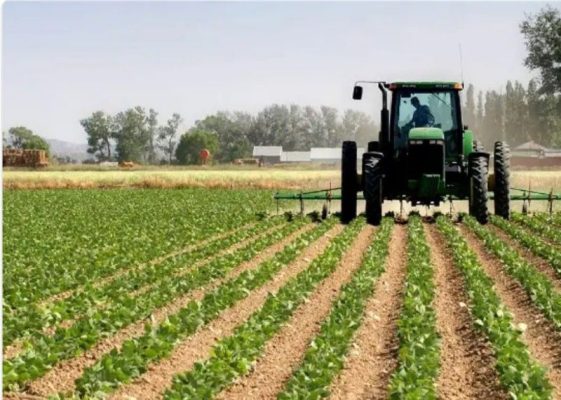
The Federal Government says it is strengthening agricultural financing, mechanisation and commodity purchasing to protect farmers from market uncertainty and support sustainable food production.
Minister of Agriculture and Food Security Sen. Abubakar Kyari made the announcement on Thursday in Enugu at the 48th Regular Meeting of the National Council on Agriculture and Food Security.
He said food price fluctuations had created difficulties for farmers and consumers. High production costs, combined with falling commodity prices, had left many farmers struggling to recover their investments.
Kyari said the government had strengthened the National Agricultural Development Fund, prioritised the recapitalisation of the Bank of Agriculture and introduced the N200 billion Guaranteed Minimum Price Programme to address these challenges.
He said the National Agricultural Development Fund had reached more than 115,000 beneficiaries across 25 states and the Federal Capital Territory, disbursing N16.27 billion in agribusiness financing.
He added that the Bank of Agriculture had financed more than 500,000 smallholder farmers.
Kyari also announced that the second phase of the Renewed Hope National Agricultural Mechanisation Programme would provide an additional 1,500 tractors and more than 8,000 pieces of complementary equipment to improve farmers’ access to modern machinery.
He stressed that, alongside increasing production, Nigeria must strengthen links between farmers and industry through reliable commodity supplies, processing and market access.
Kyari said agriculture contributed 26.15 per cent of Nigeria’s real gross domestic product in the second quarter of 2026. He urged state governments to improve agricultural production forecasts and align supply with industrial demand ahead of the 2027 farming season.
Enugu State Governor Dr Peter Mbah said his administration was transforming the agricultural sector through investments in mechanisation, farm estates, agro-industrial facilities and market access.
Mbah said more than 60,000 farmers had benefited from the state’s agricultural support programmes, while 107 tractors had been assembled through a partnership with Nortra Tractors.
He added that the state had registered more than 84,000 farmers through a digital registry and was developing 260 farm estates—one in each ward—supported by an agricultural land bank of about 187,000 hectares.
Mbah also highlighted the revival and expansion of key agro-industrial assets, including Enugu United Palm Products. He said its plantation had been expanded to 6,917 hectares, creating more than 3,500 jobs.
The governor said Enugu Songhai Farms was being developed with Tribu Limited as a 10,000-hectare agro-industrial hub.
He added that the state was reviving Sunrise Flour Mills and developing an Integrated Livestock Development Centre in Ubahu, with a proposed capacity of 15,000 to 20,000 cattle.
Mbah called for stronger collaboration among federal and state governments, development partners and private investors. He said Enugu was open to agribusiness and ready to work with stakeholders to unlock the sector’s economic potential.
