


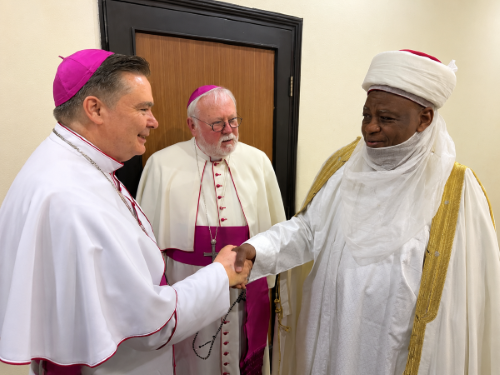
Sultan Muhammad Sa’ad Abubakar, also the President-General of the Nigerian Supreme Council for Islamic Affairs (NSCIA), and the Holy See’s Secretary for Relations with States and International Organisations, Paul Richard Gallagher, have called for deeper collaboration between Muslim and Christian leaders to promote peace, tackle hate speech and fake news, and reinforce moral values across Nigeria.
The appeal was made on Monday during a meeting at the National Mosque, where the Sultan hosted Archbishop Gallagher and a Papal delegation comprising Vatican officials and leaders of the Catholic Church in Nigeria.
According to a statement issued by the Deputy Secretary-General of the Nigerian Supreme Council for Islamic Affairs, Salisu Shehu, the visit was designed to strengthen mutual understanding and enhance cooperation between the two faith communities in promoting peace, security and peaceful coexistence in Nigeria and beyond.
Speaking during the engagement, the Sultan praised the Catholic Church in Nigeria for its sustained commitment to interfaith dialogue, describing the relationship between Muslims and Christians as essential to national unity, stability and development.
ALSO READ Sultan leads as northern rulers, Islamic scholars meet for peace talks in Kaduna
Archbishop Gallagher described the discussions as productive and expressed optimism about the future of interfaith relations in Nigeria, noting that both religious traditions shared common perspectives on the responsibility of faith leaders to work for the benefit of society.
“The visit has been very, very good. I was delighted to be invited by His Eminence, the Sultan,” Gallagher said.
“We had a very frank and illuminating conversation, and it was good to hear that many of our positions regarding the role of religious leaders, both on the Catholic side and the Muslim side, coincide.
“For me, this is a reason for optimism regarding the religious cohesion of the country and our shared commitment to working for the good of all Nigerians.
“There is a common view and a common conviction that Christians and Muslims, particularly their leaders, must work together for the common good of all Nigerians.”
Professor Shehu said the meeting examined a range of issues affecting peaceful coexistence, including hate speech, fake news, declining moral standards and the growing rejection of religion among young people.
He noted that participants identified hate speech as one of the greatest threats to harmony among religious communities, warning that inflammatory rhetoric had deepened mistrust and weakened relationships across faith lines.
“They strongly emphasised the need for all religious and faith communities to work together to combat hate speech, especially the growing trend of publicly insulting respected religious leaders,” Shehu said.
The participants also urged Nigerians to embrace mutual respect irrespective of religious belief or social status as a foundation for national unity.
On misinformation, the religious leaders warned that fake news had become a dangerous instrument capable of provoking violence and undermining peace, stressing the need for coordinated efforts to curb its spread.
They further expressed concern over what they described as rising moral degeneration globally, calling on religious leaders to intensify efforts to promote ethical conduct, responsible behaviour and shared values within their communities.
The meeting also highlighted concerns over the increasing disengagement of young people from religion in both Muslim and Christian communities, with participants urging greater engagement to strengthen faith and moral guidance.
Both sides reaffirmed their commitment to strengthening interfaith relations and sustaining cooperation between the NSCIA and the Catholic Church in advancing peace, unity and social harmony in Nigeria.
