


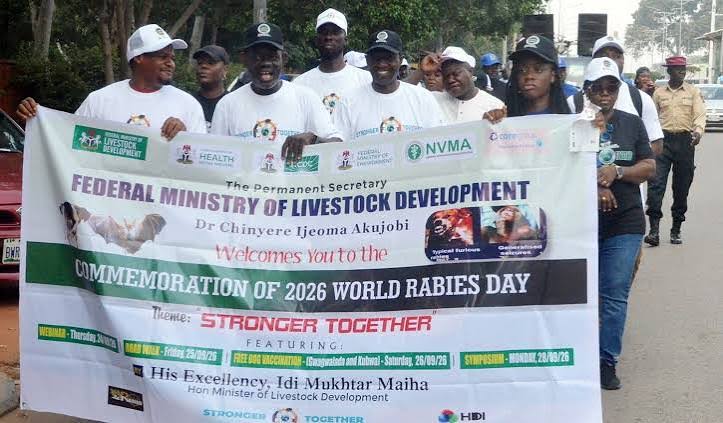
Stakeholders in the livestock, environment and health sectors have renewed their commitment to ending rabies by 2030 through sustained public awareness, animal vaccination and improved access to post-exposure treatment.
They made the pledge at a symposium in Abuja to mark the 2026 World Rabies Day.
The stakeholders included the CORE Group Partners Project, the Nigerian Veterinary Medical Association (NVMA), the World Health Organisation (WHO) and the War Against Rabies Foundation, among others.
Dr Lami Samaila, Secretariat Director of the CORE Group Partners Project, said sustained awareness, responsible animal ownership, timely reporting and surveillance were critical to preventing rabies.
She said effective management of animal bites and access to life-saving post-exposure prophylaxis required collaboration between the human and animal health sectors.
“Our approach recognises that there is an important connection between human and animal health.
“If we want to do everything regarding proper management of animal bites and giving life-saving post-exposure prophylaxis, no sector can do it alone,” she said.
She added that the project would continue to support the government and partners in strengthening community awareness, addressing misconceptions and promoting preventive measures.
Dr Chinnaemeka Joe-Iruobe, Chairperson of the FCT Chapter of the NVMA, called on the Federal Ministry of Health and Social Welfare to ensure the availability of human rabies vaccines.
Joe-Iruobe also urged stronger collaboration with the Ministry of Environment to tackle the presence of stray dogs in communities.
She cited a recent report of 10 people bitten by a rabid dog in Kano, saying the incident underscored the need for stronger inter-sectoral action.
“Do not leave the fight against rabies to the animal health sector alone because we cannot do it alone.
“It affects you and us. So, let us come together and play our part to eradicate rabies by 2030,” she said.
Earlier, Dr Alexander Chimbaru, Deputy Country Representative of WHO, speaking on behalf of Dr Pavel Ursu, WHO Representative in Nigeria, said children aged five to 14 were among those most affected.
He noted that about 40 per cent of rabies cases globally affected children, stressing the need for greater awareness and better protection of children.
Chimbaru said rabies imposed a global economic burden estimated at $8.6 billion annually through healthcare costs, psychosocial effects and lost productivity.
He called for greater awareness of dog vaccination, early treatment and responsible dog ownership, as well as improved access to post-exposure prophylaxis.
“The dogs belong to the communities. The children are suffering in the communities.
“So what is critical is to raise awareness about dog vaccination, early treatment, how to manage our dogs, as well as availability of post-exposure prophylaxis across the country and globally,” he said.
