


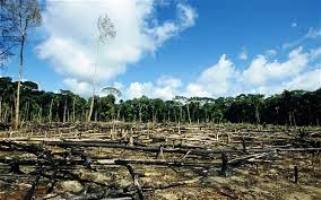
A professor of wood protection and utilisation at the Federal University of Technology, Akure (FUTA), Jacob Owoyemi, has called for sustained advocacy to promote sustainable forest management and curb deforestation. He also advocated the use of technology to assess termite risks in the construction industry.
Owoyemi made the recommendations while delivering the university’s 210th inaugural lecture on 10 October 2026.
He emphasised that sustained advocacy and public awareness were essential to addressing the clear and present danger that deforestation poses to the ecosystem.
He urged forestry institutions and wood-processing industries to adopt an integrated, circular bioeconomic approach that ensures harvested trees are systematically replaced through reforestation and wood residues are converted into value-added products to minimise waste and improve resource efficiency.
In his lecture, titled “A Conundrum of Live and Let Live: Wood’s Unending Struggle for Survival”, Owoyemi explained that “wood” and “timber” are often used interchangeably, although they have different technical meanings in forestry, materials science and the construction industry.
He recommended the development of comprehensive termite severity and probability maps for every state of the federation and, ultimately, the entire country, using modern geographic information system (GIS) technologies. He said the maps would help professionals and homeowners assess termite risks and adopt appropriate preventive measures before construction.
Owoyemi also emphasised the importance of wood preservation, noting that continuous sensitisation would encourage individuals, industries and other stakeholders to adopt appropriate wood treatment, handling and storage practices.
He called on the federal government and other levels of government to strengthen and enforce forestry laws and institutional frameworks for sustainable forest management. He said existing laws and regulations should be reviewed to address current challenges, particularly illegal timber harvesting, excessive waste, poor recovery rates and revenue losses.
Discussing the importance of wood, Owoyemi identified several agents that threaten its durability and effective utilisation. He explained that these agents affect its strength, appearance and durability, shorten its service life and cause significant economic losses worldwide. He grouped the threats into three broad categories: human activities, biotic factors and abiotic factors.
He identified three main sources of wood: natural forests, artificial or plantation forests, and trees outside forests.
Highlighting its usefulness and economic importance, Owoyemi described wood as one of the most versatile and valuable natural resources, with wide-ranging applications across various sectors. In construction, he said, wood is used for roofing, flooring, doors, windows, bridges and other structural components, as well as furniture.
He added that wood serves as an important raw material for producing paper, cardboard, plywood, wooden panels and various household items. Beyond construction, it is used to manufacture musical instruments, sports equipment, decorative materials and agricultural tools.
Owoyemi described wood as one of the earliest materials known to humankind, noting that it remains widely used because of its abundance and availability.
Introducing the lecturer, the Vice-Chancellor, Professor Adenike Oladiji, described the inaugural lecture as particularly relevant to contemporary society, given the growing importance of wood as a valuable natural resource and its wide-ranging applications.
She described Owoyemi as a practical and erudite scholar whose work adds value to his field, and expressed confidence that the lecture would contribute significantly to addressing the challenges associated with wood preservation.
