


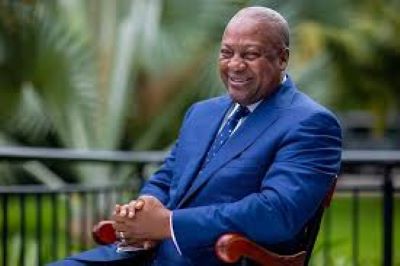
Ghana’s President John Dramani Mahama has placed agriculture and agro-processing at the heart of the government’s 24-hour economy policy, presenting continuous production and industrial value addition as the pathway to jobs, exports and long-term economic resilience.
Delivering the keynote address at the Ghana Tree Crops Investment Summit and Exhibition (GTCIS) 2026 in Accra on Tuesday, Mahama said Ghana must transition from a raw commodity exporter into a processing-led economy powered by round-the-clock activity across agricultural value chains.
The summit is being held under the theme Sustainable Growth Through Investment in Tree Crops: Resetting and Building Ghana’s Green Economy, with organisers expecting more than 6,000 participants, including institutional investors, development finance institutions, agro-industrial operators, policymakers and trade partners from across Africa and beyond.
The event is designed to mobilise investment partnerships capable of expanding processing capacity, improving producer incomes and reducing reliance on raw exports.
Mahama told delegates the summit marked a strategic turning point for Ghana’s economic transformation.
‘This summit is not merely ceremonial. It is strategic,’ he said, linking the gathering directly to the government’s economic reset agenda.
He explained that the 24-hour economy would create a system in which farming, logistics, processing and exports operate continuously to maximise productivity and employment.
‘Government is committed to building a 24-hour economy — a system in which production, processing, logistics and exports operate round the clock to create jobs and maximise productivity,’ the president said.
Tree crops, he argued, provide the strongest foundation for implementing the policy because they sustain year-round economic activity from cultivation through manufacturing and export.
The Tree Crops Development Authority (TCDA) intends to use the summit’s large attendance to secure financing commitments needed to develop six priority crops — cashew, coconut, oil palm, rubber, mango and shea.
Andy Osei Okrah, Director-General of the TCDA, described the initiative as a platform for long-term industrial partnerships.
‘The perennial crops sector of Ghana represents one of our most promising opportunities for inclusive economic growth and industrial transformation,’ he said. ‘GTCIS 2026 is not simply a conference: it is a platform to demonstrate our investment readiness, forge lasting partnerships and build a globally competitive value chain.’
In August 2025, the TCDA projected that each value chain could generate up to $2bn in annual export revenue by 2030 if investment mobilisation and processing expansion are achieved.
The scale of ambition contrasts with current performance. Ghana’s cashew exports generated $237 million in 2024, according to Ghana Statistical Service data, highlighting the gap between raw exports and potential industrial earnings.
Mahama used his address to argue that recent volatility in global cocoa markets demonstrates the risks of dependence on raw commodity exports.
‘We should not take pride in being the leading exporter of raw cocoa beans,’ he said. ‘We must take pride in exporting manufactured cocoa products.’
He announced reforms to Ghana’s cocoa financing structure aimed at raising funds locally, ensuring prompt payment to farmers and allocating more cocoa beans to domestic processors to expand industrial capacity.
The president added that Ghana would no longer export raw cashew, shea or unprocessed rubber while importing finished goods at higher prices, setting a national target of 50 to 60 percent local processing annually supported by agro-industrial parks and private-sector incentives.
In a personal reflection, Mahama described himself as the son of a farmer and an active cocoa and oil palm producer, saying firsthand experience helps policymakers understand agricultural realities.
‘I want to empathise with farmers so that when we take policy decisions, we know the effect on them,’ he said, noting that input costs and fertiliser prices directly affect production decisions.
He encouraged public officials and traditional leaders to invest in agriculture and help address land access challenges that continue to slow tree crop expansion.
Mahama framed tree crops as central to Ghana’s green economy strategy, citing their role in carbon sequestration, biodiversity protection and climate resilience.
He also relaunched the $200 million World Bank-supported Ghana Tree Crop Diversification Project, which will distribute millions of seedlings to more than 30,000 farmers while supporting small and medium enterprises through matching grants.
Policy momentum has expanded across several crops. Authorities recently announced plans to double coconut cultivation to 180,000 hectares by 2028, while a new shea processing hub in Wa aims to attract investment into cosmetics, food processing and pharmaceutical industries.
Under the National Integrated Oil Palm Development Policy for 2026–2032, government plans a $500 million financing facility to support private-sector investment and achieve oil palm self-sufficiency.
Despite these initiatives, industry stakeholders warn that structural constraints remain. The Rubber Processors Association estimates Ghana loses more than $100 million annually due to low processing capacity and weak industrial incentives.
Mahama said the 24-hour economy ultimately represents a shift toward production-driven growth built on value addition and inclusive participation.
‘The resetting agenda is about production, jobs, exports, value addition and inclusive growth,’ he said, urging investors and partners to support Ghana’s transition ‘from raw exports to industrial processing, from vulnerability to resilience.’
