


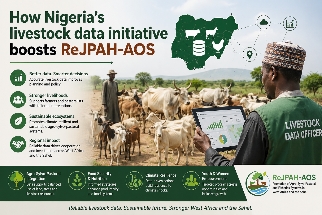
Nigeria has taken a significant step toward modernising its livestock sector with plans to establish a centralized National Livestock Information Management System (NLIMS), an initiative that could reshape decision-making across the country’s livestock value chain while advancing regional efforts to build resilient agro-sylvo-pastoral systems.
The Federal Ministry of Livestock Development recently validated the new digital platform, which is designed to serve as a single repository for livestock data nationwide. The system will support evidence-based policymaking, improve coordination among institutions, strengthen programme monitoring, and provide reliable information for investors and development partners.
For Nigeria, where livestock contributes significantly to rural livelihoods and food security, the absence of reliable and harmonised data has long limited effective planning. Policymakers have often relied on fragmented statistics, making it difficult to accurately assess livestock populations, disease trends, grazing resources, market opportunities and investment needs.
ALSO READ ReJPAH-AOS, media, farmers meet in Senegal to boost family farming visibility
According to the Permanent Secretary of the Federal Ministry of Livestock Development, Dr. Chinyere Ijeoma Akujobi, the NLIMS is intended to address these challenges by creating an integrated platform for collecting, managing, analysing and reporting livestock information. She described the initiative as a strategic institutional tool that will support better governance and guide investments across the livestock ecosystem.
Beyond improving Nigeria’s domestic livestock management, the initiative resonates strongly with the objectives of the Promotion of Agro-Sylvo-Pastoral and Fisheries Systems in West Africa and the Sahel (ReJPAH-AOS). The regional programme promotes sustainable management of agriculture, livestock, forestry and fisheries while encouraging data-driven governance, climate resilience and inclusive economic growth.
Reliable livestock data are essential to achieving these objectives. Accurate information enables governments to monitor animal health, improve disease surveillance, plan grazing corridors, strengthen pastoral mobility, reduce farmer-herder conflicts and support sustainable natural resource management. It also helps authorities respond more effectively to climate-related challenges affecting pastoral communities.
The digital platform is expected to improve transparency within the livestock value chain by providing dependable information for producers, processors, financial institutions and investors. Better access to credible data can reduce investment risks, encourage private sector participation and support the development of competitive livestock markets.
For pastoralists and livestock farmers, the benefits could extend beyond government planning. Improved data systems can enhance access to extension services, veterinary interventions, breeding programmes and financial services, while enabling quicker responses to disease outbreaks and other emergencies.
The initiative also has regional significance. Livestock production and pastoral movements frequently cross national borders within West Africa and the Sahel. Harmonised and reliable data can strengthen cross-border cooperation, facilitate livestock trade and support coordinated responses to transboundary animal diseases, all of which are central to ReJPAH-AOS.
As Nigeria continues to invest in modernising its livestock sector, the successful implementation of the National Livestock Information Management System could become a foundation for more sustainable, inclusive and climate-resilient agro-sylvo-pastoral development, contributing not only to national food security but also to broader regional efforts aimed at transforming agriculture and improving rural livelihoods across West Africa and the Sahel.
Abdallah el-Kurebe is Nigeria Country Coordinator for West African Journalists Association for Cross-Border Trade in Agro-Forestry-Pastoral and Fisheries Products
