


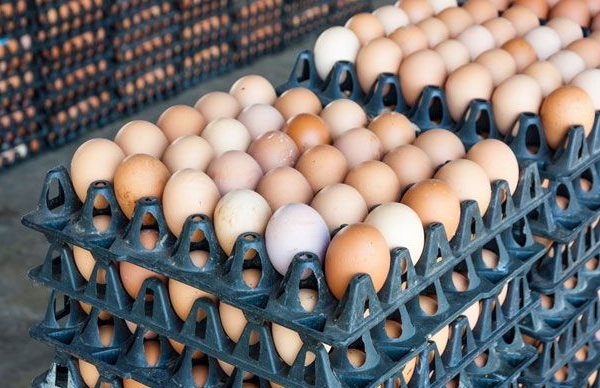
The Egg Sellers and Distributors Association of Nigeria (ESDAN) has refuted claims by some poultry farmers that its sellers are responsible for the consistent increase in egg prices.
ESDAN President, Mrs. Olaide Graham, made this known in an interview on Saturday in Lagos, describing the allegations as false and misleading.
Graham explained that the association’s core mission is to make eggs affordable and accessible to the average Nigerian, not to inflate prices.
“We currently sell a crate of eggs for as low as ₦5,500. No other source of protein—be it fish or meat—offers 30 pieces for that amount. Eggs remain the cheapest form of protein, and we all need protein to survive,” she said.
“Eggs are still available for everyone despite the price increment. That’s why we describe the accusation by poultry farmers as a blatant lie. Distributors should not be blamed for the increase in egg prices.”
Background: Rising egg prices across Nigeria
ASHENEWS reports that in recent months, egg prices in Nigeria have surged to record levels, driven primarily by escalating costs of poultry feed, supply-chain disruptions, and outbreaks of avian influenza.
Feed ingredients such as maize and soybean—key components of poultry nutrition—have become prohibitively expensive for many small farmers, squeezing margins and reducing output.
Farmers have also cited challenges such as limited access to credit, high transportation and energy costs, and insecurity in some farming regions. As a result, egg supply has declined in several markets, pushing crate prices into the ₦5,500 to ₦7,000 range, depending on location and demand.
Although some reductions in feed prices have been reported, these decreases have not always reflected at the consumer level, raising concerns that intermediaries or structural inefficiencies might also be influencing market prices.
‘The mighty egg’ campaign and industry collaboration
Graham said the association marked this year’s World Egg Day by donating items to widows, the elderly, and the less privileged, in line with the theme, “The Mighty Egg”, which highlights the nutritional importance of eggs.
She also disclosed that ESDAN had made efforts to collaborate with the Poultry Association of Nigeria (PAN) to stabilise prices, but such efforts were unsuccessful.
“We came on board to synergise with the Poultry Association of Nigeria, but they refused. The poultry farmers want to produce and sell at the same time. In this country, we have freedom of association, and many people sell eggs who are not members of our organisation,” Graham said.
“We wanted to work together so that once there’s an agreement, we can easily identify where the problem lies. But the farmers seem to enjoy the monopoly and perhaps that’s why they’re accusing us.”
Middlemen ‘critical to the egg market’
She further argued that eliminating middlemen in the poultry value chain would be detrimental to the sector.
“We heard they want to eradicate middlemen. But these are the people driving the egg market. Farmers collect money before selling to us, and we often sell on credit to retailers,” she explained.
“We’re the ones at the losing end because eggs are perishable. Sometimes we have to sell quickly to avoid losses. We also know the market dynamics better than the farmers, yet they talk of eradicating middlemen. Without us, many farmers might have to abandon the business.”
Poultry farmers, however, have maintained that the price hikes are caused by what they describe as the “greed of middlemen” who exploit the market for profit.
