


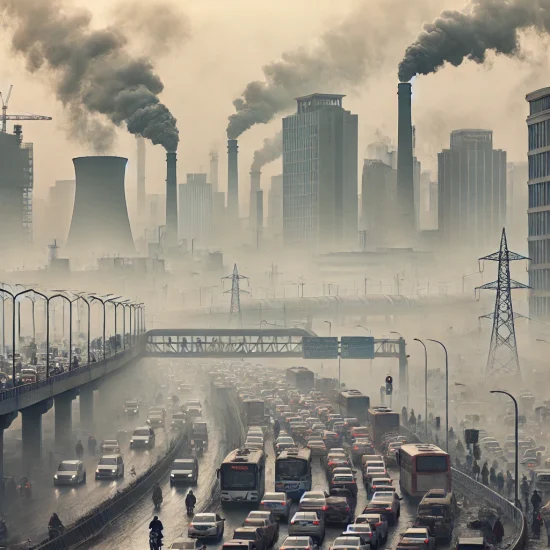
Every US$1 invested in tackling climate change and air pollution together could deliver about US$15 in economic benefits, a new United Nations report has found.
The report, released by the United Nations Environment Programme (UNEP) and the Climate and Clean Air Coalition (CCAC), makes the case that spending on cleaner air and climate protection should not be seen simply as an environmental cost, but as an investment capable of generating significant economic and health returns.
Titled Hidden Assets: The Economic and Health Case for Climate and Clean Air Action, the report was released to mark the International Day of Clean Air for Blue Skies.
It is the first comprehensive global economic assessment of the benefits of tackling climate change and air pollution through coordinated action.
According to the assessment, putting 25 proven measures into practice could generate annual economic benefits equivalent to 2.8 per cent of global Gross Domestic Product (GDP) by 2035.
The gains could rise to 4.5 per cent of global GDP by 2050 and 11.4 per cent by 2100.
The benefits include reduced healthcare spending, higher worker productivity, fewer deaths and illnesses, reduced damage from climate change and improvements in people’s overall wellbeing.
Even without putting a monetary value on improved wellbeing and other non-market benefits, the report estimated that every US$1 invested could still generate about US$4 in returns.
Delay could cost $1.5 trillion every year
The UN warned that the world cannot afford to postpone action.
It estimated that every year of delay could cost more than US$1.5 trillion in lost economic benefits, equivalent to about 0.5 per cent of global GDP.
The report’s findings challenge the idea that governments must choose between economic growth and environmental protection.
UNEP Executive Director Inger Andersen said clean air should instead be viewed as an asset that supports economic and social development.
“For too long, we have treated climate action as a cost to be managed and air pollution as the unfortunate outcome of development,” Andersen said.
She said clean air was fundamental to development, health, food and energy security, as well as climate stability.
“Proven solutions already exist. What we lack is the decisive leadership from governments, financial institutions, and businesses to deliver them with the speed and coordination this crisis demands,” she added.
Millions of lives at risk
The economic argument comes against the backdrop of a major global health burden caused by air pollution.
The report estimated that human-caused outdoor air pollution, particularly exposure to PM2.5 and ozone, was linked to 6.4 million premature deaths worldwide in 2025.
Household air pollution accounted for another two million premature deaths, including about 300,000 children.
The health consequences extend beyond deaths.
Outdoor air pollution was associated with an estimated 5.5 million new cases of childhood asthma and two million new cases of dementia in 2025, as well as millions of cases of heart attack, pulmonary disease, diabetes, stroke and lung cancer.
These illnesses impose costs on families, health systems, employers and governments through medical expenses, lost working hours and reduced productivity.
What needs to change
The UN report examined 25 measures across six sectors: energy and fossil fuels, industry, transport, agriculture and food systems, residential cooking and heating, and waste management.
The recommendations include expanding renewable energy and energy efficiency, increasing access to clean cooking and heating, adopting stricter vehicle emission standards and expanding electric vehicle use.
Other measures include reducing gas flaring and venting, tackling methane leaks from oil and gas operations, improving livestock and manure management, using fertiliser more efficiently and adopting better rice cultivation practices.
The report also recommends alternatives to crop-residue burning, improved solid waste and wastewater management and phasing down hydrofluorocarbons (HFCs).
For many countries, particularly those still dealing with high levels of household and outdoor air pollution, the measures could deliver benefits beyond climate protection.
Cleaner air could prevent 144 million deaths
Full implementation of the 25 measures by 2050 could cumulatively prevent an estimated 144 million premature deaths associated with air pollution, including 96 million deaths linked to ambient air pollution alone.
The measures could also prevent hundreds of millions of cases of chronic disease.
The climate gains would be substantial.
The report estimates that immediate implementation could halve global carbon dioxide emissions by 2050, reduce methane emissions by 60 per cent and cut major air pollutants, including black carbon, sulphur dioxide and nitrogen oxides, by around 70 per cent.
It could also avoid approximately 0.34°C of global warming by 2050 and 1.4°C by 2100.
Governments urged to break down silos
Despite the availability of proven solutions, the report identified fragmented government decision-making, weak enforcement and poor coordination as major obstacles.
These institutional barriers could delay full implementation globally by almost eight years.
Simon Dietz, Co-Chair of the Assessment and Professor of Environmental Policy at the London School of Economics, said treating climate change and air pollution as separate problems meant governments were underestimating the potential gains from tackling both simultaneously.
“When we modelled them together, the returns were larger than each could show alone, because the same sources, sectors and policies so often drive both,” he said.
The report called for governments to integrate climate, air-quality, health and economic policies rather than treating them as separate areas of public policy.
It also urged stronger enforcement and better alignment of public and private financing.
According to the assessment, removing institutional barriers through fiscal incentives and effective regulation could accelerate the deployment of cleaner technologies and unlock up to US$10 trillion in additional health benefits by 2040.
The report said the economic benefits of cleaner air could outweigh the costs of implementation within a decade, making integrated climate and clean-air action not only an environmental necessity but also a potentially lucrative economic investment.
