


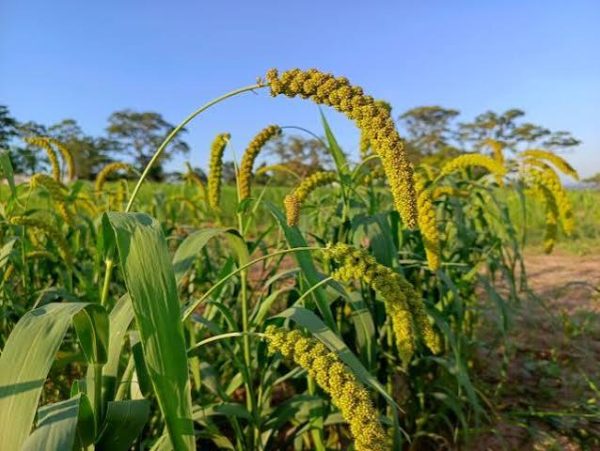
KAMPALA—Uganda’s National Agricultural Research Organization (NARO) has successfully innovated a climate change-resilient sorghum variety that withstands months of heat stress, up to 80 days [two months and twenty days], suitable for the permanently arid Karamoja region, where communities annually suffer acute food shortages and starve to death from hunger. early-maturing crop
This year alone, the Government of Uganda confirmed up to 16 deaths of Karimojong people that had occurred by July 2026, from hunger caused by an extraordinarily prolonged drought, according to the Permanent Secretary in the Office of the Prime Minister, Mr. Alex Kakooza, on July 9, 2026.
The OPM in Uganda is charged with managing disasters and human catastrophes like droughts. Mr. Kakooza recently revealed that crop failures and severe food shortages contributed to the deaths. The government, through OPM, recently dispatched 22 tons of emergency food. Thirteen (13 tons) of these were maize and 9 tons were beans to Kaabong District sub-counties of Loduku and Loyoru, and arranged more for Kotido, Amudat, Napak, Moroto” [districts of Karamoja region].
Now, the highly-acclaimed breeding of the NARO Sorghum 2 (NAROSORG2) variety for perpetually dry and annually-starved Karamoja was led by NARO’s northeast-located Nabuin Zonal Agricultural Research and Development Institute (NABUIN ZARDI) in Karamoja, and the National Semi-Arid Resources Research Institute (NaSARRI), located at Serere in Teso sub-region near Karamoja.
NARO scientists say the Drought-Tolerant (DT) NAROSORG2 can withstand extreme drought and still give you a good degree of yield. The scientists also say the new sorghum variety is early maturing: only ∼80 days from planting to maturity in Karamoja’s conditions – so you harvest before drought kills it, and that one can even plant twice, if rains allow. The third important trait is that this sorghum is bird-resistant, as birds don’t eat it, unlike local sorghum. Bird predation, especially on cereals, is a huge constraint in Karamoja: This excites farmers most.
“It offers a solution to the problem of predatory birds that often damage sorghum and other cereal crops in the region,” says American-trained food security specialist and Gulu University-cum-Director of Nabuin ZARDI, Dr. Walter Odongo, quoted by the Kampala-based NBS Television (NBSTV), as saying about the breakthrough breeding of the NAROSORG2 sorghum variety. It comes in handy when the region and most parts of Uganda are hit by a devastating drought precipitated by Climate Change.
And farmers say that while other vegetation dried up, NAROSORG2 stayed green. “When they thought it was gone during drought (many parts of Uganda have suffered 5-6 months of significant impacts of Climate Change-induced drought since March/April 2026), but it (NAROSORG2) has survived….. Yes – it’s real and happening right now in Kaabong [a district in Karamoja region]!” one of the scientists remarked.
It was tested on a 5-acre demonstration garden in Katile Sub-County in Kaabong District, where a farmers’ field day was held Sept 22-23, 2026. Also, 5-10-acre per parish demo gardens across the rest of five other Karamoja districts [Kotido, Moroto, Nakapiripirit, Nabilatuk, Amudat and Abim] have been established to provide farmers with the opportunity to see the breakthrough sorghum growing in the fields.
The media in Uganda has been abuzz with this breakthrough news from NARO. The private Nation Media Group (NMG)-owned Daily Monitor, a mostly political newspaper, heralded it thus: “New 80-Day Sorghum Variety Offers Hope for Karamoja’s Drought-Stricken Farmers.”
This was in addition to the state-run UBCTV and independent NBSTV stories that featured in their prime 10 and 9 p.m. news.
The Daily Monitor further stated that the new, drought-tolerant sorghum variety provides a crucial lifeline for farmers in the drought-prone Karamoja region. “Farmers in Uganda’s Karamoja region, currently facing severe food insecurity due to persistent drought, are finding a glimmer of hope in a newly developed sorghum variety. NARO has introduced NAROSORG2, a crop engineered to withstand harsh climatic conditions and mature in approximately 80 days, significantly faster than traditional varieties.”
The Monitor adds: “This is seen as a vital tool to combat the region’s increasing food insecurity, exacerbated by unpredictable weather patterns. NARO has established demonstration gardens across Karamoja’s six districts, allowing farmers to witness firsthand the resilience and yield potential of NAROSORG2 under local conditions.” These gardens serve as crucial learning sites where farmers can evaluate improved crop technologies and management practices.
The collaborative approach, involving local agricultural extension staff and farmer participation throughout the growing process, aims to ensure the effective adoption of this technology.
Local leaders, such as Kaabong District LCV Chairman Lotyang Albert Loris, have expressed optimism about the variety’s short maturity period, suggesting it could enable a second harvest season within a year.
This increased production potential could significantly improve household food security and income for the Karamoja people, who have been severely impacted by drought.
NARO is also supporting seed multiplication to ensure farmers have access to planting materials for this promising new variety.
For officials at NARO’s Uganda Climate-Smart Agriculture Transformation Project (UCSATP), their project goes beyond drought-tolerant crops, aiming to empower farmers with technologies that build resilience against climatic shocks.
There are positive feedbacks from farmers who noted superior performance of NAROSORG2 compared to traditional sorghum varieties, underscoring the potential of NAROSORG2 to transform agriculture in Karamoja.
Karamoja soils: the region has very fertile soil (30 cm-deep black soil, the deepest in Uganda) but short rains. An older variety, Sekedo sorghum, was developed at the National Semi-Arid Resources Research Institute (NaSARRI) at Serere for Karamoja, but NAROSORG2 is the new improved climate-smart version. NARO is now doing seed multiplication with Kaabong District extension staff so communities can multiply it themselves.
Local leaders lament that their people are suffering not because of laziness, but because of weather conditions and welcomed NAROSORG2!
Several commercial companies in Kampala have lately come up with drought-tolerant seeds of several crops given the current drought and the general climate or weather unpredictability. Among the traits companies are advertizing are mainly maize seed being early-maturing, drought-tolerant, and drying fast when harvested, among other attributes.
