


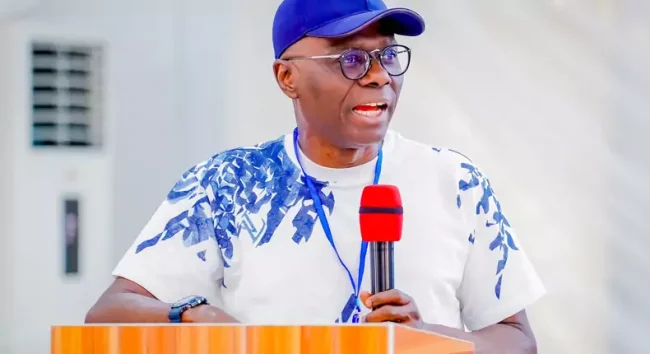
Governor Babajide Sanwo-Olu has said that the Lagos State Development Plan 2052 is more than just a state project. He described it as a national strategy that supports President Bola Tinubu’s goal of building a \$1 trillion economy by 2030 and making Nigeria a global power.
Speaking at the first 2025 Distinguished Lecture hosted by the Nigerian Institute of International Affairs (NIIA) in Lagos, Sanwo-Olu said Lagos has the vision and ability to help transform Nigeria into a major global economic and political force.
The lecture, titled “Lagos, Nigeria 2030: Projections of a World Power,” was the first in the NIIA’s new series to feature a current Lagos State governor.
Many important people attended the event, including diplomats, scholars, government officials, and civil society leaders. They came to discuss Nigeria’s future and global standing.
Sanwo-Olu explained that the 30-year Lagos development plan is based on four main goals: building a strong economy, developing modern infrastructure, creating a city focused on people, and ensuring good governance.
He said the aim is for Lagos to become Africa’s top mega city and a major global financial and economic center that is safe and productive.
He stressed that Lagos, being the business and innovation center of Nigeria, is in a strong position to help achieve President Tinubu’s economic plans.
Sanwo-Olu said that strong cooperation between the federal and state governments is needed to keep the country growing in a sustainable way.
He also noted that the Lagos plan aligns with earlier national plans like Vision 2010, Vision 20:2020, and Nigeria Agenda 2050, all aiming to move Nigeria into the group of global and middle-income economies.
According to the governor, Lagos’ plan matches the country’s goals and can serve as an example of effective leadership, innovation, and progress.
Sanwo-Olu restated Tinubu’s targets for 2030: grow Nigeria’s economy to \$1 trillion, stop gas flaring to support the climate, and generate at least one-third of electricity from renewable energy.
He said being a global power today is not just about military strength, but also about having economic influence, technology, diplomacy, and cultural reach.
The governor said that investment in technology, infrastructure, and skilled people will decide how far Nigeria can go globally. He added that the UN’s Sustainable Development Goals (SDGs) also offer a helpful guide for inclusive growth.
He pointed out that the year 2030 reminds us of the SDGs—17 goals aimed at building a fair, peaceful, and prosperous world for everyone.
Sanwo-Olu said that cities like Lagos must lead the way in creating and carrying out Nigeria’s transformation story. He also called for stronger teamwork between state and federal governments.
In his welcome speech, NIIA’s Director-General, Professor Eghosa Osaghae, said the lecture was historic because it was not only the first of the year but also the first time a sitting Lagos governor had given a talk at the institute.
Osaghae said that while there are a few global cities, Lagos is among the top. He pointed to its large population of over 22 million and its strong economy as proof.
He praised Lagos as a center of culture, business, and progress. He said: “There are five cities named Lagos in the world, but Nigeria’s Lagos leads in development and global potential.”
He also talked about how Lagos has led in areas like civil rights, legal reforms, and economic innovation, calling it a model for other cities and a hub of human progress.
Osaghae made a major announcement: Governor Sanwo-Olu has agreed to fund a new Foreign Policy School at the NIIA.
He happily shared that the school will be named after the governor, calling it the H.E. Babajide Sanwo-Olu School of International Affairs, and the audience responded with applause.
