


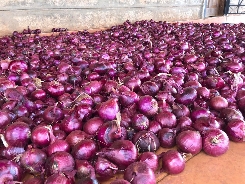
The Nigeria Customs Service (NCS) is developing a standardised export procedure for onions across designated land borders to reduce delays, limit losses and boost Nigeria’s share of the West African agricultural market.
The initiative targets an onion trade estimated at more than N200 billion and is expected to provide a uniform process for exporters, particularly those moving the highly perishable commodity through Nigeria’s land borders.
The Comptroller-General of Customs, Adewale Adeniyi, disclosed the plan through the Deputy Comptroller-General in charge of Enforcement, Inspection and Investigation, Timi Bomodi, at a meeting on the proposed Standard Operating Procedure for onion exports held at the NCS headquarters in Abuja on November 3.
The meeting followed a request by the President of the Regional Observatory of the Onion Sector in West and Central Africa, Aliyu Maitasamu Isah, for a harmonised procedure applicable across Nigeria’s land borders.
Bomodi said delays at border crossings could cause significant financial losses because onions are highly perishable and vulnerable to damage during transportation.
He said Customs’ priority was to facilitate legitimate trade rather than create obstacles for businesses, adding that the proposed framework would support the seamless movement of agricultural produce within Nigeria and across the West African sub-region.
The framework is expected to facilitate onion exports within the Economic Community of West African States (ECOWAS), where Nigerian onions qualify as originating goods because they are wholly produced locally.
According to Bomodi, Nigerian onion producers are among the largest suppliers in the sub-region, with Kebbi, Sokoto and Kano identified as major producing states. Their produce is exported to markets including Ghana and Mali.
He said Federal Ministry of Finance data put the value of the local and regional onion trade at more than N200 billion, describing the sector as a major opportunity for increased foreign exchange earnings and expanded commercial opportunities for farmers.
Bomodi said a stronger Nigerian presence in the West African onion market could also create opportunities for agricultural exports to other African countries, Europe and America.
However, he stressed that trade facilitation must be accompanied by proper documentation, standardisation and quality control to meet international requirements.
He said agricultural exports are subject to regulations covering the use of herbicides and pesticides, packaging and product sizing, adding that Customs works with agencies including Plant Quarantine and the National Agency for Food and Drug Administration and Control (NAFDAC) to ensure compliance.
Exporters are also required to obtain phytosanitary certificates confirming the plant health status of agricultural produce and compliance with applicable export regulations.
Isah called for additional strategic measures to ease onion exports and address challenges faced by traders at designated land borders.
He commended Customs for facilitating legitimate trade with neighbouring countries and for interventions aimed at curbing alleged harassment and extortion of traders at border points.
