


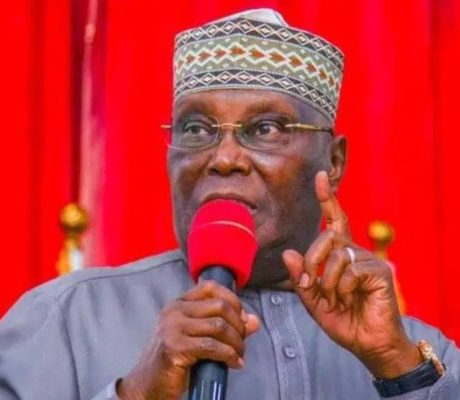
Former Vice President Atiku Abubakar has challenged President Bola Ahmed Tinubu to address questions surrounding a $460,000 forfeiture in the United States rather than focusing on the Washington-based lobbyist he hired.
Atiku’s position was contained in a statement issued by his Senior Special Assistant on Public Communication, Phrank Shaibu, in response to comments by the Special Adviser to the President on Media and Public Communications, Sunday Dare.
Dare had criticised Atiku’s engagement of Von Batten-Montague-York, a US lobbying firm, questioning the credibility and influence of its managing partner, Karl Von Batten, in relation to its activities concerning Nigeria.
However, Shaibu dismissed the criticism as an attempt by the Presidency to divert attention from what he described as existing US judicial records involving Tinubu.
He said Atiku’s $1.2 million engagement with the lobbying firm was publicly registered with the US Department of Justice under the Foreign Agents Registration Act (FARA), making the nature and financial details of the agreement subject to disclosure.
Shaibu challenged Tinubu to explain why his name appeared in historical US federal records relating to narcotics and money-laundering investigations, as well as a 1993 US court forfeiture involving $460,000 held in an account bearing his name.
He, however, acknowledged that civil forfeiture should not be equated with a criminal conviction, but argued that the existence of a court record could not be dismissed through political statements or attacks on the individuals raising questions about it.
“These are not documents written by Atiku Abubakar. They were not manufactured by Karl Von Batten. They form part of an American judicial record,” Shaibu said.
The former vice president’s camp also accused the Tinubu administration of applying double standards in its criticism of Atiku’s lobbying expenditure.
Shaibu alleged that the Federal Government had entered into a separate lobbying arrangement with DCI Group valued at $750,000 monthly, amounting to $4.5 million for six months, with contractual provisions that could raise the total value to $9 million.
He questioned why Atiku’s $1.2 million engagement should be portrayed as political desperation while a significantly larger government lobbying arrangement was being undertaken in Washington.
According to him, both the government and political actors are entitled to engage lobbyists, adding that the focus should be on transparency and accountability rather than personal attacks.
Shaibu further argued that the controversy over lobbying was distracting attention from issues affecting Nigerians, including rising food and transportation costs, electricity bills, declining purchasing power and insecurity.
He urged the Presidency to explain the records surrounding the forfeiture and account for its own alleged lobbying expenditure instead of attacking Atiku’s representative.
The renewed exchange comes as the political camps of Tinubu and Atiku intensify their preparations ahead of the 2027 general elections.
The Presidency has maintained that reports and statements emanating from the US lobbying firm should not be mistaken for the official position of the American government.
