


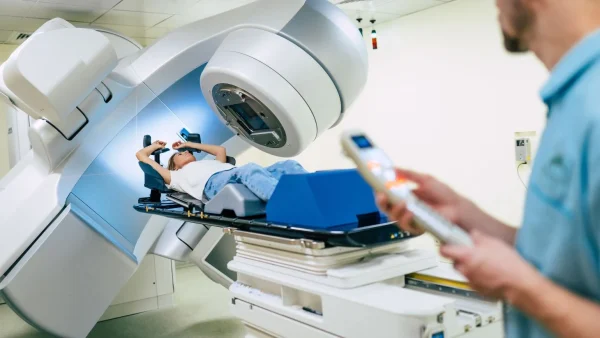
Cancer is one of the deadliest diseases the world has ever encountered.While exerting tremendous physical, emotional and financial strain on individuals, families, communities and health systems, cancer can shrink resources as it strikes the rich, poor, young, old and now even children.
According to World Health Organisation (WHO), cancer is a large group of diseases that can start in almost any organ or tissue of the body.
It develops when abnormal cells grow uncontrollably, go beyond their usual boundaries to invade adjoining parts of the body and/or spread to other organs.
The WHO also said that it is the second leading cause of death globally, accounting for an estimated 9.6 million deaths, or one in six deaths, in 2018.
ALSO READ: World Cancer Day: Tinubu calls for corporate awareness to prevent disease
There are different types of cancer but lung, prostate, colorectal, stomach and liver cancer are the most common types of cancer in men.
Breast, colorectal, lung, cervical and thyroid cancer are the most common among women.
To commemorate the World Cancer Day 2024, the organisation in a statement also said that in 2022, there were an estimated 20 million new cancer cases and 9.7 million deaths.
Financially, the estimated global economic cost of cancers from 2020 to 2050 is 25.2 trillion dollars, according to a 2023 joint study by Simiao Chen and other scholars published in JAMA Oncology.
Annually observed globally on February 4 from 2022 to 2024, the focus has been to help “Close the Cancer Gap” and for 2024 I has “Together, We Challenge Those In Power” as sub-theme.
This focuses on the global demand for leaders to prioritise and invest in cancer prevention and care, and to do more to achieve a just and cancer-free world.
According to WHO, about one in five people develop cancer in their lifetime, while approximately one in nine men and one in 12 women die from the disease.
In spite of the staggering statistics of death arising from cancer, the world body projects that over 35 million new cancer cases in 2050, a 77 per cent increase from the estimated 20 million cases recorded in 2022.
It added that in countries where health systems are strong, survival rates of many types of cancers are improving thanks to early detection, quality treatment and survivorship care.
The WHO said its global survey on Universal Health Coverage (UHC) and cancer shows that only 39 per cent of participating countries covered the basics of cancer management.
It featured as part of their financed core health services for all citizens, ‘Health Benefit Packages’ (HBP).
Bringing it home, it is estimated that over 124,000 new cases of cancer were recorded in Nigeria in 2020 which resulted in 78,899 deaths.
Stakeholders in healthcare, particularly in the cancer space, recommend early detection through routine screening as well as health insurance coverage.
Dr Zainab Bagudu, the wife of Kebbi governor and Co-Founder, Medicaid Cancer Foundation, said that the greatest burden with Low-Middle Income Countries (LMIC) like Nigeria when it comes to cancer control is awareness.
She explained that “awareness is really poor and people in rural areas do not know what to do when they have cancer.”
Bagudu whose organisation has carried out 59,273 screenings for breast, cervical and prostate cancers in the past 15 years, added that the low hanging fruit in cancer care was early detection.
“Early detection is key and it saves lives. So, with awareness, we can get a hold of that low hanging fruit and save lives easily by collaborating with civil society, scientists, government and the financial sector”, she said.
Another advocate for early detection and treatment is Ms Salomey Eferemo, Chief Executive Officer, Partnership for Eradication of Cancer in Africa (PECA).
Eferemo said measures to ensure early detection such as affordable testing should be put in place by the authorities.
She said that the rollout of Human Papilloma Virus (HPV) vaccine in 2023 was the best thing that happened to the cancer space and Nigerian women.
According to her, early detection is the secret and the cheapest means recommended by the WHO for LMICs such as Nigeria is the “Look and Treat Protocol”.
“They should make it routine in Nigeria. If a woman walks into a health center to test for HPV, they should check her for it, if she has been checked she should be given a certificate like COVID cetificate, stamped and dated.
“With this, we can have data to work with, have a registry to know who has and who does not and who needs to be escalated for treatment”, she said.
Similarly, the Nigeria National Petroleum Corporation Limited (NNPCL) Foundation collaborated with the Federal Ministry of Health and Social Welfare to carry out a two-day screening exercise free of charge.
This is part of its efforts to demonstrate the need for routine screening, especially for the three most common, breast and cervical cancer for women and prostrate for men,
The Managing Director of the Foundation, Mrs Emmanuella Arukwe, said considering that cancer is a very deadly disease, knowing ones status is very important as would aid in getting early treatment.
She said the foundation, which was the social initiative arm of the company, decided to embark on the project convinced that cancer is one of the scourges the Nigeria is suffering from.
“It is our pilot project and we will do other things.
“We know there is a healthcare gap in Nigeria and we are doing this as one of our projects to help bridge the gap,” she said.
One of the beneficiaries at the exercise, Madam Lilian Duke, said women should not shy away from carrying out the tests, otherwise they may die out of ignorance.
She said she decided to screen for cervical cancer to see if she was pre-disposed to having the disease.
“If you are shy you may die of a sickness that you would have had an opportunity of getting rid of.
“When such opportunities as this comes up people should be bold enough to come out to know their status”, she said.
While the private sector is doing its best to some stakeholders want the public sector to take the lead.
According to the President, Nigerian Cancer Society (NCS), Dr Adamu Umar, the Federal Government should incorporate comprehensive cancer services into National Health Insurance packages.
He said though there was some level of coverage for cancer under the National Health Insurance Act (NHIA), it is not holistic.
“There are some aspects of cancer that are covered under the insurance scheme. For example, the insurance coverage gives patients the ability to have one annual medical checkup.
“This is something that a lot of civil servants are not even aware of. Now, we are talking about prevention, we are talking about screening and these are all aspects of cancer care”, he said.
Umar said to address late diagnosis and treatment of cancer the federal government should implement routine screening programmes and integrate them into existing healthcare systems.
The Director-General, National Institute for Cancer Research and Treatment (NICRAT), Prof. Usman Aliyu, said thought Nigeria has done a lot to improve cancer treatment more needs to be done.
“We have made significant progress in raising awareness about the causes, symptoms, and prevention of cancer.
“By empowering individuals with knowledge, we aim to reduce the incidence of late-stage cancer diagnoses and improve early detection rates across Nigeria”, he said.
The N200 million earmarked for indigent cancer patients` treatment in the 2024 budget through Cancer Health Fund (CHF) demonstrates Federal Government’s commitment to reducing the cancer burden, says the Minister of State for Health, Dr Tunji Alausa.
He also said the federal government had put in N1.3 billion into the CHF in the last four years to enhance the treatment of indigent patients.
He, however, added that though the fund would not be enough to do what needed to be done to take care of Nigerians; the ministry was mobilising funds through a sector wide approach and involving private sector participation.
“The NHIA will ultimately manage funding for cancer care in the future, to avoid duplication of roles in terms of purchase of services for all patients.
“Recently, the operational guideline of the NHIA Act was launched to pave the way for full operationalisation of the Act, which also provides for funding for vulnerable Nigerians including cancer patients”, he said.
Stakeholders say although it is difficult to eradicate cancer, it is important that appropriate steps are taken to mitigate its impact on the society through routine screening.
By Folasade Akpan
NANFeatures
