


• Home
  • Agric
  • Sci & Tech
  • Health
  • Environment
  • Hausa News
  • More
    • Business/Banking & Finance
    • POLITICS
    • Entertainments & Sports
    • International
    • Investigation
    • Law & Human Rights
    • Africa
    • ACCOUNTABILITY/CORRUPTION
    • Hassan Gimba
    • Column
    • Prof. Jibrin Ibrahim
    • Prof. M.K. Othman
    • Defense/Security
    • Education
    • Energy/Electricity
    • Entertainment/Arts & Sports
    • Society and Lifestyle
    • Food & Agriculture
    • Health & Healthy Living
    • International News
    • Interviews
    • Investigation/Fact-Check
    • LAW & HUMAN RIGHTS
    • Oil & Gas/Mineral Resources
    • PRESS FREEDOM/JOURNALISM/PR
    • General News
    • Presidency
  • About Us
    • Contact Us
    • Board Of Advisory
    • Privacy Policy
    • Ethics Policy
    • Teamwork And Collaboration Policy
    • Fact-Checking Policy
    • Advertising
  • Media OutReach Newswire
    • Wire News
  • The Stories
Facebook Twitter Instagram
Trending
  • Naira strengthens to N1,360/$, strongest level since June
  • Telemedicine in Nigeria: Where the smart money should go next [III], by Dr. Fakunle Aremu
  • Kenya unveils strategy to place youth at centre of agrifood economy
  • CBN raises 364-day T-bill rate to 17.59% despite N4.4trn demand
  • SAPZ Kano launches quarterly feedback forum
  • GSMA launches circularity services for mobile operators
  • WHO: DRC Ebola outbreak second-largest on record
  • CAPRIGHTS-VP launches child rights ambassadors forum in Alimosho schools
Facebook Twitter Instagram YouTube
AsheNewsAsheNews
  • Home
  • Agric

    Kenya unveils strategy to place youth at centre of agrifood economy

    August 13, 2026

    SAPZ Kano launches quarterly feedback forum

    August 13, 2026

    JICA awards scholarships to 18 Nigerians

    August 13, 2026

    FG unveils national agricultural mechanisation policy

    August 13, 2026

    Lagos inaugurates Agege fresh food hub

    August 13, 2026
  • Sci & Tech

    GSMA launches circularity services for mobile operators

    August 13, 2026

    Digital literacy key to fighting youth unemployment in Kano – Experts

    August 12, 2026

    YIN urges investment in youth, digital skills for Nigeria’s economic growth

    August 12, 2026

    Alleged violations: Data Protection Commission probes UNILAG, 2 others

    August 12, 2026

    NIGCOMSAT: Continuous tech upgrades critical to Nigeria’s security

    August 11, 2026
  • Health

    Telemedicine in Nigeria: Where the smart money should go next [III], by Dr. Fakunle Aremu

    August 13, 2026

    WHO: DRC Ebola outbreak second-largest on record

    August 13, 2026

    CAPRIGHTS-VP launches child rights ambassadors forum in Alimosho schools

    August 13, 2026

    FG equips 239,726 youths with skills via NiYA

    August 13, 2026

    Mutfwang congratulates Plateau youths on int’l youth day

    August 12, 2026
  • Environment

    Wike orders closure of SFGH secretariat

    August 13, 2026

    Stakeholders call for investment in African youth

    August 13, 2026

    NGO trains Sokoto youths as peace, climate ambassadors

    August 12, 2026

    Nasarawa builds flyover at Keffi to curb deadly crashes

    August 11, 2026

    Lagos needs larger infrastructure budget – Hamzat

    August 10, 2026
  • Hausa News

    UNA signs MoU to launch air Bissau in Guinea-Bissau

    June 15, 2026

    Otti plans 250-room 5-star hotel in Umuahia

    April 11, 2026

    Anti-quackery task force seals 4 fake hospitals in Rivers

    August 29, 2025

    [BIDIYO] Yadda na lashe gasa ta duniya a fannin Ingilishi – Rukayya ‘yar shekara 17

    August 6, 2025

    A Saka Baki, A Sasanta Saɓani Tsakanin ‘Yanjarida Da Liman, Daga Muhammad Sajo

    May 21, 2025
  • More
    1. Business/Banking & Finance
    2. POLITICS
    3. Entertainments & Sports
    4. International
    5. Investigation
    6. Law & Human Rights
    7. Africa
    8. ACCOUNTABILITY/CORRUPTION
    9. Hassan Gimba
    10. Column
    11. Prof. Jibrin Ibrahim
    12. Prof. M.K. Othman
    13. Defense/Security
    14. Education
    15. Energy/Electricity
    16. Entertainment/Arts & Sports
    17. Society and Lifestyle
    18. Food & Agriculture
    19. Health & Healthy Living
    20. International News
    21. Interviews
    22. Investigation/Fact-Check
    23. LAW & HUMAN RIGHTS
    24. Oil & Gas/Mineral Resources
    25. PRESS FREEDOM/JOURNALISM/PR
    26. General News
    27. Presidency
    Featured
    Recent

    Naira strengthens to N1,360/$, strongest level since June

    August 13, 2026

    Telemedicine in Nigeria: Where the smart money should go next [III], by Dr. Fakunle Aremu

    August 13, 2026

    Kenya unveils strategy to place youth at centre of agrifood economy

    August 13, 2026
  • About Us
    1. Contact Us
    2. Board Of Advisory
    3. Privacy Policy
    4. Ethics Policy
    5. Teamwork And Collaboration Policy
    6. Fact-Checking Policy
    7. Advertising
    Featured
    Recent

    Naira strengthens to N1,360/$, strongest level since June

    August 13, 2026

    Telemedicine in Nigeria: Where the smart money should go next [III], by Dr. Fakunle Aremu

    August 13, 2026

    Kenya unveils strategy to place youth at centre of agrifood economy

    August 13, 2026
  • Media OutReach Newswire
    • Wire News
  • The Stories
AsheNewsAsheNews
Home»Environment/Climate Change»Viewpoint: The Environmentalist case in favor of GMO food
Environment/Climate Change

Viewpoint: The Environmentalist case in favor of GMO food

Abdallah el-KurebeBy Abdallah el-KurebeMay 13, 2018No Comments5 Mins Read
Share
Facebook Twitter LinkedIn Pinterest Email

By Omri Ben-Shahar

Consumers are deeply suspicious of GMO foods–products made from genetically modified agricultural crops. They are told that growing such crops may have adverse health effects. They are warned that the transfer of genes across species amounts to an “unnatural” global experiment in human beings. They are led to believe that GMO cultivation techniques have disastrous environmental effects, due to  heavy use of pesticides and insecticides. And they worry about crop biodiversity and about the unintended effects on other species that live in GMO fields.

I used to worry about these things too. I was concerned about the environmental impact and the integrity of the food production. But then I decided to teach a class on “Food Law” at the University of Chicago, and in preparation I read the literature—not the pamphlets, but rather the underlying science. I was astonished to discover that my prior suspicions were deeply misguided. I have since witnessed the same “aha” moment among numerous audiences, realizing that their GMO environmental fears are refuted by the evidence. And yet, outside the narrow confines of the informed public, GMO paranoia continues to rage.

Now, a new report published in Nature’s “Scientific Reports” has the potential to help put a categorical end to these worries. The report compiles the entire body of science that previously examined the impact of genetically modified corn—over 6,000(!) published articles—and distills the essential findings of that massive research. The conclusion of the report is clear cut. It is a dramatic account of how big the benefit and small the risk is from GMO crops.
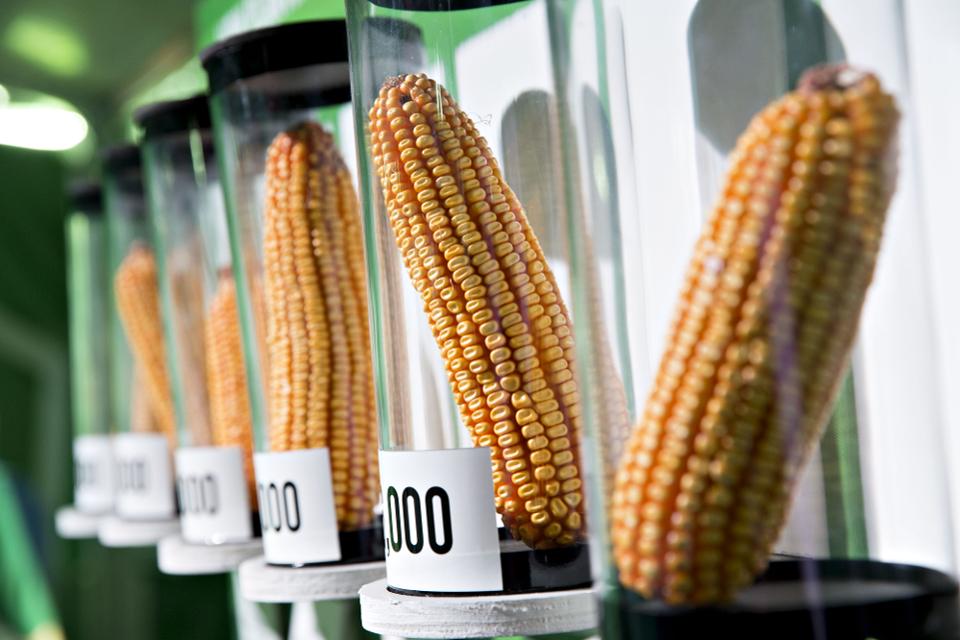
Maize crop

Cobs of GMO corn sit on display in the Monsanto Co. booth during the Farm Progress Show in Decatur, Illinois, U.S., on Tuesday, Aug. 29, 2017. The show, sponsored by Farm Progress Co. and owned by Penton Media, is billed as the largest outdoor farm show in the U.S. Photographer: Daniel Acker/Bloomberg

 The societal effects of GMO crops, and especially corn, have attracted enormous public and scientific attention, not least because such crops dominate the food we eat. Almost all the science in the area has consistently produced a reassuring message, but until now it continued to be received with skepticism in some circles. To persuade the skeptics, the new report examines the results only of those prior scientific investigations that performed large field experiments and that compared GM and conventional corn crops grown under identical conditions. Here are the results:

First, genetic modification increases corn yields, by a lot. This not surprising: pests account for a loss of almost one third of yields, and weeds for a loss of another 10%. Genetic modification addresses these two sources of loss, and thus crops resistant to either pest or weeds yield on average 10% more grain, and crops resistant to both deliver a 25% increase in grain yield. Consider the global importance of such an effect: the world could use one-fifth less farm land to produce its food. This means less deforestation. It also means less greenhouse gas emissions, by as much as  one-eighth of the annual emissions from automobiles. There is no other policy that a true environmentalist should support more vigorously than the transition of the rest of the world to GMO-based agriculture.

Statistics

Second, genetically modified crops are not only richer, but also better. In GMO fields, there is an average 60% reduction in damaged crops (84% reduction if counting only the most advanced GMOs). None of the nutritious composition of corn is reduced. On the contrary: GMO corn was found to have one third less “mycotoxins”—poisonous chemicals introduced into the crops by insect attacks. This reduction in the contamination of grain is particularly large in developing countries, where the illnesses such contaminations cause have significant economic costs.

Finally, there is a prevailing concern that GMO agriculture uses chemicals that cause unintended environmental harms. The meta-report shows that the concern is misguided. Of all the species living in the cornfield ecology, only one family of parasitic wasps is negatively affected. Overall, there is no substantial effect on insect biodiversity. And other studies have found a dramatic reduction in the use of herbicides and insecticides.

Wisely, the authors of the report chose to err on the side of caution. They excluded much evidence that provides even stronger support for the safety and quality of GMO crops. They did not examine the enormous advantages of GM crops other than corn, which are engineered to yield important nutritional value or to reduce the adverse effects of conventional crops.

This comprehensive and careful assessment is exactly the kind of science that should be taken as conclusive to resolve a public policy debate. Consumers should not attach any added value, and should not agree to pay any added price, for “non-GMO” food products. And environmentalists should be at the forefront of advocating in favor of GMO technology. And yet, paradoxically, the more resounding the statements of scientific unanimity about the environmental benefits of GMOs, the stronger the ongoing campaigns in retail markets to promote non-GMO foods.

Why are consumers oblivious to the scientific reality? The blame, in part, falls on anti-GMO propaganda. Advocacy groups that ordinarily preach for the supremacy of scientific evidence in informing public policy (climate change? gun control?) remain unshakeable by the mountains of scientific proof in this context. There is a dogmatic, almost religious, fervor in the conviction that “frankenfoods” are immoral. It seems that no quantum of evidence can budge this belief.

Consumers are also misled by opportunistic non-GMO campaigns launched by companies that know the underlying science. It is ironic that in the epicenters of such consumer demand—in elite stores that purport to sell environmentally responsible foods—there is an ongoing concerted effort to breed, rather than uproot, these irrational and harmful fears.


Environmentalist GMO Monsanto University of Chicago
Share. Facebook Twitter Pinterest LinkedIn WhatsApp Reddit Tumblr Email
Abdallah el-Kurebe
  • Website
  • Facebook
  • Twitter
  • LinkedIn

Related Posts

Kenya unveils strategy to place youth at centre of agrifood economy

August 13, 2026

SAPZ Kano launches quarterly feedback forum

August 13, 2026

JICA awards scholarships to 18 Nigerians

August 13, 2026

Leave A Reply Cancel Reply

Naira strengthens to N1,360/$, strongest level since June

August 13, 2026

Telemedicine in Nigeria: Where the smart money should go next [III], by Dr. Fakunle Aremu

August 13, 2026

Kenya unveils strategy to place youth at centre of agrifood economy

August 13, 2026

CBN raises 364-day T-bill rate to 17.59% despite N4.4trn demand

August 13, 2026
About Us
About Us

ASHENEWS (AsheNewsDaily.com), published by PenPlus Online Media Publishers, is an independent online newspaper. We report development news, especially on Agriculture, Science, Health and Environment as they affect the under-reported rural and urban poor.

We also conduct investigations, especially in the areas of ASHE, as well as other general interests, including corruption, human rights, illicit financial flows, and politics.

Contact Info:
  • 1st floor, Dogon Daji House, No. 5, Maiduguri Road, Sokoto
  • +234(0)7031140009
  • ashenewsdaily@gmail.com
Facebook Twitter Instagram Pinterest
© 2026 All Rights Reserved. ASHENEWS Daily Designed & Managed By DeedsTech

Type above and press Enter to search. Press Esc to cancel.