


Central Bank of Nigeria (CBN) Governor Olayemi Cardoso has said Nigeria’s foreign exchange reserves are helping to protect the economy from external shocks, arguing that stronger dollar buffers and relative exchange-rate stability have benefits for households and businesses.
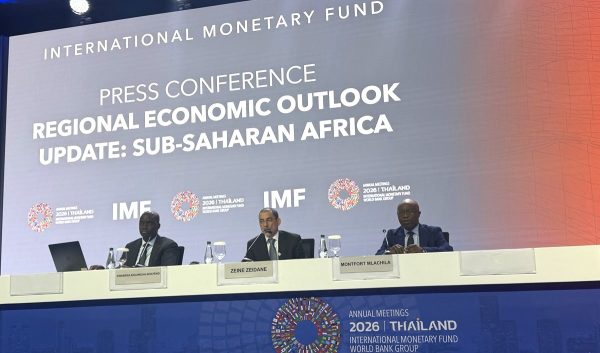
Cardoso spoke at the 2026 IMF–World Bank Annual Meetings in Bangkok, Thailand, where he highlighted the country’s improving external position and the potential benefits of recent economic reforms.
Nigeria’s gross external reserves stood at $55.1 billion as of October 13, 2026, the highest level in 18 years, according to the governor.
He said the stronger reserves provide a buffer against international economic pressures, including disruptions associated with geopolitical conflicts and uncertainty over tariffs.
According to Cardoso, the reserves have helped position Nigeria to withstand pressures that could otherwise have had more severe consequences for the economy and its citizens.
He argued that the gains from stronger reserves extend beyond official financial statistics because external stability can influence exchange-rate movements, business confidence and the cost of imported goods.
Cardoso links reserves to naira stability
The CBN governor also pointed to the naira’s relative stability and recent appreciation as evidence of the impact of the bank’s policies.
He maintained that exchange-rate stability has direct and indirect implications for Nigerians, particularly through the prices of imported products and other goods whose costs are influenced by foreign exchange.
Cardoso also identified falling inflation as a critical benefit of the reforms, noting that rising prices disproportionately hurt low-income households by eroding their purchasing power.
He described inflation as a particularly heavy burden on poorer Nigerians and argued that reducing price pressures would improve conditions across the economy.
The governor urged Nigerians to recognise improvements in the country’s economic position, while maintaining that the absence of stronger reserves and a more stable foreign exchange market could have exposed the economy to greater external pressures.
Reserves continue to climb
Nigeria’s external reserves increased from approximately $53.90 billion on September 1 to $54.93 billion on September 30, representing a monthly gain of about $1.03 billion.
The reserves continued rising in October, reaching $54.95 billion on October 2 and $55.08 billion on October 9 before climbing to $55.1 billion on October 13.
The improvement strengthens Nigeria’s capacity to meet external obligations and manage periods of pressure on foreign exchange supply.
However, a higher reserve balance does not automatically translate into lower living costs. The extent to which households benefit also depends on sustained inflation moderation, exchange-rate developments and the transmission of improved macroeconomic conditions into prices and incomes.
Cardoso’s remarks come as the CBN seeks to consolidate foreign exchange market stability and maintain progress in reducing inflation while preserving the external buffers built up through recent reforms.
