


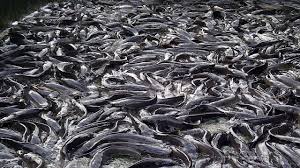
The Lagos State Catfish and Allied Farmers Association of Nigeria (LASCAFAN) has commended the Federal Government for setting up a technical committee on aquaculture.
The LASCAFAN President, Mr Olatoye Fajimi, gave the commendation in an interview with reporters on Thursday in Lagos.
It was reported that the Federal Ministry of Marine and Blue Economy recently inaugurated a technical committee to address feed production, value addition and other challenges in aquaculture.
Fajimi, however, urged the committee to ensure the standardisation of Nigerian aquaculture, adequate feed supply and need-based research to address challenges confronting practitioners.
“When we saw the news of the Ministry of Marine and Blue Economy commissioning a technical committee to address the issues in the sector, it gladdened our hearts.
“As the LASCAFAN President in Lagos State, and as an aquaculture practitioner who has been in the business for about 25 years, the committee’s setup is good news.
“We have read through the Minister’s charge to the committee, and it seemed top-notch, though I have not seen the policy paper he wants the committee to work on.
“But we want to believe that the right set of people were called to develop that policy paper and that it will be beneficial to all fish farmers.
“The Nigerian aquaculture industry is due for a lot of overhaul and standardisation. One of the challenges we have with agriculture in Nigeria is that there are no standards.
“Most of the practitioners, about 80 per cent of those who practise agriculture, never had a background in studying agriculture in any form.
“So, they are learning by rote. For example, anyone can come up with the idea, ‘this is what my friend is doing, this is what my neighbour is doing,’ and immediately become a fish farmer.
“This attitude has gone a long way to reduce us to peasant fish farming, instead of commercial farming,” Fajimi said.
According to him, the committee should develop a working document that would lead to the standardisation of aquaculture and fish farming.
“This will ensure that it will not be a jack-of-all-trades kind of business, and everyone coming into the sector will know the requirements for fish farming.
“They will know the space required, references for pond construction and management, marketing, and all that entails running a fish farm,” he said.
The LASCAFAN President also urged the committee to consider measures to make the feed industry more favourable to local fish farmers.
“Most of the feed materials currently in use are highly competitive because they are the same things used for poultry feed, human consumption, large-scale farming, ruminants and all of that.
“So, there is usually a lot of scarcity, which leads to high cost of feed for fish.
“We are hoping there will be better collaboration with research institutes to identify other products around us for alternative feeds.
“We need a variety of feeds and other materials that can be used as alternative fish feed, which are less competitive and readily available in commercial quantities for feed production,” Fajimi said.
He also called for collaboration between the town and the gown in aquaculture research to unlock the sector’s potential.
“Another vital area is research. The way research institutes operate now, there is no link between the research institutes and the industry itself.
“Every year, agricultural universities conduct projects. But most of the time, the findings end up on the shelf because they do not connect with practising farmers.
“The research institutes need to conduct proper needs-assessment research to find out what fish farmers really need.
“What are the challenges on the field? Then work on them to develop solutions.
“Research institutes are supposed to be solution developers and create synergy with the industry,” Fajimi said.
