



KAMPALA—Recently released vitamin A-rich bananas in Tanzania, improved from locally grown varieties, are expected to prevent more than 33 per cent of children under five from eyesight-related illnesses, including blindness, researchers have said.
A multi-institutional consortium of local and international researchers from the Tanzania Agricultural Research Institute (TARI), the Alliance of Bioversity International and the Colombia-based, Spanish-acronymed Centro Internacional de Agricultura Tropical (CIAT) joined hands to conventionally breed three bananas to fight vitamin A deficiency and improve food security.
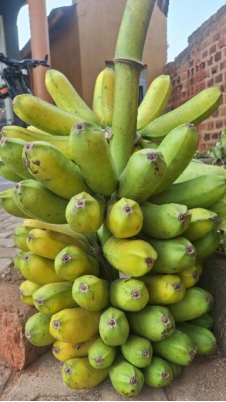
The three vitamin A-enriched banana varieties—Bira, Lahi and Apantu—some with origins in Southeast Asia, are naturally known for their high levels of pro-vitamin A (pVA). “These varieties were introduced to help address vitamin A deficiency, which affects approximately 33% of children under five in Tanzania. Bananas are a vital food source in the country, supporting over 30% of the population and being a significant contributor to food security and income generation.… The Bira variety has historical roots in Papua New Guinea and has been adapted to local conditions, while the Lahi and Apantu varieties are also designed to improve nutrition and food security for vulnerable groups [like children],” according to Eliot Gee [The EurekAlert Press Officer] and Rachel Kibui, a media consultant from the Alliance of Bioversity International & CIAT.
“The three pro-vitamin A-rich banana varieties represent the culmination of years of scientific research. Bira exemplifies the long journey bananas have taken to reach Tanzanian communities. Although the variety has its roots in distant Papua New Guinea, bananas from this centre of origin reached Tanzania’s Haya community centuries ago. The community established bananas as a staple crop within its traditional Kinja farming system, which supported some of the highest rural population densities in tropical Africa. Bira plants also produce multiple suckers. This means that once the plants’ mats—their underground stem systems—are established, farmers can easily propagate the shoots and share them with their neighbours…,” say Eliot Gee and Rachel Kibui.
Contacted on October 19 for further details on, among other things, the public response and reaction to the new product; whether the breeding process was conventional or genetic engineering (GE); whether the transformed banana varieties are cooking bananas and plantains; and how long it takes after eating the vitamin A-rich banana for blindness and poor night vision to be rectified, Rachel Kibui replied: “Thank you for your queries. We have received them and will get back to you as soon as possible.… We look forward to working with you to amplify voices and insights on food systems.… Kind regards, Rachel.” As of October 21, no response had been received from them yet.
Other Tanzanian varieties—Pelipita, To’o and Muracho—performed well [during the transformation and trials], but were not officially released.
The Alliance says the three varieties were registered by the Tanzania Official Seed Certification Institute (TOSCI) on September 30, 2026, and that what makes them special is that they are “naturally rich in pro-vitamin A carotenoids (pVAC)—not GMO. One serving can provide up to 100% of a child’s daily vitamin A need. Samples from the Asia-Pacific region, like Bira and Apantu, are orange-reddish inside.” They quote researcher Dr Deborah Nabuuma (Alliance) as saying farmers can increase diversity on their farms, thereby improving access to and consumption of foods rich in vitamin A and enhancing consumers’ health.
They also say bananas are the fourth most important crop in Tanzania for food security, [that they] support 30% of the population [and that] more than 900,000 farming households depend on them [for their livelihoods and nutrition]. “Tanzania is East Africa’s second-largest producer after Uganda, with consumption of 280–500kg per person per year—the highest in the world…”
Tanzania is East Africa’s second-largest banana producer after Uganda and has one of the world’s highest banana consumption rates, estimated at between 280 and 500 kilograms per person per year. “Bananas [which are a staple food in Tanzania] can address a nutrient gap and feed Tanzanians from all walks of life; from nourishing soups (Mtori), savoured by nursing mothers, to street-side snacks (Ndizi Kaanga) enjoyed by children on their way home from school, and the mild beer (Mbege) traditionally consumed by the Chagga people.
The Alliance further explains that, as children grow, vitamin A deficiency can cause eye damage and even blindness, in addition to severely compromising the immune system.
“Historically, supplementation has been the principal intervention proposed to address this public health threat. However, research has demonstrated that introducing naturally nutrition-rich banana varieties can provide a culturally sensitive and cost-effective alternative…. Building on a long history, three varieties were registered in Tanzania…. The three best-performing varieties were selected based on their agronomic performance and the acceptability of their fruit. Their registration marks the culmination of a decade of scientific research dedicated to developing nutrient-rich banana varieties suited to Tanzania’s cultivation conditions and consumers’ needs.
The Alliance quotes Dr Deborah Nabuuma, a researcher (Alliance), as expressing optimism that the new banana varieties would benefit stakeholders across the value chain—from producers to consumers. “This research has brought us to the point where farmers can increase diversity on their farms, thereby improving access to and consumption of foods rich in vitamin A and enhancing consumers’ health,” she said.
They say Dr Mpoki Shimwela, Senior Tanzanian Banana Breeder at TARI, welcomed the registration of the three new varieties as “a significant milestone for both farmers and consumers. The release of these vitamin A-rich varieties marks an important step towards strengthening food and nutrition security in Tanzania. With the varieties now officially registered, larger-scale promotion and dissemination can proceed, bringing the potential benefits of vitamin A-rich crops to more farming communities,” he is quoted as saying.
Researchers from the Alliance, which maintains the world’s largest collection of bananas, and TARI have collaborated to test and disseminate these banana varieties. Eleven promising varieties were initially identified from the Alliance’s Belgium-based Genebank and subsequently evaluated by TARI in Tanzania, in collaboration with local communities.
For the first time in the world, Uganda in the early 2000s conducted research on a genetically modified (GM) banana resistant to the devastating Banana Bacterial Wilt (BBW) disease and on a banana variety rich in both vitamin A and iron, at the National Agricultural Research Laboratories (NaRL), Kawanda, north of Kampala.
After several years of trials and tests in different agro-ecological conditions around Uganda—in the western, eastern and mid-western regions—the National Agricultural Research Organization (NARO) completed the research, which was partly led by the then lead biotechnologist/molecular biologist, the late Dr Andrew Kiggundu (who passed away early this year, 2026). However, the badly needed products have never been released after the government failed to approve two Bills passed by the Parliament of Uganda into the National Biosafety Act (NBA) and the Genetic Engineering Regulatory Act (GERA), which would have sanctioned the release and commercialisation of GM crops.
Banana, identified by the Ministry of Agriculture as a priority crop, is infested with diseases such as BBW and fungal black sigatoka, and pests such as nematodes, and lacks vitamin A nutrients. As such, scientists at NaRL in 2010 began breeding bananas rich in vitamin A and iron to address challenges of food nutrient deficiency. Their goal is to help rural families suffering from a deficiency of vitamin A and iron, which are essential for proper growth, maintenance of the human [consumers’] immune system and good vision.
In their conclusions, NaRL says the vitamin A research effort came up with promising results, expressing 100 percent vitamin A content. “The fortified variety is more golden-coloured than ordinary bananas. The scientists are conducting multi-locational trials in Mbarara [Western], Bulindi, NaRL [mid-western] and Bugiyanya Zonal Agricultural Research and Development Institute [East], under a breeding programme that began when scientists determined that a good number of rural communities, particularly in Western Uganda, are deficient in vitamin A and iron.
“Some 28 percent of Uganda’s pre-school-age children and 23 percent of pregnant women are deficient in vitamin A and iron, according to World Bank statistics. Scientists at NaRL felt it was better to incorporate vitamin A into food, which can be grown by the affected communities and consumed directly, than to encourage pregnant women and mothers to buy vitamin A and iron tablets, especially since they often do not have the resources to buy supplements,” one of the NaRL reports says in part about the research that underwent Confined Field Trials (CFTs).
This research was visited in 2019 by a delegation of Tanzanian policymakers, legislators and scientists. One of the visitors, an MP representing workers in the Bunge (Tanzanian Parliament), expressed great interest in Uganda’s pro-vitamin A research and questioned why a very vital product proven to be vitamin A-enriched was held up in a CFT while over 30% of Ugandan children went blind annually.
The Ugandan NARO/NaRL report adds that there is hidden hunger in western Uganda and, since banana is the dietary staple for many Ugandans, it was the most likely candidate for fortification. “The team accessed genes with beta-carotene from a non-edible banana obtained from Papua New Guinea, Southeast Asia. These were isolated and introduced through genetic engineering into two local cultivars, Nakitembe and M9, commonly known as Kiwangazi, used for processing juice.”
There were initially 800 lines in NARL confined field trials. The team selected two lines with traits similar to those of the conventional variety but also with enhanced vitamin A properties. The team checked vitamin content using molecular methods in the laboratory, confirming vitamin A levels in the new banana varieties.
The flesh of the fortified banana is orange in colour. There is also an orange colour expression deep in the leaves. The existing vitamin A content in local banana varieties is 3–6 micrograms, but the currently selected varieties contain 35 micrograms, suitable for human health.
The team has also ensured that the banana plant grows true to the traditional type, with the initial traits remaining intact apart from the introduction of the vitamin A gene. “When conducting the research, we consider the yield rate, and we are harvesting bunches that weigh 50kg. We also consider pest and disease challenges and the stability of the plant. We planted in January 2020, and we keep harvesting every seven months for Nakitembe and five months for Kiwangazi,” the report notes.
