


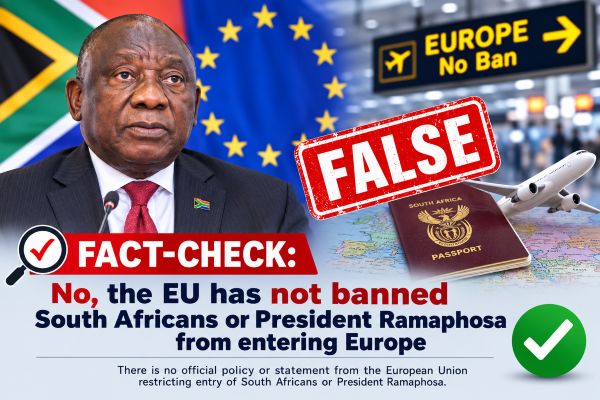
CLAIM: A viral claim that the European Union has banned South Africans—including President Cyril Ramaphosa—from entering its countries is false, fact-checks have confirmed. The allegation, which has spread widely on TikTok and WhatsApp since late July 2026, misuses old footage of Ramaphosa and misrepresents current travel rules.
Verdict: The claim that the EU has banned South Africans and President Ramaphosa from entering Europe is false. The video used to support it is from 2021 and relates to pandemic-era travel restrictions, not to the current xenophobic violence in South Africa.
Full Text: Posts circulating on social media allege that “Europe has banned South African citizens, including President Cyril Ramaphosa, from entering European countries” in response to recent xenophobic attacks on Black African migrants in South Africa.
Verification: However, investigations by GhanaFact and Africa Check found no evidence that the EU or any European country has imposed such a ban in 2026.
The key piece of “evidence” in the posts is a video of Ramaphosa referring to a European travel restriction. Fact-check traced the clip to the Dakar International Forum on Peace and Security in Africa in December 2021, where Ramaphosa described receiving “patronising” calls from European officials over a travel ban triggered by the Omicron COVID-19 variant, not by xenophobic violence.
In 2021, the EU and several member states temporarily suspended or restricted flights and entry from southern Africa, including South Africa, after the detection of Omicron. But that emergency measure has long since ended, and there is no new EU-wide or national European ban on South Africans linked to the 2026 xenophobia crisis.
Africa Check noted that, while the UN, the African Union, and several African governments have expressed concern over the attacks, and some countries have issued travel advisories or organised repatriations, no European country has announced travel bans or restrictions on South Africans in response.
As of July 2026, South Africans continue to travel to the Schengen area and other European countries under normal visa and entry requirements, including short-stay Schengen visas, proof of sufficient funds and return tickets.
Why it matters: The false claim risks inflaming tensions around an already sensitive issue, while also undermining trust in official information. It underlines how old footage can be repackaged to fit new narratives and spread rapidly on social media.
Conclusion: There is no blanket EU prohibition on South African passport holders or on President Ramaphosa
