


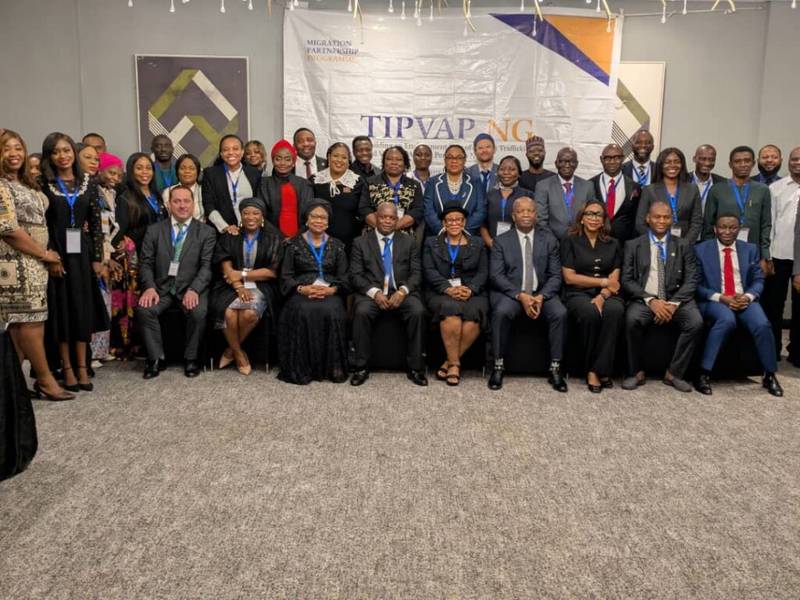
Stakeholders in Nigeria’s criminal justice system have called for stronger digital evidence management, inter-agency collaboration, and continuous capacity building to keep pace with increasingly sophisticated cybercriminals.
They made the call during a specialised training on Cybercrime, Artificial Intelligence (AI), and Digital Evidence for members of the Joint Case Team on Cybercrime (JCTC) and designated Federal High Court judges on Friday in Lagos.
The training was organised by the International Centre for Migration Policy Development (ICMPD) in partnership with the JCTC.
The workshop was held under the Building an Environment Free of Human Trafficking in Persons and Violence Against Persons (TIPVAP) Project, funded by the Government of the Kingdom of the Netherlands’ Ministry of Justice and Security.
The Director of Public Prosecutions of the Federation, Mr Rotimi Oyedepo, SAN, said cybercrime had evolved beyond conventional hacking and online fraud. It now includes AI-assisted crimes, deepfakes, voice cloning, ransomware attacks, cryptocurrency-enabled offences, identity theft, and complex transnational cyber networks.
According to him, criminals are adapting faster than ever, making innovative, intelligence-driven, and forward-looking approaches essential.
“Our response cannot remain static. It must be innovative, intelligence-driven, collaborative, and forward-looking,” he said.
Oyedepo described the Joint Case Team on Cybercrime as one of Nigeria’s most strategic innovations, bringing investigators, prosecutors, regulators, and forensic experts together on a single coordinated platform.
He emphasised that cybercrime cannot be tackled by isolated institutions, as investigations increasingly cross national borders and involve multiple agencies.
“The fight against cybercrime cannot be won by isolated institutions. It requires partnership, trust, coordinated intelligence, and shared responsibility,” he said.
Oyedepo noted that including judges in the training strengthened the criminal justice process, since cybercrime cases ultimately end in the courtroom. Participants, he said, are now better equipped to identify red flags, conduct diligent investigations, and build stronger prosecutions.
He added that investigators learned that rushing cases to court without thorough investigations could weaken prosecutions and make it difficult to prove guilt beyond reasonable doubt.
Participants also examined the recovery, preservation, and presentation of digital evidence from phones, computers, and other electronic devices.
Oyedepo identified inter-agency rivalry and delays in international cooperation as major obstacles to cybercrime prosecution.
“The essence is to reinforce teamwork because no one can be an island in the administration of criminal justice,” he said.
On his part, ICMPD TIP-VAP Project Manager, Mr Matthias Esene, said the organisation supported the training because technology has changed how traffickers operate. Traffickers now increasingly exploit digital platforms, encrypted communications, social media, and artificial intelligence.
He noted that strengthening the capacity of the JCTC would directly improve Nigeria’s response to trafficking in persons through its partnership with the National Agency for the Prohibition of Trafficking in Persons (NAPTIP).
“Strengthening the capacity of the JCTC therefore directly contributes to strengthening Nigeria’s response to trafficking in persons,” he said.
Offering an international perspective, Mr Markko Künnapu, a Cybercrime and Electronic Evidence Expert from Estonia, said access to electronic evidence remains one of the biggest global challenges.
“I think the biggest problem is how to quickly get evidence and use it in criminal proceedings,” he said.
Künnapu advised Nigeria to continue strengthening cooperation through existing legal instruments and partnerships with governments and service providers.
Mrs Jamila Akaaga-Ade, Deputy Director and Head of the Cybercrimes Unit at the Federal Ministry of Justice, who is also Head of the JCTC, said collective action remains central to combating cybercrime.
She emphasised that effective international cooperation can only be achieved where strong national collaboration already exists among relevant institutions.
“The main takeaway for me is the need for collective action in countering cybercrimes,” she said.
CSP Samuel Umezurike of the Nigeria Police Force National Cybercrime Centre, Abuja, said participants gained practical knowledge on AI-generated crimes, voice cloning, and cybercrime investigations. He added that interactions with judges exposed investigative shortcomings that often weaken prosecutions in court.
Ms Becky Jibo, a Prosecutor with the Federal Ministry of Justice, said the training deepened participants’ understanding of acquiring, preserving, and presenting electronic evidence. She stressed the importance of due process, including obtaining necessary court orders and maintaining an unbroken chain of custody.
“When evidence is not properly handled, it becomes useless and the case may be lost. But when it is properly gathered and preserved, it strengthens prosecution,” she said.
Forty participants attended the four-day training, including investigators, prosecutors, analysts, forensic experts, and six designated Federal High Court judges.
